Draven is Fury/Chaos pressure that also asks you to respect attrition. Glorious Executioner keeps mattering because it is not only fast and not only efficient — it can make your early answers feel insufficient while still drawing enough cards to ask the same question again. The engine and the beatdown reinforce each other.
A note on how we write this. We do not have a verified current Vendetta Draven list in our own data — the most recent Draven list we have on record is a retired, pre-Vendetta Unleashed shell — so we are not going to hand you a card-for-card 'package' and call it the deck, and we are not sending you to an aggregator to find one. What we give you instead is durable: Draven's Domain and gameplan, the cards in his kit and what they do, and a counter plan keyed to mechanics. Read any card's exact text in the card database, build both sides in the deck builder, and map the rest of your gauntlet on Riftbound Counters.
What We Can And Can't Tell You
The last first-party Draven list we have on record is a runner-up shell from a pre-Vendetta Unleashed regional — history, not the current format. We treat it as an earlier list, not as the current deck, because a counter plan built on 'Draven always runs these cards' rots the moment the format shifts. A plan built on 'here is what Draven is trying to do, and here is the kit that punishes loose play' keeps working. This guide is the second kind.
Draven's Identity: Fury/Chaos Combat Value
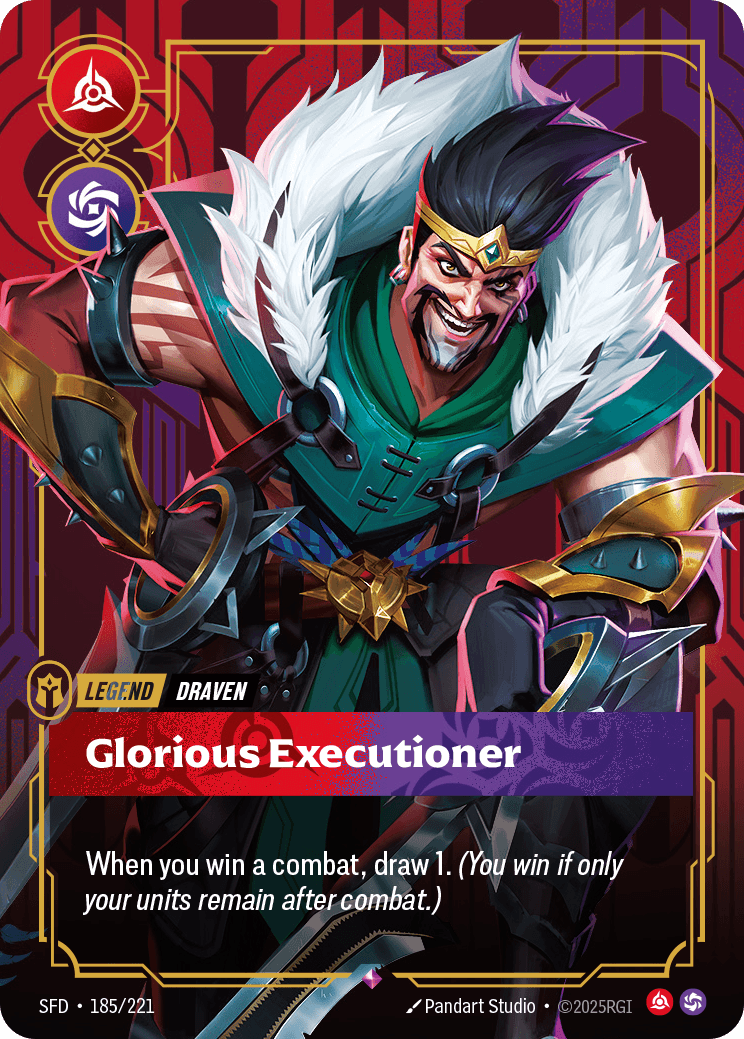
Fury/Chaos Legend
Draven - Glorious Executioner
The Legend draws a card every time he wins a combat, which is why denying profitable attacks is also how you deny his card flow.
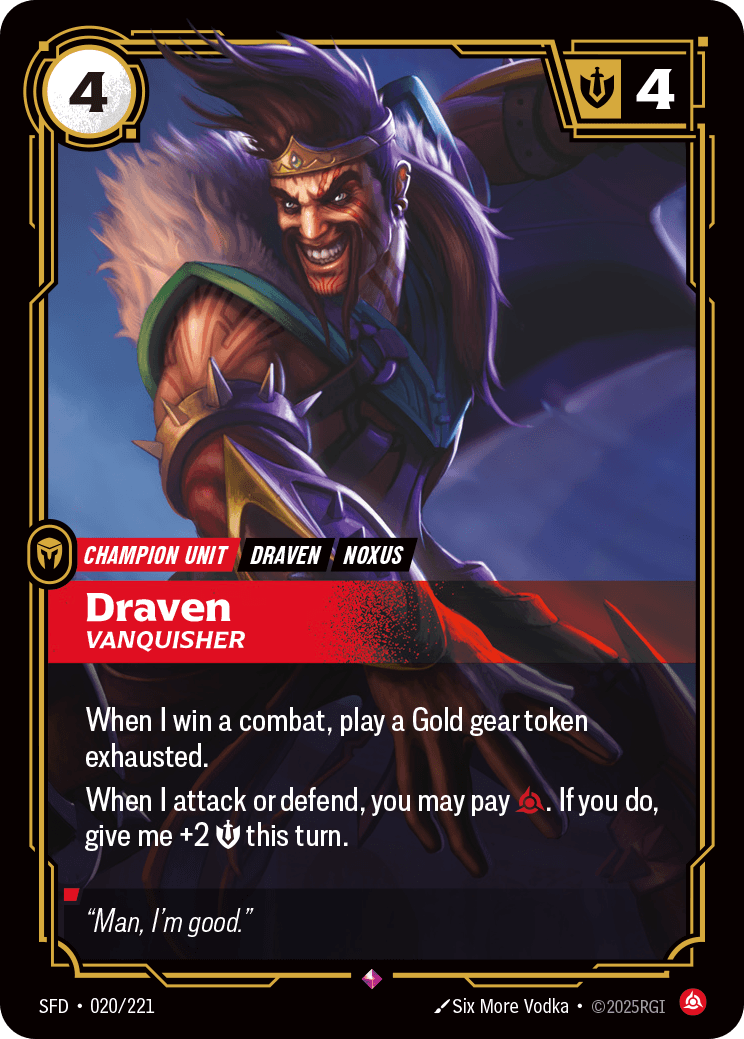
Fury Unit
Draven - Vanquisher
In Draven's kit: he turns winning combats into extra gear and can pay to give himself +2 Might in a fight, so his attacks pay for themselves and punish a block that was almost enough.
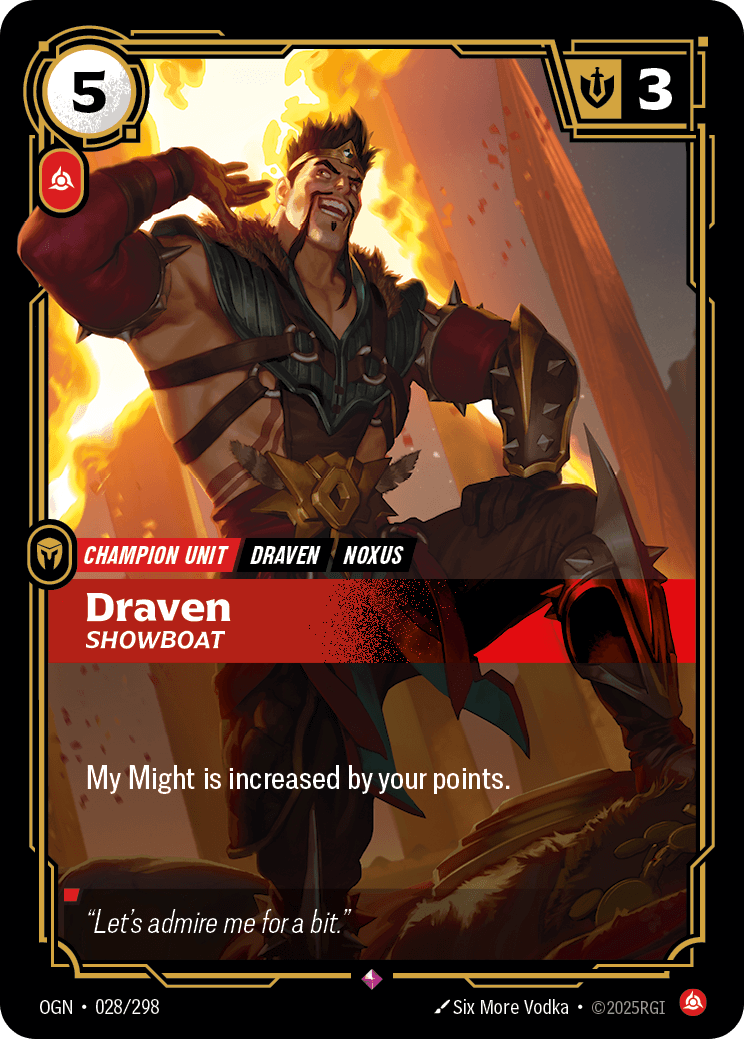
Fury Unit
Draven - Showboat
In Draven's kit: his Might scales with Draven's own points, so every point you let slip early makes him harder to block later.
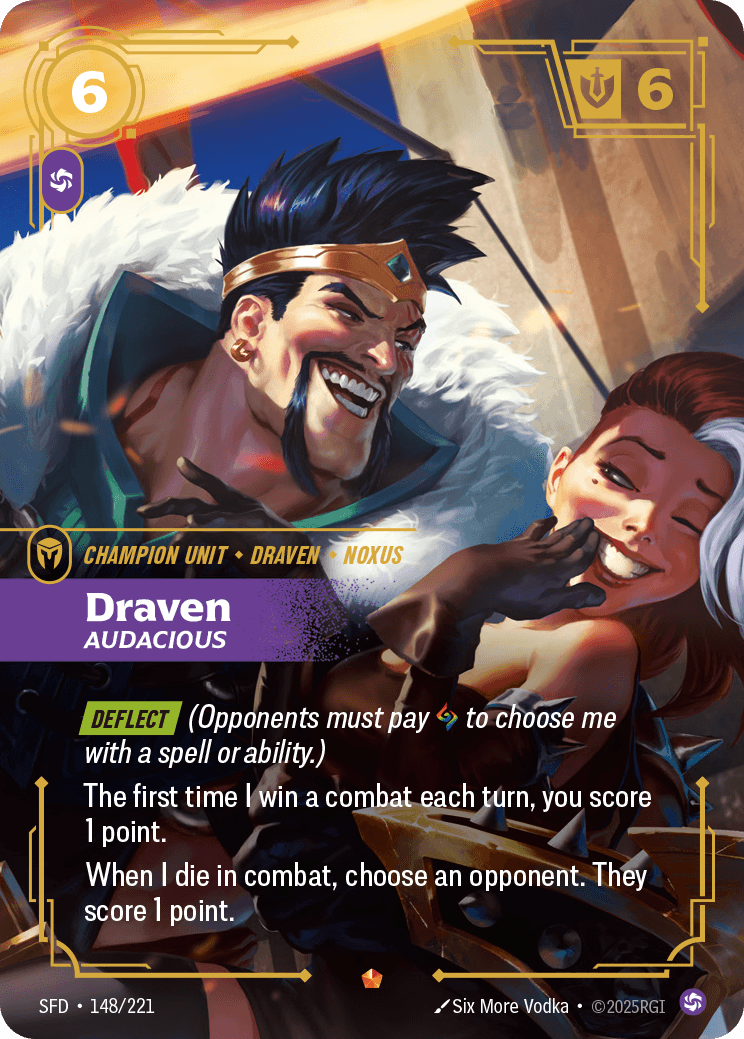
Chaos Unit
Draven - Audacious
In Draven's kit: hard to target, scores on his first winning combat each turn, and hands you a point if you kill him in combat — a closer that makes both blocking and not blocking cost something.
Draven - Glorious Executioner is a Fury/Chaos pressure deck. Fury gives it efficient attackers and combat tricks; Chaos gives it reach and disruptive angles. The thing that ties it together is combat itself: the Legend draws a card every time he wins a combat, so the pressure and the card flow are the same plan. Answer slowly and he attacks and refills; answer clumsily and he trades efficiently and refills anyway.
What The Matchup Is Trying To Do
Draven pressures three things at once:
- Your first battlefield setup, before your answers are online.
- Your ability to trade efficiently into Fury and Chaos threats.
- Your ability to survive one strong attacker without falling behind on cards and map position.
The trap is thinking of it as a simple race. If your line only survives the aggression but lets the winning combats convert into cards, Draven keeps asking the same question with a fuller hand each time. Before each combat, ask: if Draven wins this fight, what does he draw into, and can I afford to give him that? If the answer is no, do not take the fight on his terms.
Draven's Kit, By Function
These are the cards in Draven's kit — the legend-locked pieces the deck is built around. Naming them is not the same as claiming a given list runs a specific count of each; kits vary list to list. Respect them for what they do, and confirm the exact wording in the card database.
- Draven - Glorious Executioner, the Legend, draws a card every time he wins a combat, which is why denying profitable attacks also denies the card flow.
- Draven - Vanquisher turns winning combats into extra gear and can pay to give himself +2 Might in a fight — so his attacks pay for themselves and punish a block that was 'almost' enough.
- Draven - Showboat has Might equal to Draven's own points. The further ahead he gets, the harder he is to block, which is why letting early points slip is so dangerous.
- Draven - Audacious is the closer: it is hard to target, scores a point the first time it wins a combat each turn, and hands you a point if you kill it in combat — so both blocking and not blocking cost you something.
- Spinning Axe is a Reaction-speed gear that attaches to a unit to swing a combat and disappears if left unattached — cheap, repeatable combat math that makes a fight bigger than the board looked.
How To Beat Draven
1. Contest The First Real Attacker Cleanly
The biggest mistake against Draven is spending the first two turns on vague setup and then realizing the first good attacker already owns the battlefield. Your deck needs a clean plan for the first attacker that actually matters — removal, a blocker that trades up, a recall or stun line, or a battlefield pivot that invalidates the push. The exact tool matters less than the fact that the first profitable line does not go unanswered.
2. Don't Let Winning Combats Become Free Cards
Draven's pressure and card flow reinforce each other. If your answers are slow, he attacks and refills; if your answers are clumsy, he trades and refills anyway. Prioritize lines that reduce both pressure and value at once — a play that forces a bad attack and denies the winning combat is worth more than a flashier removal spell a turn later.
3. Punish Overcommits Instead Of Only Defending
Draven is much easier to beat when he has to wonder whether pushing harder is safe. If you can threaten a blowout block, a challenge turn, a battlefield pivot, or punishment for a stacked lane, do it. Purely passive lines let Draven dictate every combat step; the matchup gets better when he has to respect you back.
4. Deny The Scaling Before It Snowballs
Some of Draven's payoffs get bigger as his score climbs, and one hard-to-target closer turns a small lead into an inevitability. Do not let early points slip on the theory that you will stabilize later — a point given now is Might and reach handed to the exact cards designed to run away with the game.
5. Don't Sideboard Like It's Only Aggro
The trap is boarding for Draven as if you only need to survive a red aggro deck for four turns. That is usually not enough. You need cards that matter early and cards that keep the game from slipping after the first exchange, because Draven's strength is that it keeps converting.
Turn By Turn Counter Plan
Turns 1-2: Contest Early, Don't Freeze
Make sure Draven cannot set up a profitable first attacker for free. A hand that neither affects the board nor holds a cheap answer is usually too slow. Contest with something that survives the first swing, or contest a battlefield he is less invested in and force him to split.
Turns 3-4: Break The Profitable Attack
This is where the matchup turns. Identify the attack that both scores and refills his hand, and answer that one. Spend your good answer on the body that converts into cards and points, not on a random threat that was never going to matter.
Turns 5-6: Keep Pressure Coming Back
If you answered the first big push, do not pass back with nothing. Draven punishes purely reactive turns by rebuilding and attacking again. Keep enough of your own pressure that he has to defend instead of freely choosing every combat.
Late Game: Don't Let A Closer Steal It
If the game stretches, watch for the hard-to-target closer and the point-scaling threats. Hold your cleanest answer for the card that turns Draven's setup into repeated points, and make sure removing one threat does not simply hand him the tempo to deploy the next.
Mulligan Guide Against Draven
Keep hands that can do at least two of these:
- Contest the first meaningful battlefield with a body that survives a swing.
- Hold a cheap answer for the first profitable attacker.
- Threaten a second battlefield so one attacker cannot dictate the whole map.
- Punish an overcommitted or stacked lane.
- Recover after losing one early exchange.
Ship hands that only come online late. A pile of expensive cards and one reactive spell is not enough when Draven is attacking and drawing on curve. The ideal keep is functional: a hand that makes his first profitable attack cost something.
Matchup Plans By Archetype
Aggro And Pressure Decks
Make Draven spend resources defensively. Do not race blindly; force him to answer a battlefield before his best setup turn is ready, and keep one cheap interaction piece for the first swing that would actually change the score.
Midrange Decks
You usually have the cleanest tools, but you can still lose by trading too fairly. Identify the attacker that fuels the draw, hold the premium answer for the payoff turn, then turn the corner immediately instead of passing back with no pressure.
Control Decks
Do not keep hands that only become good after the game is already stable. You need early speed bumps, one efficient answer, and a plan to stop the card that turns Draven's winning combats into repeated points.
Engine And Combo Decks
Buy one clean setup turn without giving up the whole map. If your engine takes time, pair it with early contest bodies or cheap disruption so Draven cannot choose every fight before your payoff is live.
Common Mistakes Against Draven
- Taking the first profitable attack on the chin for no reason.
- Using premium answers on low-leverage threats.
- Letting one strong attacker also generate free card flow.
- Letting early points slip to the threats that scale with his score.
- Boarding too passively and hoping to outlast the deck.
- Failing to punish stacked battlefield commits.
If you fix only one habit, fix this one: make every Draven attack prove it is worth it, and deny the winning combats that turn pressure into cards.
Build And Test On RiftStorm
Everything here is buildable with our own tools:
- Search Draven's kit in the card database to read exact wording.
- Clone a shell in the deck builder and goldfish the counter plan against a fast, combat-focused start.
- Compare community lists in Riftbound decks.
- Pair this with adjacent matchups on Riftbound Counters.
If you open one of our counter shells, treat it as a RiftStorm testing shell — a starting point built from card roles, not a tournament decklist — and tune it against what you actually see.
Bottom Line
Draven is one of the best punishment decks in Riftbound because it can pressure, convert, and keep asking for answers — the Legend draws off every winning combat, so the beatdown and the card engine are the same plan. Beat it by stopping the first real profitable push, denying the winning combats that refill his hand, punishing overcommits, and holding your cleanest answer for the closer. That is when Draven starts looking manageable instead of inevitable.