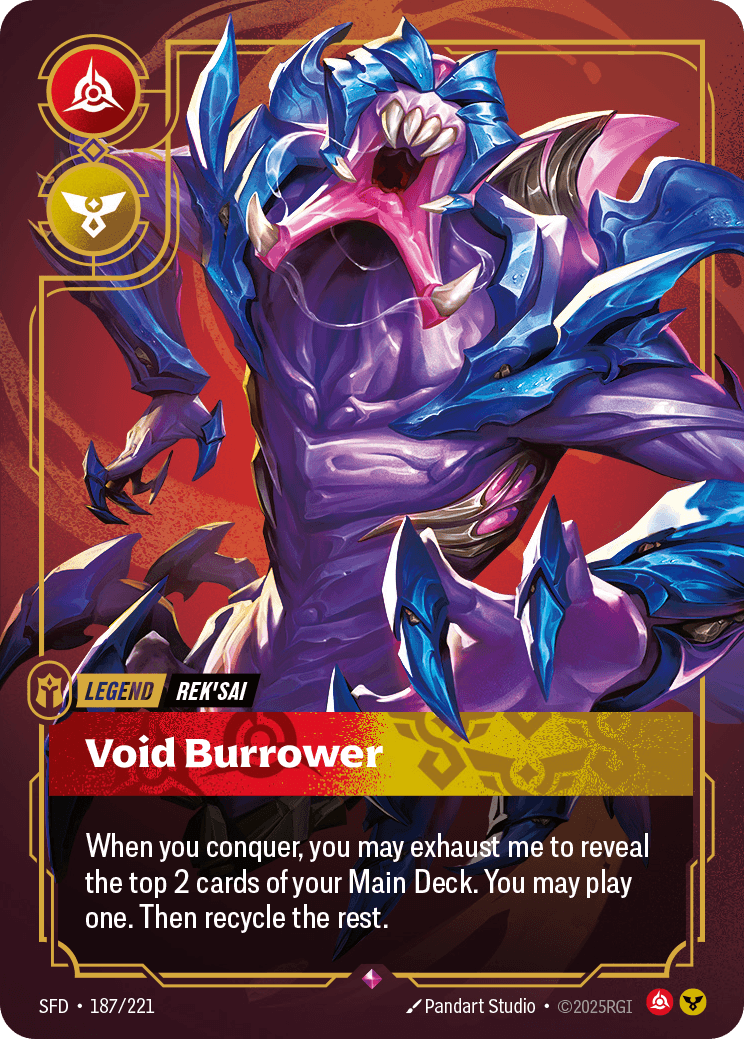
Garen - Might of Demacia is a Body/Order deck that wins by committing a wide board to one battlefield, buffing it, and cashing the conquer for cards. His legend pays off going wide, not going tall: when you conquer a battlefield where you have four or more units, you draw two. So the deck floods a location, out-muscles the fight, takes the point, and refuels — then does it again. If you plan around a single oversized threat, you will misread the matchup entirely.
A note on how we write this. We don't have a verified current Garen list in our first-party data, and we won't point you at a third-party aggregator to go find one. What we give you instead is durable: what Garen is trying to do, the cards in his kit and what each does, and a counter plan keyed to mechanics. Read any card's exact text in the card database, build both sides in the deck builder, and pair this with adjacent matchups on Riftbound Counters.
What We Can And Can't Tell You
We do not publish a card-for-card Garen "package" we can't verify from our own current data, and our records don't include a current Vendetta Garen list. So this is a gameplan-and-kit guide, not a fixed decklist — which is exactly the kind of counter plan that survives a rotation. For bans, errata, and format legality, read Riot's ban and rules updates.
That honesty matters here more than most, because Garen is easy to describe wrong. He is not a pile of oversized stat-walls; his legend is a go-wide payoff, and the counter plan follows from that.
What Garen Is Trying To Do
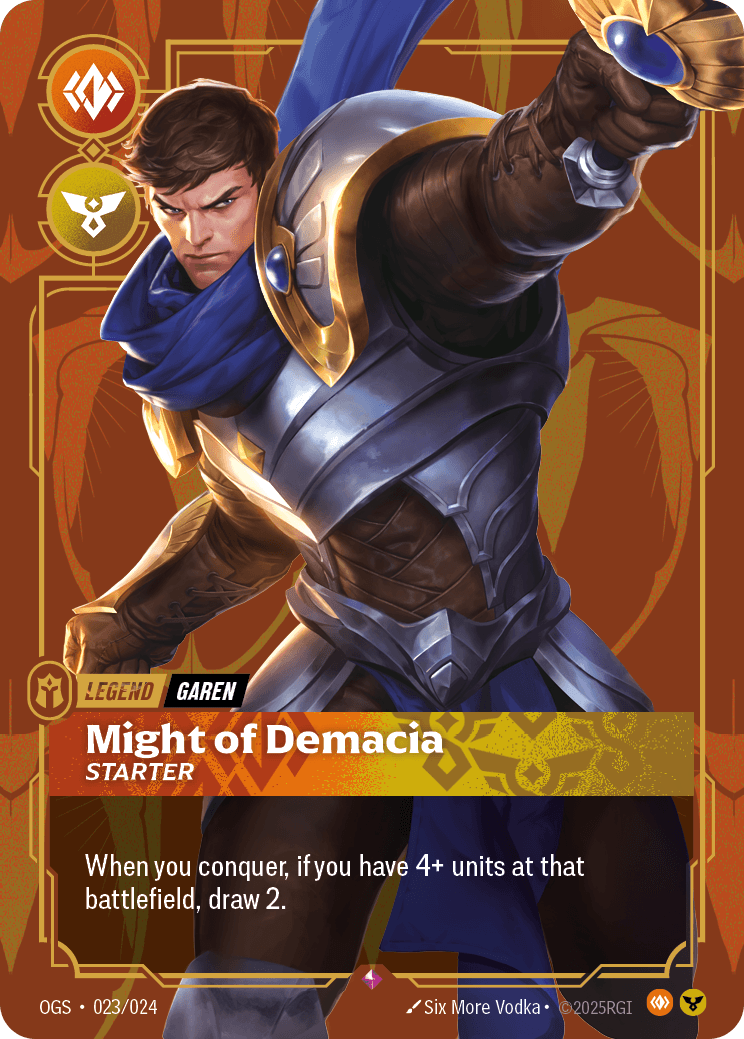
Body/Order Legend
Garen - Might of Demacia
The payoff for going wide: conquer a battlefield holding four or more of your units and draw two, so the whole deck is built to fill one location and refuel off the point.
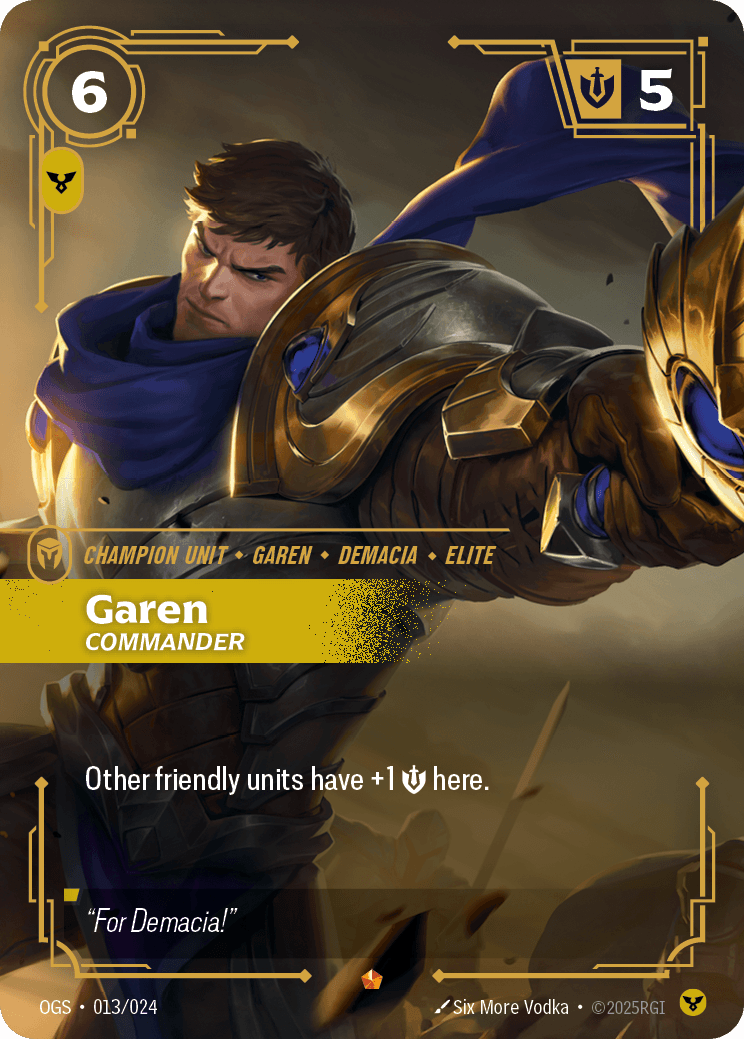
Order Legend
Garen - Commander
An anthem that gives his other units +1 Might at his battlefield, quietly turning a wide board into a board that trades up across the whole line.

Body/Order Legend
Decisive Strike
His signature action pumps your units +2 Might for the turn, flipping an even mass-combat into a one-sided conquer.
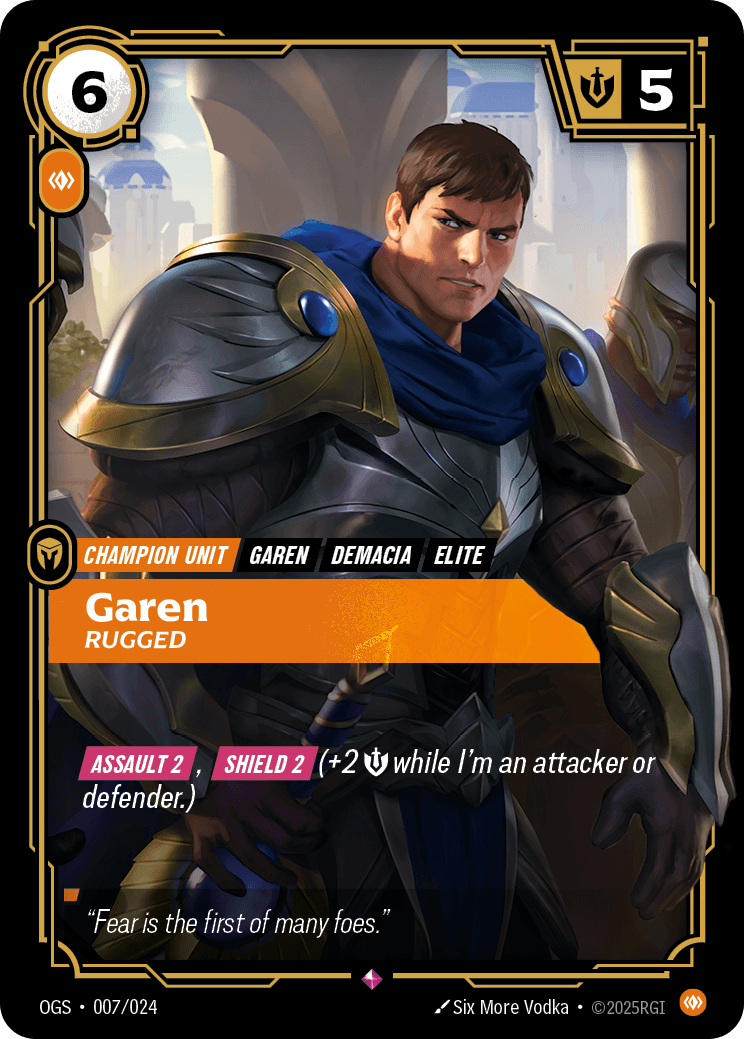
Body Legend
Garen - Rugged
The sticky top end: Assault 2 hits for two more in combat and Shield 2 ignores the first two damage, so chip answers bounce and you need clean removal or an overwhelm.
Garen is a go-wide midrange deck, not a stat wall. The line the pilot wants is:
- Develop several units onto one meaningful battlefield.
- Buff the whole group so the combat math tips his way.
- Conquer with four or more units there and draw two off the legend.
- Reinvest the extra cards into another wide turn and repeat.
The reason it snowballs is the conquer draw. A normal wide board is annoying; a wide board that refills his hand every time it takes a point is a deck that never runs out of gas. So the matchup is not "kill his biggest unit." It is "stop the four-unit conquer from being free," because that is the trigger that turns one good turn into two.
Garen's Kit — What Each Piece Does
These are the cards in Garen's kit: the legend-locked pieces the deck is built around. Naming them is not the same as claiming a given list runs a specific count — kits vary list to list — so respect them for what they do, and confirm the wording in the card database.
- Garen - Might of Demacia, the legend, draws two when you conquer a battlefield holding four or more of your units. Going wide is the payoff, so the whole deck is pointed at filling one location.
- Garen - Commander is an anthem: other friendly units at his battlefield get +1 Might. On a wide board that is a lot of extra Might spread across every attacker at once.
- Decisive Strike is his signature action that gives your units +2 Might for the turn — a team-wide pump that turns an even mass-combat into a one-sided one, and can push a whole board's worth of units past your blockers.
- Garen - Rugged is the sticky top end: Assault 2 and Shield 2 mean he hits for two more while attacking or defending and shrugs off the first two damage, so chip answers bounce off him.
How To Beat Garen
1. Contest The Battlefield Before It Fills
The legend only pays out at four-plus units. If you make Garen fight for a location while he only has one or two units there, he either conquers without the draw or overcommits reinforcements he would rather spend elsewhere. Do not wait for the board to be scary — the cheapest turn to break the plan is before the fourth unit arrives.
2. Answer Width With Width
One premium removal spell into a wide board is poor value: you spend a card, he loses one of four. Area damage, mass combat, and cheap blockers that trade with several attackers are worth far more here. If your deck can wipe or shrink a group, hold it for the turn he has committed the whole board, not for the first unit down.
3. Respect The Team Pump
Decisive Strike gives the whole board +2 Might at speed, and Garen - Commander already adds +1 to everything at his battlefield. Measure combats as if both are live: a fight you read as an even trade can flip into a clean conquer once every one of his units is two or three Might bigger than it looks. Leave yourself a margin on the exchange that decides the battlefield, and don't send exactly-even blocks into an open board.
4. Make Him Play Two Places At Once
The four-unit threshold is a location tax. If you threaten a second battlefield he cannot ignore, he has to split his units, and a split board struggles to hit four anywhere. Forcing him to defend or divide is often better than trying to out-muscle the stack he wants to build.
Mulligan Guide Against Garen
Keep hands that can do at least two of these:
- Contest a battlefield in the first two turns so the board never fills uncontested.
- Present multiple blockers so a wide attack does not simply run you over.
- Hold an area or group answer for the turn he commits four units.
- Threaten a second battlefield so he cannot funnel everyone into one conquer.
- Carry a real answer for a Shield 2 body like Garen - Rugged, not just chip damage.
Ship hands that are all single-target removal and nothing else. Against a go-wide deck that draws two every time it conquers wide, precision answers arrive a card behind. The ideal keep is the one that makes his first four-unit conquer cost something.
Turn By Turn Counter Plan
Turns 1-2: Deny Free Development
Garen wants quiet turns to build a board. Make him answer something instead. Cheap, replaceable bodies are perfect — they contest the location he wants and keep a wide attack from being a free conquer later.
Turns 3-4: Break The Conquer Turn
This is where the game usually turns. Look for the battlefield where he has stacked units and open resources — that is the four-unit conquer he needs to draw two. Contest it or make winning it cost more than the two cards are worth. Spend your interaction to break that conquer, not to pick off a random unit.
Turns 5-6: Refuse The Refuel
If you denied the first wide conquer, he still has cards and a fresh board to try again. Keep pressure coming back so he has to choose between defending and rebuilding the stack. The best anti-Garen games are the ones where he never gets a free turn to reload off the draw.
Late Game: Don't Let Width Become Inevitable
Left alone, the conquer draw buries you in cards. Keep a clock so a long game is your win condition too, and keep answering the wide turns rather than trading one-for-one into a board that refills itself.
Matchup Plans By Archetype
Aggro And Pressure Decks
You are well positioned: you naturally contest battlefields and can race the four-unit turn. Force him to spend units on defense before his conquer board is ready, and spread pressure so he can't hit four in one place.
Midrange Decks
You have clean tools but can lose by trading too fairly. Save your area or group answers for the committed board, respect the team pump, and turn the corner instead of passing back with no pressure.
Control Decks
Do not keep hands that only stabilize late. The conquer draw out-resources a slow deck. Bring early speed bumps and a group answer so his wide turns cost something before your top end lands.
Combo And Engine Decks
Buy setup turns with contest bodies so Garen can't take free wide conquers while you assemble. If your engine forces him to defend a second battlefield, his four-unit plan slows down, and that is your window.
Common Mistakes Against Garen
- Spending premium single-target removal on one unit in a wide board.
- Letting a battlefield fill to four units before you contest it.
- Reading combats at face value while Decisive Strike and Garen - Commander are live.
- Chipping at Garen - Rugged into his Shield 2 instead of answering him cleanly or overwhelming him.
- Ignoring a second battlefield and letting him choose exactly where to go wide.
If you fix only one habit, fix this: stop answering single units, and start denying the four-unit conquer that draws his cards.
Build And Test On RiftStorm
Everything here is buildable with our own tools:
- Search Garen's kit in the card database to read exact wording, then look up area damage, cheap blockers, and clean removal for a Shield 2 body.
- Clone a shell in the deck builder and goldfish his conquer turn: let a test copy build a four-unit battlefield on curve, then practice contesting it before the draw and answering the board with width instead of a single spell.
- Map Garen against the rest of your expected room on Riftbound Counters, and compare community lists in Riftbound decks.
If you open one of our counter shells, treat it as a RiftStorm testing shell — a starting point built from card roles, not a tournament decklist — and tune it against what you actually see.
Bottom Line
Garen - Might of Demacia matters because he turns a wide board into a card engine: commit four units to a battlefield, buff them with Commander and Decisive Strike, conquer, and draw two to do it again. He is not a stat wall and he is not a single oversized threat — he is a location deck. Beat him by contesting the battlefield before it fills, answering width with width, and forcing him to split so the four-unit conquer is never free. Do that, and the draw engine never turns over.