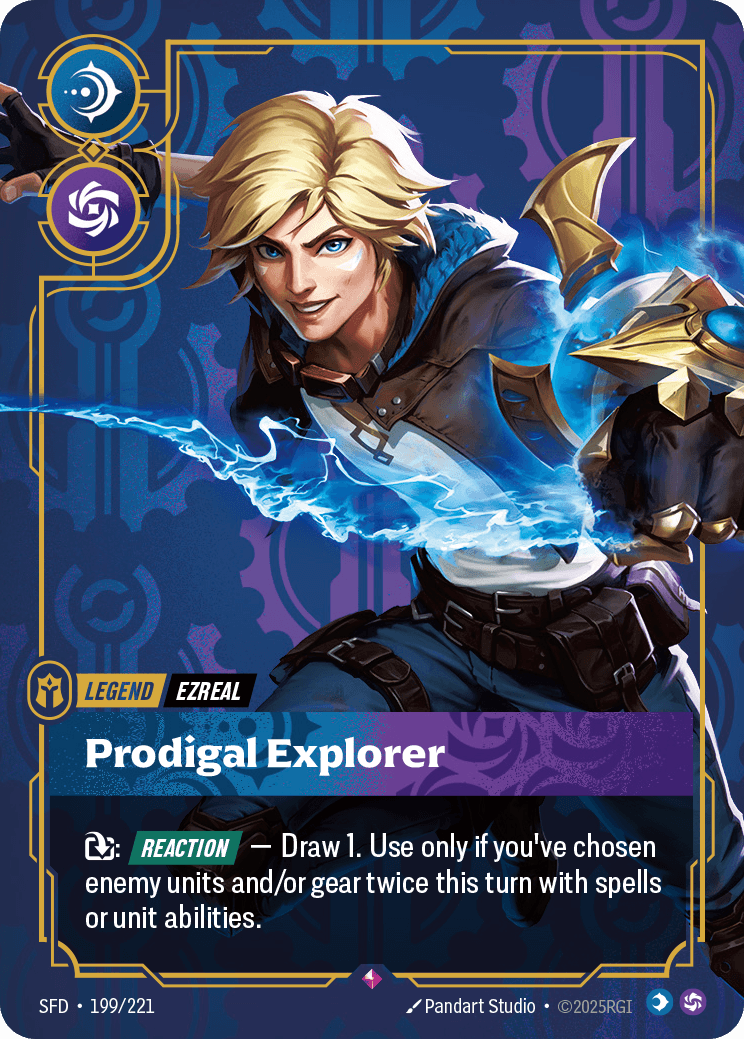
Darius is Fury/Order beatdown built on a rhythm, not a single broken card. His whole game is a Legion engine: play a cheap card, use the Legend to add Energy, play a second card, and turn that card count into oversized attackers and re-attacks. If your plan is to develop slowly and win on card quality, that quality never gets to matter.
A note on how we write this. We do not have a verified current Vendetta Darius list in our own data, so we are not going to hand you a card-for-card 'package' and call it the deck — and we are not sending you to someone else's site to find one. What we give you instead is durable: Darius's Domain and gameplan, the cards in his kit and what each one does, and a counter plan keyed to mechanics. Read any card's exact text in the card database, build both sides in the deck builder, and map the rest of your gauntlet on Riftbound Counters.
Darius's Identity: Fury/Order Legion Tempo
Fury/Order Legend
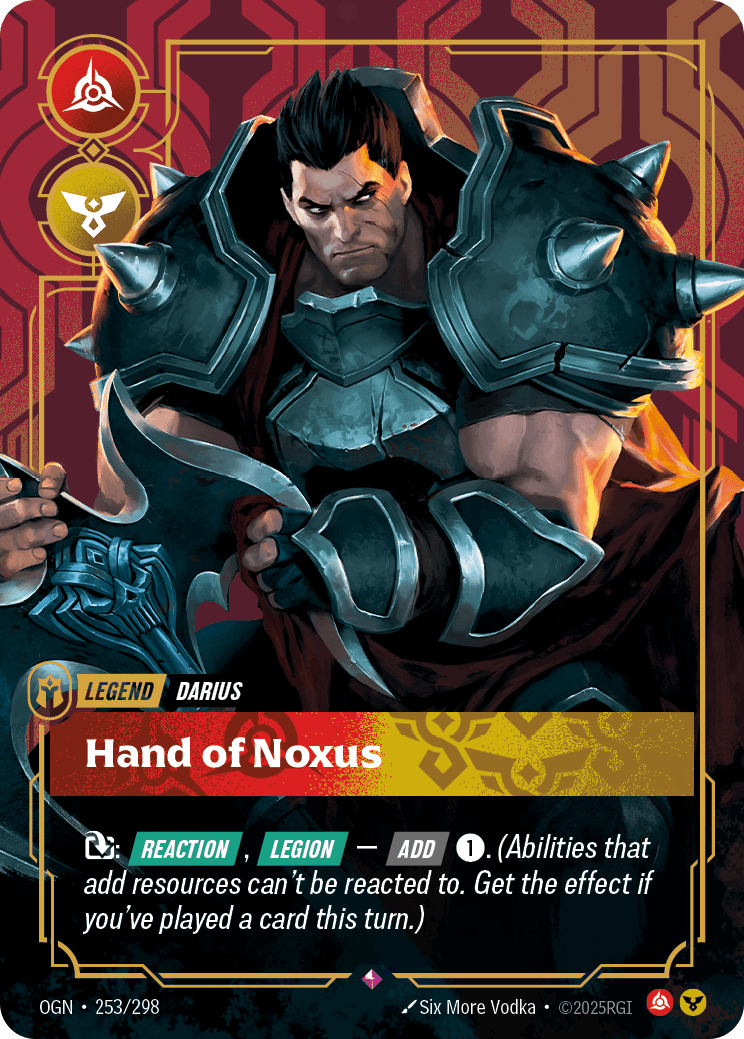
Darius - Hand of Noxus
The Legend adds Legion Energy once Darius has played a card this turn, and that Energy cannot be reacted to — so he always represents more resources than his ready runes show.

Fury Unit
Darius - Trifarian
In Darius's kit: playing a second card in the turn gives Trifarian +2 Might and readies him, turning one cheap follow-up into a re-attacking threat.

Order Unit
Darius - Executioner
In Darius's kit: he readies himself when he enters with Legion active and gives every other friendly unit at his battlefield +1 Might, so an unanswered Executioner lane grows the whole board.
Darius - Hand of Noxus is a Fury/Order engine deck. Fury gives it cheap, aggressive bodies that contest battlefields immediately; Order gives it the payoffs that convert a fast start into a lasting board. The glue is Legion — an ability that turns on once he has already played a card this turn.
His Legend ability is the hinge. Darius - Hand of Noxus can exhaust to add one Energy at Reaction speed through Legion, and because it adds a resource it cannot be reacted to. So a Darius pilot who has already played a card is representing an extra Energy you cannot see on the board and cannot interrupt. Plan combat as if his ready runes are all he has, and you will walk into showdowns where he has one more Energy than you counted.
What The Matchup Is Trying To Do
Darius wants a tempo curve, not a combo:
- Land a cheap Fury body that pressures a battlefield the turn it arrives.
- Play a second card every turn to switch the Legion payoffs on.
- Convert that card count into Might, readies, and lane-wide buffs.
- Close the game before a slower, card-quality deck stabilizes.
That means the matchup is not solved by killing his first unit. Sometimes that is right; just as often it is exactly the trade that lets him play a second card, ready a threat, and score somewhere you were not defending. Before every key turn, ask: what happens if Darius plays one more cheap card and adds one Legion Energy during this fight? If your whole line collapses, you need a different line.
Darius's Kit, By Function
These are the cards in Darius's kit — the legend-locked pieces the deck is built around. Naming them is not the same as claiming a given list runs a specific count of each; kits vary list to list. Respect them for what they do, and confirm the exact wording in the card database.
- Darius - Hand of Noxus, the Legend, adds Legion Energy once he has played a card, and that Energy cannot be reacted to. It is why he always represents more resources than the visible runes.
- Darius - Trifarian rewards the second card: when Darius plays it, Trifarian gets +2 Might for the turn and readies. One cheap follow-up turns a five-drop into a re-attacking threat.
- Darius - Executioner readies himself when he enters with Legion active and gives every other friendly unit at his battlefield +1 Might. He turns a contested lane into a losing one for you.
- Noxian Guillotine marks a unit to die the next time it takes damage — and with Legion active, kills it outright at Action speed. It is efficient, Reaction-speed removal that punishes a body you just committed.
How To Beat Darius
1. Make The Second Card Expensive
Almost every Darius payoff keys off playing a second card in a turn. If he can chain that second card for free, Trifarian readies, the lane grows, and the Legion Energy comes online. Pressure him enough that his cheap cards have to be spent on defense instead of on the engine. A second card played to survive is not a second card fueling a re-attack.
2. Force The Legion Energy To Be Defensive
The extra Energy you cannot see is only scary when it is converting position into points. Make Darius spend it holding a battlefield rather than taking one. If he is exhausting his Legend to survive your pressure, he is not using that resource to push a showdown on his own timing.
3. Answer The Lane, Not The Body
Darius - Executioner's +1 Might buff only applies at his battlefield. A common way to lose this matchup is to answer the small bodies, feel fine, then watch Executioner arrive, ready, buff the stack, and flip a fight you were winning. Either remove Executioner cleanly, or refuse the fight and contest a different battlefield so his buff lands where it does nothing. A Darius stack in the wrong lane is a Darius stack doing nothing.
4. Respect Reaction-Speed Combat
Darius's cheap interaction is what makes a fight never as clean as it looks: a one-cost pump can win a combat you thought you had blocked and double as the second card that fires the engine, and hidden removal can erase your first real blocker at Reaction speed. Do not commit a block as though the attacker is its printed size when Darius has open Energy. If your line loses to one cheap card, make him spend that card on a lower-stakes exchange first.
5. Survive The Burst, Then Grind
Darius is the aggressor by design and hates a long, reactive game. His structural weakness is a hand of cheap cards that empties. If you get past the early explosion with your board intact, the engine has nothing left to chain. The counter is a control-leaning plan with enough early speed bumps to not die before your answers matter.
Turn By Turn Counter Plan
Turns 1-2: Deny Free Development
Your first job is to make sure Darius cannot build a board for nothing. A hand that neither affects the board nor holds a cheap answer is usually too slow. You do not need to overextend — you need to make him answer something so he cannot spend the opening turns setting up the engine while you do nothing. Do not commit a fragile body into open Darius Energy; assume Reaction-speed removal.
Turns 3-4: Break The Engine, Not The Symptom
This is where the matchup turns. Find the turn where the second card would ready Trifarian, discount his follow-up, or set up an Executioner lane, and interact there. Spend removal on the readied attacker or the buff lane, not on a body that was never going to score. If you can force him to hold his second card defensively, you have stalled the whole rhythm for a turn.
Turns 5-6: Survive The Legion Push, Turn The Corner
If Darius has committed Executioner and a stacked lane, either answer it cleanly or refuse the fight and make him move the buff. His +1 Might is local. Around here his cheap-card hand starts to thin, and a control-leaning deck earns its keep: keep answering the readied threats one for one and start applying your own pressure so he cannot rebuild for free.
Late Game: Grind Him Out Of Cards
If you survive the burst, Darius's hand of cheap cards empties and the engine has nothing to chain. Do not stop interacting, but shift toward out-resourcing him. Make the game go long enough that his rhythm has nowhere to go.
Mulligan Guide Against Darius
Keep hands that can do at least two of these:
- Contest a battlefield on turn one or two with a body that survives a small ping.
- Hold a cheap answer for a readied threat or an early aggressive body.
- Threaten a second battlefield so an Executioner buff lands in the wrong lane.
- Punish an over-committed engine turn where he dumps cheap cards.
- Recover after losing one early exchange.
Ship hands that only come online after turn five. A pile of expensive cards and one reactive spell is not enough when Darius is chaining cards and adding Legion Energy on turn two. The ideal keep is functional, not necessarily aggressive: a hand that makes his first engine turn cost something.
Matchup Plans By Archetype
Aggro And Pressure Decks
You are not racing blindly. You are forcing Darius to spend his cheap cards and Legion Energy on defense instead of engine turns. Split pressure across two battlefields so the Executioner buff lands where it does the least and one Reaction cannot answer your whole plan.
Midrange Decks
You have the cleanest structural matchup but the highest risk of getting comfortable. Your threats need to demand answers before his engine gets rolling, then your removal needs to be there for the Executioner lane. If you only trade one for one forever, his discounts and Legion Energy pull ahead. Turn the corner once his hand thins.
Control Decks
Do not pretend the game starts on turn six. Darius will end it before then if you have no early speed bumps. Bring cheap contest bodies and enough removal to survive the burst, then lean on the fact that Darius hates a long, reactive game. Once your card advantage comes online and his cheap hand is empty, you win.
Combo And Engine Decks
Your priority is buying one clean setup turn without letting Darius own the board. Keep hands that can interact while developing. If your first turns do nothing, Darius forces you to combo under a clock you cannot beat.
Common Mistakes Against Darius
- Answering the first cheap unit instead of the second-card payoff or the Executioner lane.
- Committing fragile blockers early into open Reaction-speed removal.
- Ignoring the Legion Energy and planning combat as if his ready runes are all he has.
- Blocking into open combat tricks and losing a fight you thought was decided.
- Stacking one battlefield so a lane-wide buff and a wide board punish everything at once.
- Keeping slow hands because they look powerful after turn five.
If you fix only one habit, fix this one: stop answering symptoms. Break the card-count engine, force the Legion Energy to be defensive, and make the second card cost him tempo.
Build And Test On RiftStorm
Everything here is buildable with our own tools:
- Search Darius's kit in the card database to read exact wording.
- Clone a shell in the deck builder and goldfish the counter plan against a fast, second-card start.
- Compare community lists in Riftbound decks.
- Pair this with adjacent matchups on Riftbound Counters.
If you open one of our counter shells, treat it as a RiftStorm testing shell — a starting point built from card roles, not a tournament decklist — and tune it against what you actually see.
Bottom Line
Darius turns cheap cards into Energy, oversized attackers, and lane-wide buffs. He develops early, chains a second card to ready Darius - Trifarian, and stacks Darius - Executioner into a lane to make the whole board bigger. You beat him by making the rhythm expensive: contest early, count the Legion Energy he cannot show you, answer the readied threat and the buffed lane rather than the symptom, survive the burst, and grind him out of cards — the reactive long game he was never built to win.
That is the difference between losing to the idea of Darius and beating the actual deck across the table.