Pyke is not a fair midrange deck wearing a Fury/Chaos coat. Bloodharbor Ripper is a tempo-and-resource engine that quietly banks free value every turn he passes, then cashes it in on the turn you least expect. He does not need to look explosive to win — he needs you to feed him deaths, let his Gold tokens pile up, and stack your defense in one place so a Hidden threat can walk in and score.
The whole matchup is a fight over one question: who is spending real Energy, and who is spending free tokens. If Pyke is laundering his Energy through Gold gear tokens while you pay full price for everything, you are losing even when the board looks even.
A note on how we write this. We do not publish a card-for-card Pyke 'package' we cannot verify from our own current data, and we do not send you to someone else's site to find one. What we give you instead is durable: the gameplan Pyke is running, the cards in his kit and what each one does, and a counter plan keyed to mechanics. Read any card's exact wording in the card database, build both sides in the deck builder, compare public shells in Riftbound decks, and map the rest of your gauntlet on Riftbound Counters.
What We Can And Can't Tell You
We do not have a current first-party Pyke decklist on record for this format, so we are not going to hand you a 40-card list dressed up as the live version. That honesty is the point. A counter plan built on 'Pyke always runs these cards' rots the moment the list shifts. A counter plan built on 'here is what the Bloodharbor Ripper is trying to do, and here is the kit that punishes loose play' keeps working. This guide is the second kind.
Why This Matchup Is About Tokens, Not Bodies
Read the legend's activation: for one Energy, exhaust him, return a friendly unit at a battlefield to hand, and play a Gold gear token exhausted. That single line is the whole deck in miniature.
The bounce is not just protection. It is a re-trigger button. Every unit Pyke replays gets its enter effect again, and every activation prints a Gold token. Those Gold tokens each carry a Reaction: kill this and exhaust it to add a rainbow rune. So a Gold token is not a body — it is stored fixing and ramp that Pyke spends later, on his terms.
That is why counting his open runes lies to you. A Pyke board with three exhausted Gold tokens is a board with three extra rainbow runes waiting to happen. He can pay a Fury kicker, cast a Hidden card for zero Energy, or curve into discounted top-end far ahead of what his face-up resources suggest. The counter rule is simple: make Pyke spend real Energy, and make his tokens worthless before he can cash them.
What Pyke Is Trying To Do

Fury/Chaos Legend
Pyke - Bloodharbor Ripper
The legend loop: for 1 Energy, return a friendly unit to hand and make a Gold gear token. The bounce re-triggers enter effects and dodges removal; the token is stored rainbow fixing. Count his exhausted tokens, not just his open runes.
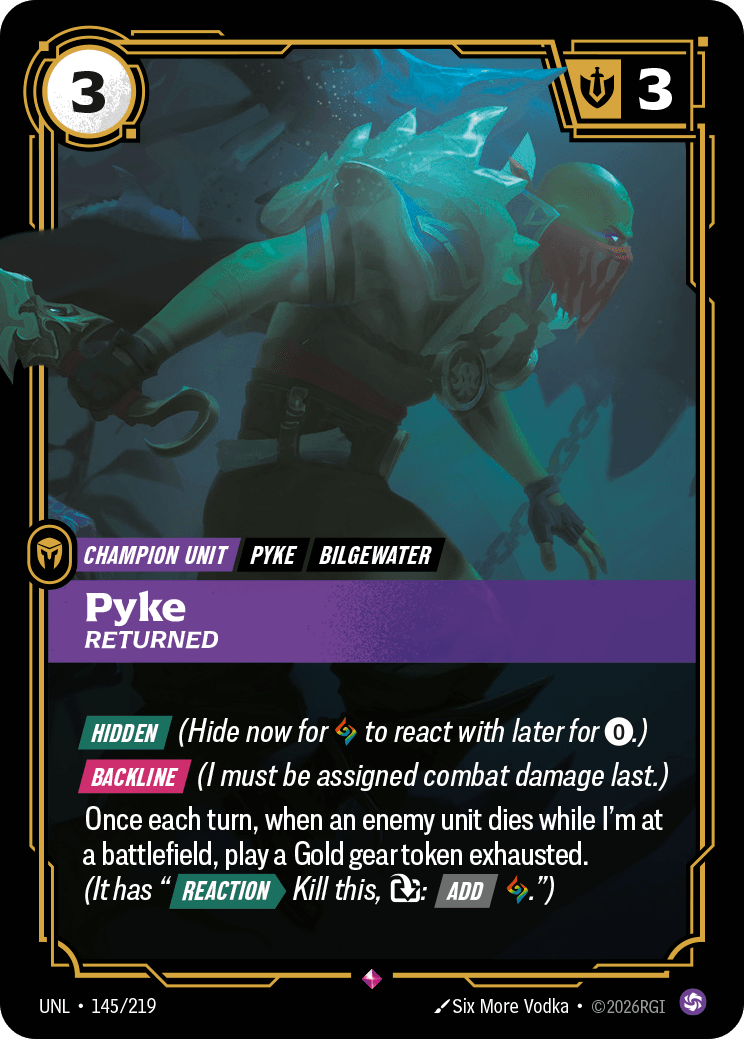
Chaos Unit
Pyke - Returned
In Pyke's kit: a Hidden Backline unit that makes a Gold token every time an enemy unit dies at his battlefield, so trading into him literally pays for his next turn. Pick your fights instead of feeding it.
Fury Unit
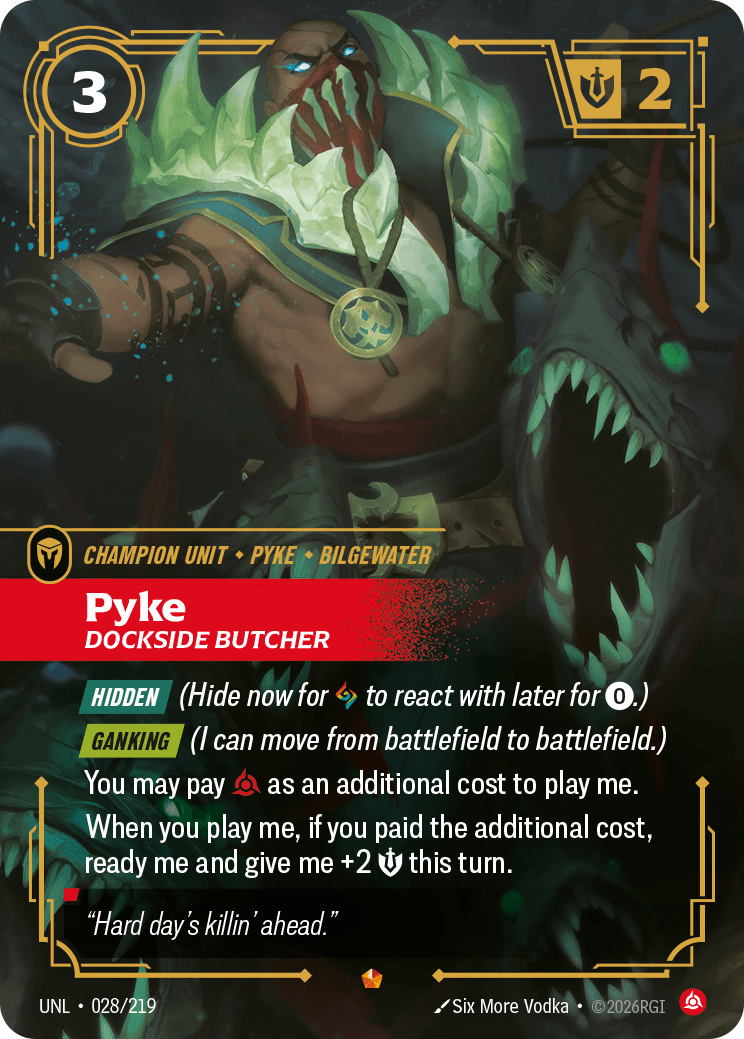
Pyke - Dockside Butcher
In Pyke's kit: Hidden plus Ganking plus a Fury kicker for ready and +2 Might means he can flip in at any battlefield and swing before you respond, so do not clump one big unit and pass.
Most competitive Pyke shells are Fury/Chaos tempo with a Gold-token economy bolted underneath. The Pyke player wants to generate tokens off the legend, off enemy deaths at his backline, and off his Hidden flips; use those tokens as rainbow fixing to pay kicker costs and cast Hidden cards for free; bounce and replay his own units to re-trigger value and dodge your removal; hold up Hidden threats so he can attack and defend in the same window; and close with Ganking bodies and discounted top-end once the resource lead is unfair.
That means 'just kill his units' is a trap. Pyke wants you to spend a card removing a body he was going to bounce anyway. Sometimes killing a unit is correct; sometimes it is exactly how you hand him a Gold token and a free re-trigger. Before every key turn, ask: what happens if Pyke sacrifices two Gold tokens for rainbow runes right now? If your line collapses when he suddenly has extra Energy, you need a different line.
Pyke - Returned: Stop Feeding The Backline
Pyke - Returned is a three-cost Hidden Backline unit. Once each turn, when an enemy unit dies while he is at a battlefield, he plays a Gold gear token exhausted. Backline means he must be assigned combat damage last, so he is hard to kill in a straight fight, and Hidden means he can appear as a surprise.
Read that trigger carefully: it rewards enemy deaths. Every time your unit dies at his battlefield, you are personally paying for his next Gold token. Trading into a battlefield where Pyke - Returned sits is often worse than not contesting it at all, because the trade itself funds his engine. The counterplay is death discipline:
- Do not throw expendable units into a lane Pyke - Returned is holding just to 'contest' it. You are feeding the token.
- If you must fight there, kill him first or make the exchange lopsided enough that the free token does not matter.
- Because he is Backline, plan your damage assignment so you can actually reach him, or bring reach that ignores the combat order.
- Where possible, win the battlefield somewhere else so he is a Backline body doing nothing instead of a token printer.
The instinct to always trade is exactly what this card taxes. Slow down and ask whether the death helps you or him.
The Legend Loop Is A Bounce, Respect It
Because the Bloodharbor Ripper returns a friendly unit to hand as part of every activation, your removal is playing against a moving target. Point removal at a bounced-and-replayed unit and you may have spent a card on something that resets for one Energy. This changes how you value interaction:
- Cheap, repeatable answers beat expensive one-shots here. A two-cost removal spell you cast twice is better than a five-cost bomb Pyke bounces around.
- Combat that kills on your terms is often better than targeted removal, because you decide the timing rather than letting him bounce in response.
- The best moment to remove a unit is when Pyke is tapped out and cannot pay the one Energy to bounce it away.
Do not get baited into a removal war. You will run out of answers before he runs out of things to bounce.
Pyke - Dockside Butcher: The Hidden Gank That Trades Up
Pyke - Dockside Butcher is the card that punishes lazy battlefield stacking. He is a three-cost Hidden Fury unit with Ganking, so he can move from battlefield to battlefield, and he carries a Fury-rune kicker: pay it and he enters ready with +2 Might this turn.
Stack that together and it is ugly. He can hide, flip in as a surprise, move to wherever the fight is, enter ready so he attacks immediately, and swing as a boosted threat. The Fury rune for the kicker is exactly the kind of cost Pyke's Gold tokens exist to pay. This is where single-big-unit plans die: commit one fat blocker to a battlefield and pass, and a readied, boosted Dockside Butcher can gank in and trade up or push damage before you respond.
Your counterplay is board shape, not just removal:
- Do not clump one expensive unit where a Ganking threat can pick the fight. Spread just enough that he cannot swing a single lane for free.
- Hold a cheap answer for the turn he flips in, rather than tapping out into open Fury runes.
- Respect the kicker: if Pyke has Gold tokens and open Fury access, assume the ready-and-boosted version is live and plan blocks as if it is.
Death from Below: Cheap, Recursive Removal

Fury/Chaos Spell
Death from Below
In Pyke's kit: cheap removal that kills a unit and can replay itself from the trash if the target was small, so a single sticky threat is not a plan — layer your pressure so one recursive answer cannot reset your board.
Death from Below is a Fury/Chaos removal spell in Pyke's kit: kill a unit at a battlefield, and if it had 3 Might or less, he may replay the spell from his trash for a rainbow rune — a cost his Gold tokens happily cover. It answers your cheap early bodies and can come straight back, so a single sticky threat is not a plan against it. Layer your pressure so that one recursive removal spell cannot undo your whole board, and remember that a small unit dying at his backline can also feed a token on the way out.
The Free-Value Multipliers
Two more effects are why 'the board looks even' is a lie against Pyke. His shell leans on Hidden spells that can re-ready his whole board — letting him attack with everything and still keep blockers up — while printing another Gold token in the process. And a token-multiplier body can turn every Hidden flip into an extra token, converting the Hidden package from a tempo tool into a full economy.
Your reads:
- If Pyke has passed with resources open and Hidden cards likely in hand, do not attack into a board that a re-ready effect can suddenly flip back to full blockers.
- If you have efficient interaction, prioritize a token-multiplier body over a bigger threat. Killing the multiplier slows the whole economy, which matters more than one trade.
- Use the card database to find cheap units and Reaction spells that answer the multipliers before they snowball.
The Gear Axis
Pyke's board has a second layer: units and gear. Cheap Fury equipment can turn a bounced-and-replayed body into a real threat, so what you see in units is not the whole story. That is a gift for you, because gear and token removal hits both his equipment and his Gold economy at once. If your list runs cheap gear answers, they do double duty — strand the tokens before he can sacrifice them for runes, and blunt the equipment aggression. Search the card database for cheap gear answers and build a real plan around them if Pyke is common in your room.
Battlefield Sequencing: Turn By Turn
Turns 1-2: Deny The Free Start
Your first job is to stop Pyke from developing for free. Contest, but contest smart. Do not throw a body into a battlefield where Pyke - Returned will convert its death into a token. Take the initiative on a battlefield Pyke does not want to defend. If you make him spend real Energy and real cards early, his Gold economy never gets ahead of curve; if you let him pass turns quietly banking tokens, his midgame becomes unfair.
Turns 3-4: Attack A Second Lane
This is the pivot. Pyke is a tempo deck that wants to dictate where the fight happens so his Ganking and Hidden threats arrive on his terms. Take that choice away by forcing action on a second battlefield. If he has to commit his bounce and his tokens to defending one lane, he cannot also set up the surprise turn in another. Spread pressure so a single Hidden gank cannot solve everything at once.
Turns 5-6: Punish The Tap-Out
Pyke's big turns require him to spend. The moment he taps out to sacrifice tokens, cast a Hidden chain, or ready his board, he cannot also bounce a unit to save it. That is your window. Land your removal, push your attack, or trade your best unit into his key threat when he has no Energy to bounce it away. The whole deck is built to make you flinch first; do not.
Late Game: Watch For The Discount Finish
If the game stretches, keep track of whether Pyke has moved from tempo to closing power. His discounted top-end gets cheaper the more he plays in a turn, so his big multi-card token turns are also the turns a fat body lands for almost nothing. Do not strip so much of your own pressure that you let one closing turn steal the game.
Mulligan Guide Against Pyke
Keep hands that can do at least two of these:
- Contest or pressure a battlefield without feeding a death into Pyke - Returned.
- Hold a cheap, bounce-proof answer for an early threat.
- Threaten a second battlefield so Pyke has to defend.
- Interact with gear or tokens to slow the economy.
- Keep applying pressure after one exchange.
Ship hands that are all expensive one-for-one removal. Against a bounce deck those cards are half as good as they look, because Pyke resets the target. The ideal keep is proactive and cheap: something that makes his first tempo turn cost real resources.
What To Bring
If you tune a list for the matchup, build around a plan instead of a pile of maybes:
- Gear and token answers aimed at Gold tokens and cheap equipment, to strand his economy before he can cash it.
- Cheap, repeatable interaction that survives a bounce and can answer a token-multiplier body or a flipped Ganking threat.
- Proactive units that force Pyke to defend a second battlefield, ideally mobile bodies that reward you for winning combat.
- A reach effect to clear a blocker or ping down Pyke - Returned before a swing.
- A recovery or closing card for grindy games where Pyke boards into discounted top-end.
The big warning: do not overboard into slow control. Every passive turn you take is a turn Pyke spends banking tokens. You want better interaction and more initiative, not a slower deck.
Common Mistakes Against Pyke
These are the habits that make Pyke feel unbeatable:
- Trading into Pyke - Returned and personally funding his Gold tokens with your own dead units.
- Spending expensive removal on a unit Pyke bounces and replays for one Energy.
- Counting his open runes and forgetting the exhausted Gold tokens are stored rainbow fixing.
- Clumping one big unit where a readied, Hidden gank can trade up.
- Attacking into open resources and getting blown out by a Hidden re-ready that brings his blockers back.
- Ignoring the token multipliers while they quietly turn every Hidden flip into more fixing.
- Playing passively and letting Pyke pick the battlefield, the timing, and the tempo.
If you fix only one habit, fix this: stop feeding him. Do not trade, do not tap out, and do not attack in ways that pay for his next turn. Make Pyke spend real Energy, then punish the turn he has none left to bounce.
Testing Checklist
Run at least five focused games before calling the matchup solved:
- Can your opening hand pressure a battlefield without feeding Pyke - Returned?
- Which of your cards answers a Gold token or a cheap gear cleanly?
- Does your removal still work if Pyke bounces the target in response?
- Can you force a second-battlefield fight that pulls his tokens away?
- Which tuned card would you keep after seeing it once?
Use the deck builder to build your real deck and a Pyke test shell, goldfish his token turns, and play only the windows where a Hidden gank or the legend loop actually matters. Then browse community decks to see how other players are adapting, and pair this page with the rest of your gauntlet through Riftbound Counters.
Bottom Line
Pyke is a dangerous Riftbound tempo deck because he turns free tokens into an unfair resource lead, then converts that lead into Hidden gank turns and discounted top-end. The bounce protects his threats, the Gold tokens hide his real Energy, and the death triggers make your own trades pay for his engine.
You beat Pyke by making the free value expensive. Deny the tokens. Do not feed Pyke - Returned. Strand his gear economy. Force a second battlefield. Save your interaction for the turn he taps out and cannot bounce. That is the difference between losing to the idea of the Bloodharbor Ripper and beating the actual deck across the table.