Sett is Body/Order buffed midrange — not a flashy combo deck, and it does not need to be. It buffs its units, holds battlefields, and refuses to die to the removal that beats everyone else. That is why it is a dedicated counter target: even as a mid-shelf pick in our read, Sett punishes the exact 'kill their best threat' plan most decks default to.
The matchup matters because Sett asks an uncomfortable question: can your deck actually convert a good combat into a real advantage? Most decks assume that killing the biggest unit puts them ahead. Against Sett that assumption is wrong. His legend recycles the unit you spent a card and a turn to kill, and a conquest hands the save right back. Play the matchup on autopilot and you win the fight but lose the game.
A note on how we write this. We don't publish a card-for-card Sett 'list' we can't verify from our own current data, and we don't send you off-site to find one. Read any card's exact text in the card database, build both sides in the deck builder, and pair this with adjacent matchups on Riftbound Counters.
What We Can And Can't Tell You
We do not have a verified current Sett decklist on record, so this guide is written the durable way: the gameplan Sett is running, the cards in its kit and what they do, and a counter plan keyed to mechanics. Buff enablers and combat tricks rotate; the save-and-recall engine at the center of the deck does not. That is what we build the counter around.
Sett, The Boss: Why This Matchup Matters
Body/Order Legend
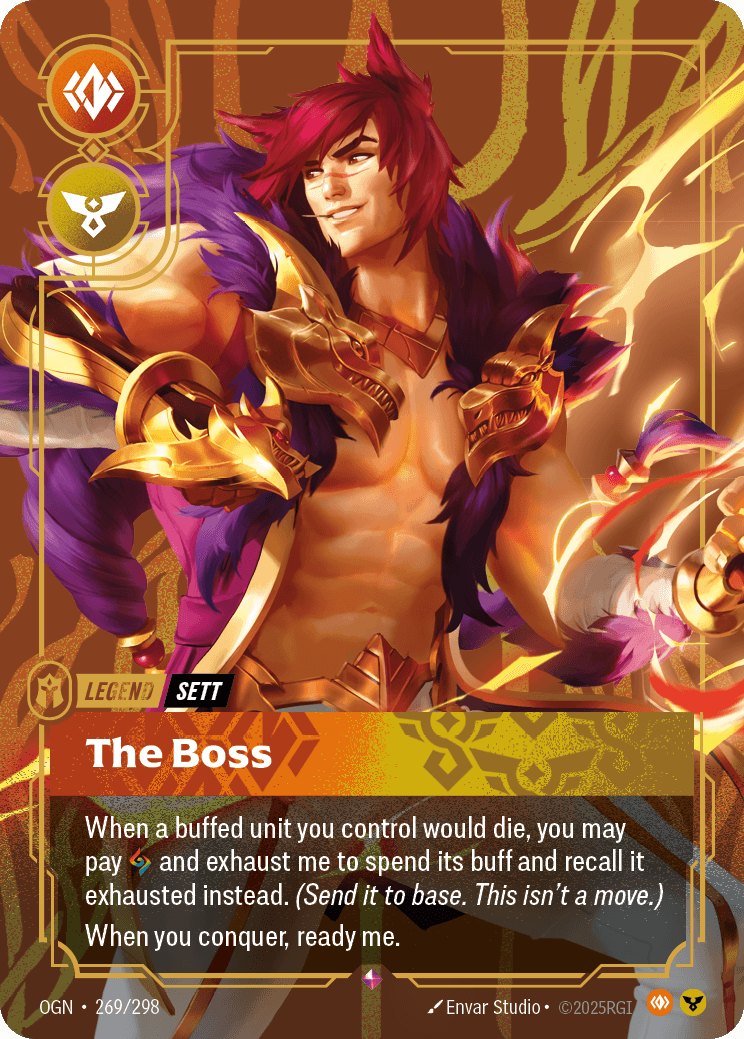
Sett - The Boss
The Boss turns a dying buffed unit into a heal, exhaust, and recall for one rune, and conquering readies him — so racing his one save per turn is the whole matchup.
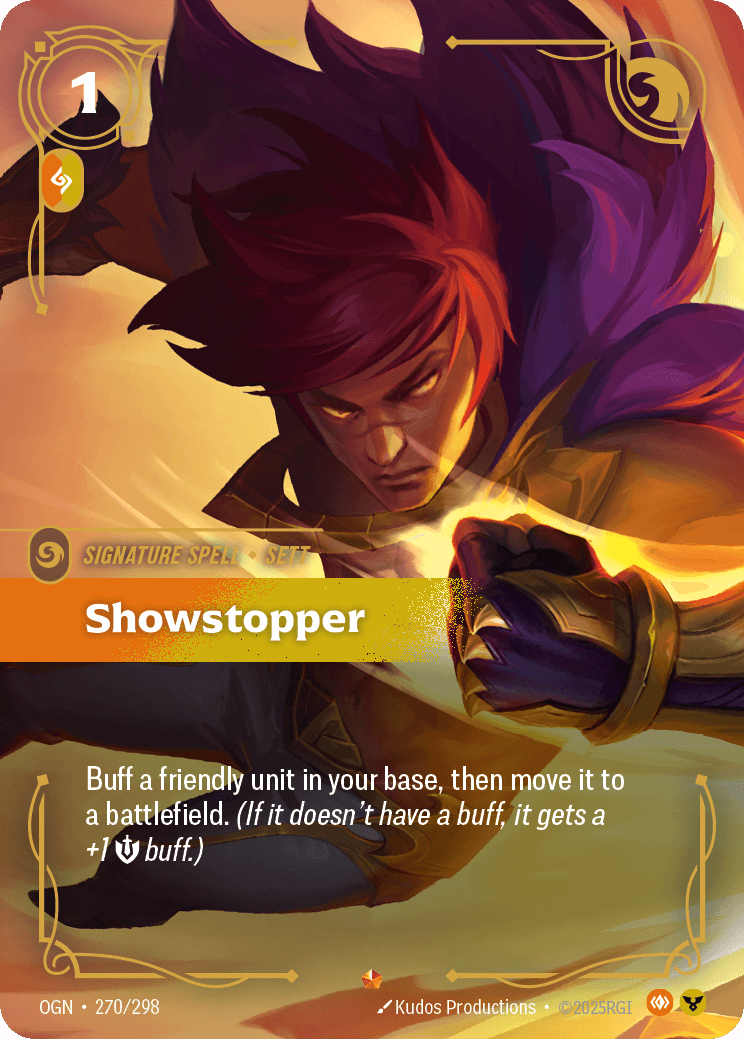
Body/Order Legend
Showstopper
His signature spell buffs a unit waiting in base and moves it to a battlefield, reinforcing a lane with a fresh buffed body he can later spend on a save.
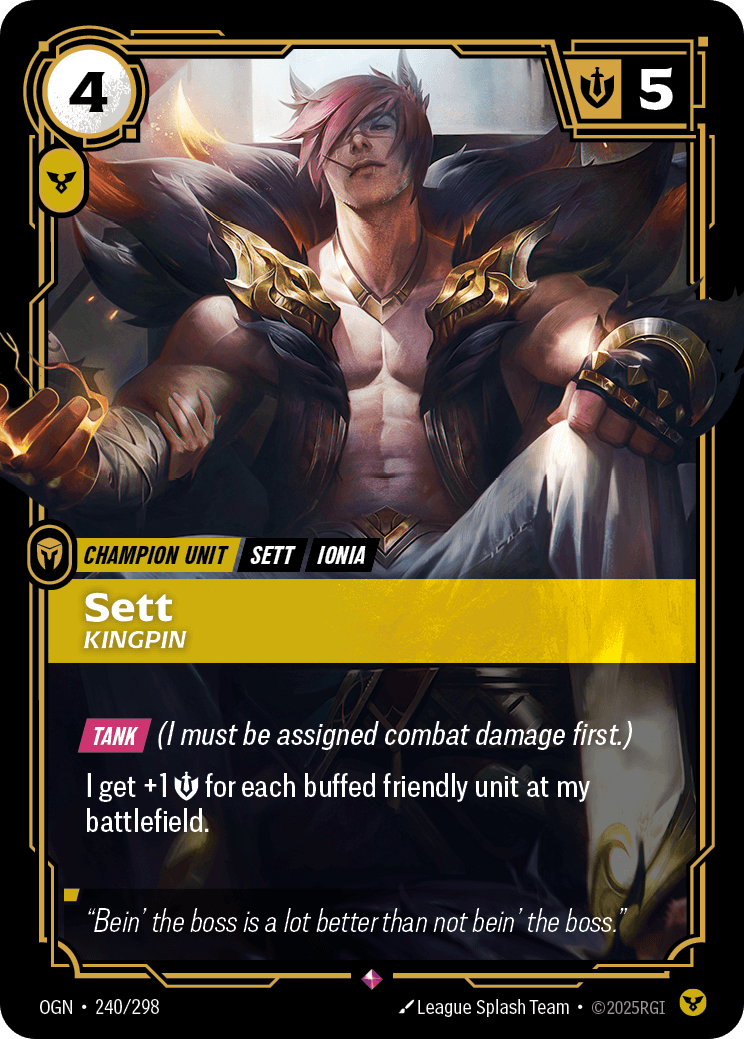
Order Legend
Sett - Kingpin
Kingpin has Tank and grows with every buffed unit beside him, so he soaks your combat and shields the real payoffs.
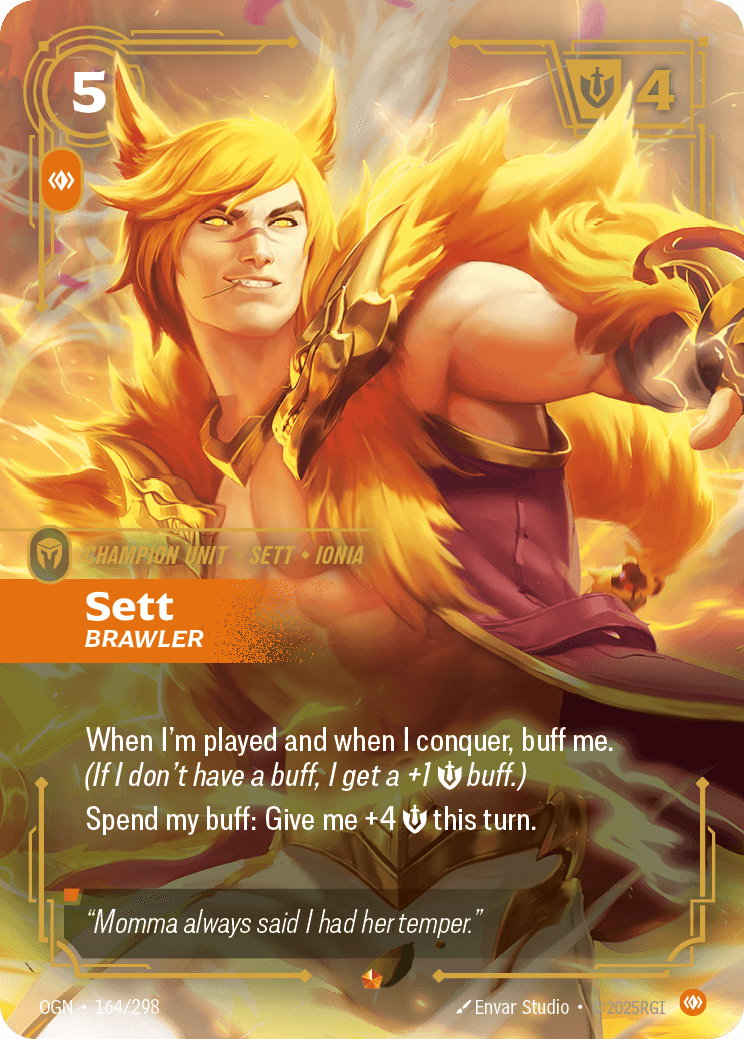
Body Legend
Sett - Brawler
Brawler buffs on play and on conquer, then spends the buff for +4 Might, so blocking him small usually just feeds a bigger swing.
Sett combines three things that are individually annoying and collectively hard to beat:
- Cheap buffs that make every unit sticky.
- A legend that turns your removal and your winning combats into recycled units.
- Tank and buff-scaling bodies that make the battlefield you most want to contest the worst one to fight on.
The format's faster, removal-heavy decks should in theory punish a slower board-holder. In practice Sett is the deck that punishes them, because removing a buffed unit is the plan he is built to beat. Here is the mechanical truth to internalize. Sett - The Boss reads: if a buffed unit you control would die, you may pay a rainbow rune, exhaust Sett, and spend that unit's buff to heal it, exhaust it, and recall it to base instead; and when you conquer, ready Sett. So every buffed unit is protected once per Sett activation, the protection costs only a buff plus a rune, and conquering refreshes it.
The counter rule is simple to say and hard to execute: make Sett spend the save when it does not matter, then attack when he cannot make it.
What Sett Is Trying To Do
Sett is resilient midrange, not aggro. The deck is trying to:
- Deploy buffed bodies early off cheap buff enablers.
- Hold one or two battlefields and dare you to attack into buffed units.
- Use Sett - The Boss to recall dying buffed units instead of losing them, and reload buffs with his signature Showstopper.
- Grow Sett - Kingpin with each buffed unit at his battlefield while Tank forces damage into him first.
- Convert small, repeated edges into scored points while your removal accomplishes nothing.
So the matchup is not solved by 'kill the biggest thing.' Sometimes killing it is correct. Often it is exactly how Sett recycles the unit, readies his legend off the conquest, and comes back next turn with the same threat plus a fresh buff. Before every key turn, ask: if I win this combat, does the unit actually die, or does Sett just recall it? If the answer is recall, you are not winning the fight — you are paying for it.
Sett - The Boss And The One-Save-Per-Turn Rule
The single most important number in this matchup is one. Sett - The Boss must exhaust to save a unit, so absent extra effects he protects one buffed unit per activation. Conquering readies him, which is how the deck refreshes the save, but a Sett who has already exhausted and has not conquered this turn cannot make a second save.
This is your entire lever, and two truths fall out of it. First, a buffed unit is only invincible while Sett is ready and holds a rainbow rune — track both, because if Sett is exhausted or has no rune, buffed units die like anything else. Second, if you threaten two battlefields at once, one recall cannot cover both; force the choice, and the unit he does not save dies for real.
The losing line is throwing your best answer at a buffed unit while Sett is ready and holding a rune. You spend a card, they spend a buff and a rune, and the unit walks back to base fully healed. Do not fund the recall.
Sett - Brawler And The +4 Buff Swing
Sett - Brawler buffs himself when he is played and again when he conquers, and he can spend that buff to give himself +4 Might for the turn. He is the clearest example of why blocking Sett units 'small' backfires. Block him expecting a clean trade and he spends the buff for +4, wins the combat, and if he conquers he buffs again. You spent a unit, he kept his, and he is buffed for the next save.
Make Brawler's math bad before combat, not during it:
- Do not offer a block that only wins if Brawler has no buff to spend.
- Use Might reduction so +4 still loses, rather than trading a body that dies.
- If you must fight him, do it when Sett is exhausted so a dead Brawler stays dead.
- Attack elsewhere and make Brawler defend, so he cannot pick the buff-and-conquer sequence.
Sett - Kingpin Is The Wall You Should Not Punch
Sett - Kingpin has Tank, so he must be assigned combat damage first, and he gets +1 Might for each buffed friendly unit at his battlefield. In a deck built to stack buffed units on one battlefield, Kingpin is often the biggest thing on the board and the mandatory damage sink.
That is a trap for aggressive decks. You send attackers into his battlefield, Tank forces your damage into him, he is already huge from the buffed units around him, and your attackers die while Kingpin lives — meanwhile the buffed payoffs behind him never had to fight. Do not try to break his lane by force. Instead:
- Contest a different battlefield where no Tank body soaks your damage.
- Shrink the board around Kingpin so his +1-per-buffed-unit bonus collapses.
- Save real removal for Kingpin only when killing him opens a scoring lane, and only when Sett cannot recall him.
Showstopper Is The Signature That Reloads The Buff Engine
The card that keeps this matchup from settling is Sett - The Boss's signature spell, Showstopper. For one energy it buffs a friendly unit sitting in his base, moves that unit to a battlefield, and if the unit has no buff it gets a +1 Might buff on the way. That is the whole plan compressed into one card: it manufactures a fresh buffed body exactly where Sett wants it.
Read what that does to your counterplay. A base you thought was empty can suddenly reinforce a contested battlefield with a buffed unit, so the combat math you set up on your turn is not the math you fight. Every buff it hands out is also one more unit The Boss can later spend on a save, so the card feeds the offense and the recall at once. Play around it by not committing a combat that only wins if Sett's base stays empty, contest a second battlefield so a single reinforcement cannot cover both, and remember the buff it grants makes that new unit a save target the moment you try to kill it.
The Buff Enablers Fuel The Engine
Sett does not run out of buffs by accident. Body/Order shells lean on cheap buff enablers — spells and units that hand out buffs, replace themselves, and sometimes turn spent buffs into extra resources. The exact enablers change from list to list, so do not counter a specific card; counter the pattern.
Treat those as the resource turns they are. When a buff-loading turn happens, the opponent is stocking multiple saves and multiple payoffs at once. That is usually the turn you want to have already applied pressure elsewhere, so the buffs go toward defense rather than a free scoring push. This is a good place to open the card database and search for Might reduction, damage prevention, and cheap bodies that let you contest a second battlefield without overcommitting into a Tank wall.
Showdown Combat Tricks Change The Math
Body has access to burst Might at showdown speed. Paired with a Showstopper that drops a fresh buffed body into the lane, it means the buffed board you are looking at is not the board you will fight. Do not commit a combat as if the visible Might numbers are final. Assume a key Sett unit can gain a sudden chunk of Might during the showdown, and assume a fresh buffed unit can be pushed into the battlefield you are pressuring. If your entire line only works when Sett has no trick, you are gambling, not playing the matchup. The rule mirrors the whole guide: if your plan loses to one cheap trick, make Sett spend that trick on a low-stakes exchange first.
Deflect And Untargetable Threats Tax Your Removal
Two patterns specifically punish targeted removal. Body/Order lists can run gear that grants friendly units Deflect, so you must pay a rainbow rune to choose them with a spell or ability, and they can run threats that cannot be chosen by enemy spells and abilities at all — once buffed, those are answerable only in combat. If your Sett plan leans entirely on targeted removal, these turns blank you exactly when you most want an answer.
Your counterplay:
- Keep some non-targeted answers: combat, board-wide Might reduction, or damage-based lines that do not need to choose.
- Attack a second battlefield so an untargetable threat cannot be everywhere.
- Remember that temporary gear is a single-turn window, not a permanent shield — race it rather than trying to out-answer it.
Turn By Turn Counter Plan
Turns 1-2: Deny The Free Buff Turn
Your first job is to make Sett answer something instead of freely developing buffed units. A hand that does not threaten or contest early lets the buff enablers set up unopposed. You do not need to overcommit; you need Sett to spend resources on defense before his recalls are online. If he buffs and holds while you build nothing, you are handing him the board-centric game he wants.
Turns 3-4: Bait The First Save
This is where the matchup usually turns. Somewhere here Sett - The Boss comes online and buffed units become sticky. Attack in a way that forces his one save, ideally on a unit that does not matter much, and ideally when he is not conquering to ready himself. Once Sett is exhausted and his rune is spent, the buffed board is briefly killable — that is your window. Do not blow premium removal into a ready Sett holding a rune; spend it after the save is gone.
Turns 5-6: Attack The Battlefield He Cannot Cover
If you made Sett spend a save, split your pressure. One recall cannot protect two battlefields, and a single Showstopper can only reinforce one lane at a time. Present a real threat at a second location and let the recall economy break. The best anti-Sett games are not pure control; they are games where Sett has to choose which unit to save, and the other one dies for good.
Late Game: Do Not Let Recursion Grind You Out
If the game stretches, Sett's edge grows, because every conquest refreshes the save and buff-fueled card draw keeps the buffs flowing. Do not drift into a long game where Sett recalls a unit every turn. Keep a clock, and make sure the tapped-out turns you create convert into scored points, not just clean combats.
Mulligan Guide Against Sett
Keep hands that can do at least two of these:
- Contest an early battlefield so the buff turn is not free.
- Threaten a second battlefield to break the one-save-per-turn rule.
- Reduce Might or prevent damage instead of only offering trades that feed the recall.
- Fight through a Tank body without throwing away your whole board.
- Close the game on a turn when Sett is exhausted.
Ship hands that only kill one big unit and call it a plan. A pile of single-target removal with no way to break two saves or pressure two battlefields is exactly what Sett wants to see. The ideal keep is not the most explosive hand; it is the hand that makes Sett's first buffed turn cost something and gives you a second angle he cannot recall away.
Sideboard Framework Into Sett
If you use a sideboard, build a real plan instead of a pile of maybes. A role-based first draft:
- Two cheap contest cards that let you pressure a second battlefield before the saves come online.
- Two Might-reduction or non-lethal answers that strip a buff or shrink a unit without funding the recall.
- Two ways to fight through Tank on Sett - Kingpin without sacrificing your whole board.
- One non-targeted or overkill answer for Deflect turns and untargetable threats.
- One clock or reach card so the tapped-out Sett turns convert into a finish.
The big warning: do not overboard into slow, single-target removal. Every extra 'kill their unit' card is a card Sett is built to recycle. You want answers that beat the save, not answers that feed it.
Matchup Plans By Archetype
Aggro And Pressure Decks
You are not trying to punch through Kingpin's battlefield. You are spreading damage across two battlefields so his one recall cannot cover both. Make Sett defend, make him spend the save early, and count a possible showdown trick before you swing. If all your pressure lands in one lane behind a Tank body, you are attacking the exact wall Sett wants.
Midrange Decks
You can play the cleanest game, but you also risk trading one-for-one forever while Sett recycles everything. Your threats need to force saves and then punish the exhausted turn. Prefer Might reduction and combat over spot removal, since your removal is the resource Sett is best at neutralizing.
Control Decks
Do not pretend the matchup starts on turn six. If you sit back, Sett buffs, holds, and grinds you out with recursion and card draw. You need early speed bumps and a real clock. Non-targeted sweepers and board-wide Might reduction are worth far more than a stack of single-target answers a recall undoes.
Combo And Engine Decks
Buy one clean setup turn without letting Sett own the board. Interact while developing. If you spend the early turns doing nothing, Sett builds a buffed wall and forces you to combo through Tank, Deflect, and the save engine.
What To Test On RiftStorm
This guide should become reps, not just reading. Use Riftbound Counters to map Sett against the rest of your expected room, and compare public shells in Riftbound decks. In the deck builder, build two lists: your real deck and a Sett test list around Sett - The Boss, Sett - Brawler, Sett - Kingpin, Showstopper, and a set of buff enablers. Then play only the turns that matter: the turn Sett makes his first save, the turn you try to break two battlefields at once, and the turn you close while he is exhausted. Use the card database to search Might reduction, damage prevention, non-targeted answers, cheap contest units, and Tank-breakers, then save the tuned copy before you publish your own counter list.
Common Mistakes Against Sett
- Killing a buffed unit while Sett is ready and holding a rune, funding the recall for free.
- Attacking into Sett - Kingpin's battlefield and feeding a Tank body that soaks all your damage.
- Trading small into Sett - Brawler and eating the +4 buff swing plus a conquer.
- Ignoring Showstopper and letting a buffed reinforcement flip a combat you had already counted as won.
- Committing combat before a showdown trick and losing to a Might burst you did not count.
- Leaning entirely on targeted removal into Deflect gear and an untargetable threat.
- Playing one battlefield so the one-save-per-turn rule never gets stressed.
If you fix only one habit, fix this: stop spending removal into a ready Sett. Spend it when he cannot make the save.
Practice Checklist
Before you call your Sett matchup ready, answer honestly:
- Can your deck contest a second battlefield to break the one-save-per-turn rule?
- Do you know exactly which of your answers beats the save instead of feeding it?
- Can you fight through Tank on Kingpin without giving up your whole board?
- Do you track whether Sett is ready and holding a rainbow rune before you commit removal?
- Are you accounting for Showstopper reinforcing a lane after you commit combat?
- Can you close the game on the turn Sett is exhausted?
Bottom Line
Sett is a resilient Body/Order midrange deck because he makes your removal and your winning combats into recycled units. He buffs early, holds battlefields, saves dying units with The Boss, reloads with Showstopper, and grinds small edges into points. You beat him by making the save expensive and rare: contest early so the buff turn is not free, spread pressure across two battlefields so one recall cannot cover both, reduce Might and prevent damage instead of feeding the recall, bait Sett into exhausting, then attack when he cannot save. Respect Kingpin's Tank, count the showdown trick, and never blow premium removal into a ready legend holding a rune. That is the difference between losing to the idea of Sett and beating the actual Boss across the table.