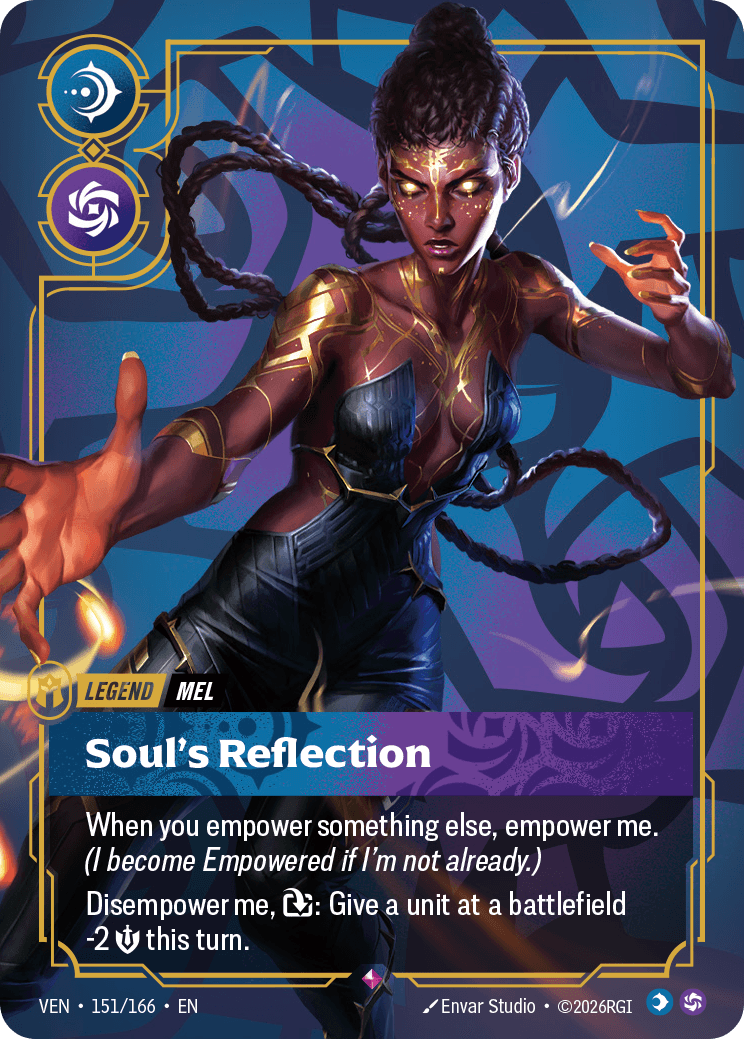
Mel plays like Mind/Chaos control — a deck that would rather bend your best combat by a point or two, protect its own key turn with a reaction, and grind you out once every fight is happening on its terms. She is worth learning early in Vendetta because that identity is stable even while the exact list is still settling.
A note on how we write this. Mel is new enough that her cards are not in our card database yet, and we have no verified current list for her — so we are not going to hand you a card-for-card 'package' we cannot stand behind, and we are not going to send you to someone else's site to go find one. What we can teach is durable: the kind of deck Mel is, what it is trying to do, and a counter plan keyed to mechanics that survive any list change. Build and test both sides in our deck builder, read exact card text in the card database as her cards are added, and pair this with adjacent matchups on Riftbound Counters.
What We Can And Can't Tell You
We do not have a first-party Mel decklist on record, and her cards are not yet in our own catalog. That is not a stub — it is the honest state of a brand-new legend. For the format-legality picture that governs every Mel list, read Riot's official rules and ban updates.
Here is why that honesty helps you. A counter plan built on 'Mel always runs these cards' rots the instant the list shifts — and for a legend this new, the list is going to shift. A counter plan built on 'here is what a Mind/Chaos control engine is trying to do to you, and here is how to break it' keeps working. This guide is the second kind.
What Mel Is Trying To Do
Across the table, Mel plays like a control engine, not a beatdown deck. It wants to:
- Spend the early turns setting up rather than racing, then start turning ordinary plays into value.
- Shave your combat math at the scoring moment, so the attack you planned comes up a point or two short.
- Hold a reaction to protect the one turn that actually closes, and punish you for tapping out into it.
The deck is dangerous because those jobs overlap. It is not trying to win every fight on raw stats; it is trying to make your planned fight fail by the smallest margin at exactly the wrong time, then bury you in the value that margin buys. If you only ask 'can this kill my unit,' you miss the matchup: it is tempo and timing, not raw removal.
The Mel Counter Rule
Make Mel answer the board before Mel is ready to answer your spell.
A slow opening lets a control deck develop, get its engine humming on a safe turn, and sit behind an open reaction while it shrinks the unit you needed to score. Your first job is to make Mel spend resources on the battlefield. Your second is to pick a scoring turn where one reduction effect cannot erase the whole attack.
How To Beat Mel
1. Pressure Before The Engine Comes Online
Keep an early unit that can contest a battlefield on its own. Control decks are strongest when the first turns are free — spent selecting cards, assembling an engine, or holding interaction while you do nothing. A cheap body forces Mel to spend a setup card on defense or accept a contested battlefield before she is ready. Pressure is not overextension, though: you want two real battlefield questions, not one pile of small units a single sweep or reset can erase.
2. Respect The Reaction Window
Mel's plan leans on holding up a reaction to counter or steal your key spell. Treat an open, untapped Mel as a trap. Lead with units and non-spell pressure so any reaction she holds has to be spent on something that is not deciding the game, or test the window with a cheap spell first. When you must cast the spell that matters into an open window, make sure it either changes the score immediately or leaves your board functional if it is answered. The goal is not to stop casting spells — it is to stop handing Mel a free two-for-one on the exact turn you need to convert.
3. Don't Trust Printed Might
A control deck like Mel wins a lot of games by turning your winning attack into a losing one with a small reduction at showdown. Count on it. Whenever you can, attack with enough total Might that shaving a point or two does not flip the exchange, and spread pressure across battlefields so one reduction effect placed in one lane cannot cover the whole map. If you are relying on a single large attacker, make sure the attack still scores after it shrinks, and never assume the printed number is the combat number.
4. Don't Overload One Lane With Small Bodies
Control engines love a scoring lane made entirely of small, interchangeable units — it is the cheapest thing to answer and the easiest to erase with a single effect. Present at least one threat that stands on its own, or make the small units expendable before the answer comes. If your best board is a row of fragile bodies, the deck can remove the exact piece that made your attack work without giving you a fair fight.
5. Use Board Pressure To Break The Control Posture
Mel wants to hold interaction while you walk into it. The best counter decks keep asking questions on more than one battlefield and force her to choose between developing her engine, leaving up her reaction, and defending the score. If she spends a turn setting up without protecting the second battlefield, take that window. If she passes with resources open, threaten a low-cost line first and make her premium answer matter only after she has shown where the real fight is.
Mulligan Guide Against Mel
Keep hands that do at least two of these:
- Contest a battlefield in the first two turns without needing a spell to survive.
- Present pressure on a second battlefield by the midgame.
- Hold one flexible answer that works on a unit, a spell window, or the scoring turn.
- Keep a follow-up threat live after a reaction or one reduction effect.
- Win a fight after your Might is shaved, rather than relying on exact math.
Ship hands that are only expensive answers, only narrow tech, or only one slow threat. A reactive hand that never develops gives a control deck free setup turns and lets its reaction trade up.
Turn-By-Turn Counter Plan
Turns 1-2: Make Mel React
Claim a battlefield or make Mel spend a card to contest it. Don't passively sculpt your hand while a control deck sets up — a slow opening is exactly the gift it wants. Develop units first when possible, and don't expose your only fragile scoring body to an obvious removal line.
Turns 3-4: Find The Real Scoring Turn
This is the setup checkpoint. Read whether Mel's engine is online, whether she is holding a reaction, and which battlefield actually scores. Pressure the second lane so one exhausted effect or one shrink cannot cover the whole map. If she is forced to spend her reaction on a low-value spell or a unit on defense, convert immediately.
Turns 5-6: Keep Threats Layered
If you dump your whole finish into one lane, a control deck's reset and reduction become perfect. Keep threats layered so one effect can't erase your pressure. If a grindy plan is forming, ask whether you can close before the lock; if not, hold disruption for the actual closer rather than another small spell.
Late Game: Don't Let Value Become Inevitability
Late Mel wins by making every turn awkward — you attack, your unit shrinks; you hold back, she develops and draws; you overcommit, a reset punishes you. The way out is repeated battlefield questions: make Mel answer a real board every turn and keep one answer for the key unit. If you stop asking questions, her card flow buries you.
Common Mistakes Against Mel
- Keeping a hand with no early board presence, and handing a control deck free setup turns.
- Casting your most important spell into an open, untapped Mel.
- Trusting printed Might and walking a winning attack into a reduction.
- Building a scoring lane out of small, interchangeable bodies.
- Attacking only one battlefield, so a single effect covers everything.
- Boarding narrow tech that does nothing when Mel just draws ordinary Mind/Chaos tools.
Practice Checklist
Before you call the Mel matchup ready, answer honestly:
- Can your opening hand affect the first meaningful battlefield?
- Can you pressure two battlefields without overextending?
- Can your key spell resolve without giving an open reaction a clean two-for-one?
- Does your attack still score after a point or two of reduction?
- Can you keep pressure after the first reset or shrink?
Build And Test On RiftStorm
Everything here is buildable with our own tools:
- Read exact card text in the card database as Mel's cards are added to our data.
- Clone a shell in the deck builder and goldfish the counter plan.
- Compare community lists in Riftbound decks.
- Pair this with adjacent matchups on Riftbound Counters.
If you open one of our counter shells, treat it as a RiftStorm testing shell — a starting point built from card roles, not a tournament decklist — and tune it against what you actually see.
Bottom Line
Mel beats you by making every turn awkward and every fight a little worse than it looked. Beat her back by pressuring the board before her engine is online, respecting the reaction window, refusing to trust printed Might, and keeping enough width that one reduction can't decide the game. That plan holds even as her exact list settles — which is exactly why we wrote it this way. As soon as Mel's cards are in our database, we will teach her kit card-by-function right here; until then, we would rather give you the durable plan than invent a package.