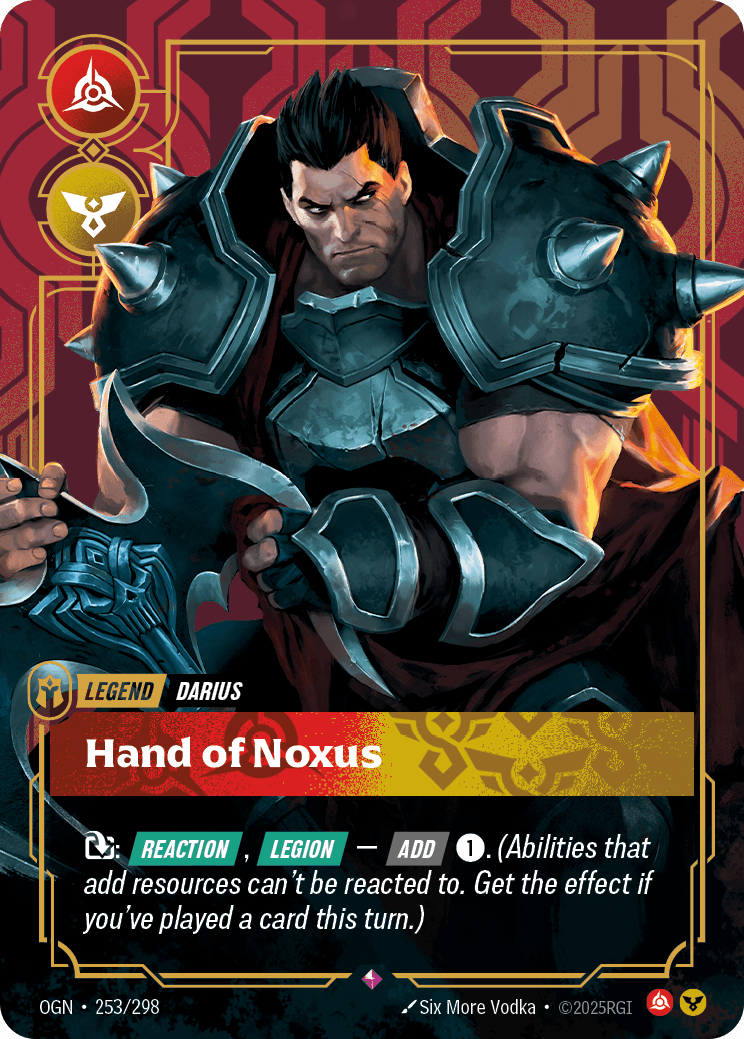
Rengar is Fury/Body midrange pressure — a deck that wants every combat to happen on its terms, leaning on reaction-speed units and a legend that quietly hands out Might so the fight you thought you understood tilts at the last second. It stays a first-shelf counter target in Vendetta because that identity is stable even when the exact list moves.
A note on how we write this. We don't hand you a card for card Rengar 'list' we can't verify from our own current data, and we don't send you to someone else's site to find one. What we give you instead is durable: the gameplan Rengar is running, the cards in its kit and what they do, and a counter plan keyed to mechanics. Read any card's exact text in the card database, build both sides in the deck builder, and pair this with adjacent matchups on Riftbound Counters.
What We Can And Can't Tell You
Rengar is one of our A-tier pressure matchups — a repeat converter, not a one-week story. But we do not have a verified current Rengar decklist on record, so we will not dress up a guessed package as 'the deck.' A counter plan built on 'Rengar always runs these 40 cards' rots the moment the list shifts. A counter plan built on 'here is what Rengar is trying to do, and here is the kit that punishes loose play' keeps working. This guide is the second kind. Build and test your own read in the deck builder.
What Rengar Is Trying To Do
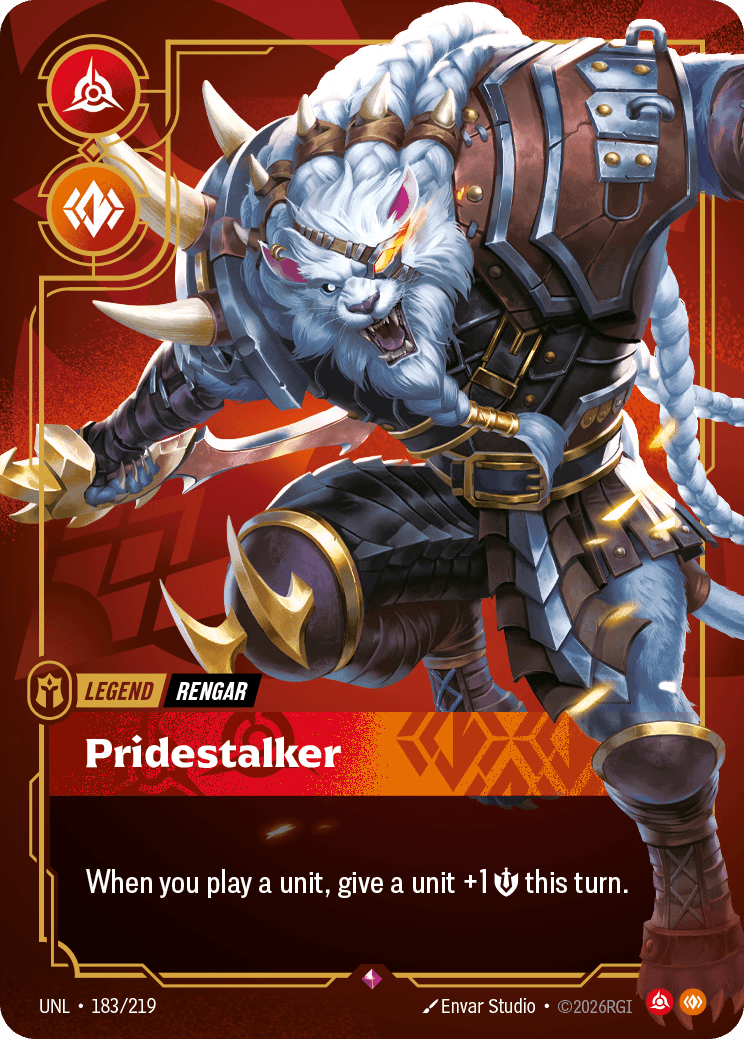
Fury/Body Legend
Rengar - Pridestalker
Rengar's legend hands a unit +1 Might for the turn every time he plays a unit, so the Might you see is never the Might you fight.
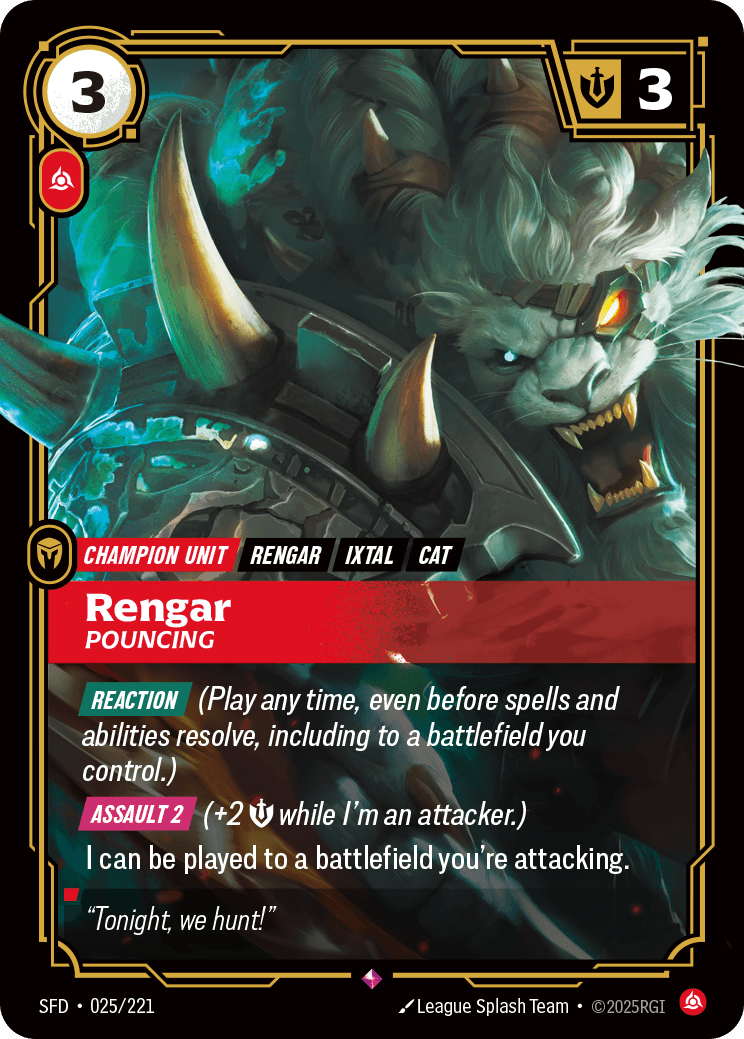
Fury Legend
Rengar - Pouncing
A Reaction with Assault that can be played to a battlefield you're attacking — an extra attacker that shows up mid-combat instead of ahead of it.
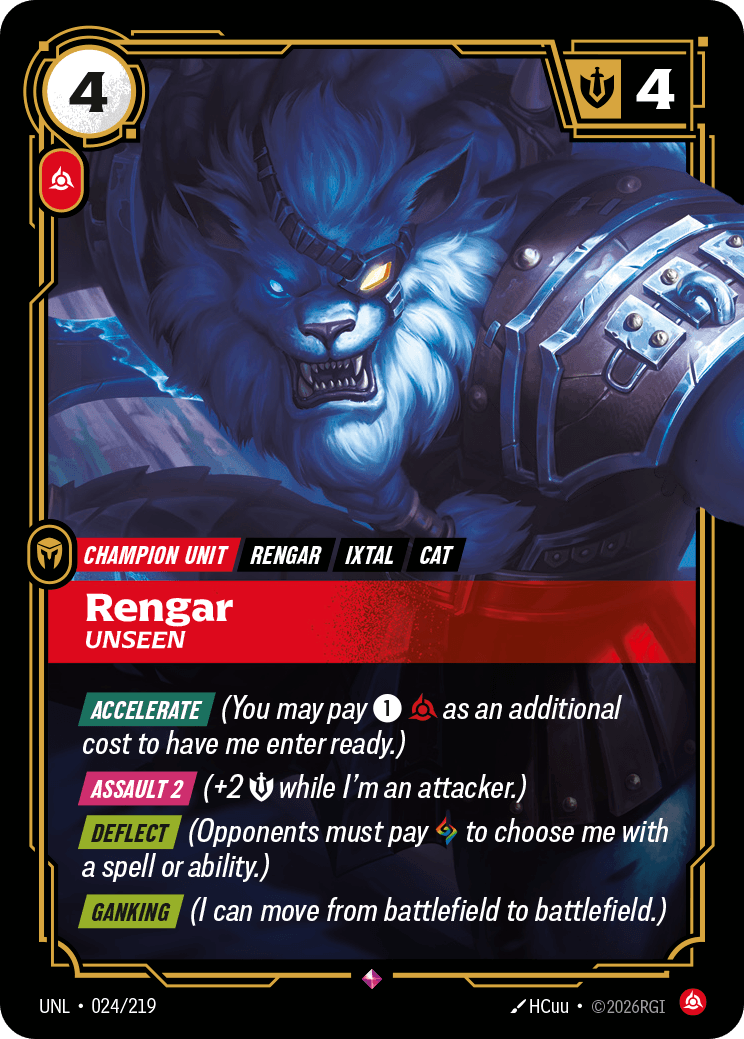
Fury Legend
Rengar - Unseen
Accelerate, Assault, Deflect, and Ganking on one body: it enters ready, hits harder attacking, taxes your removal, and moves between battlefields.
Body Legend
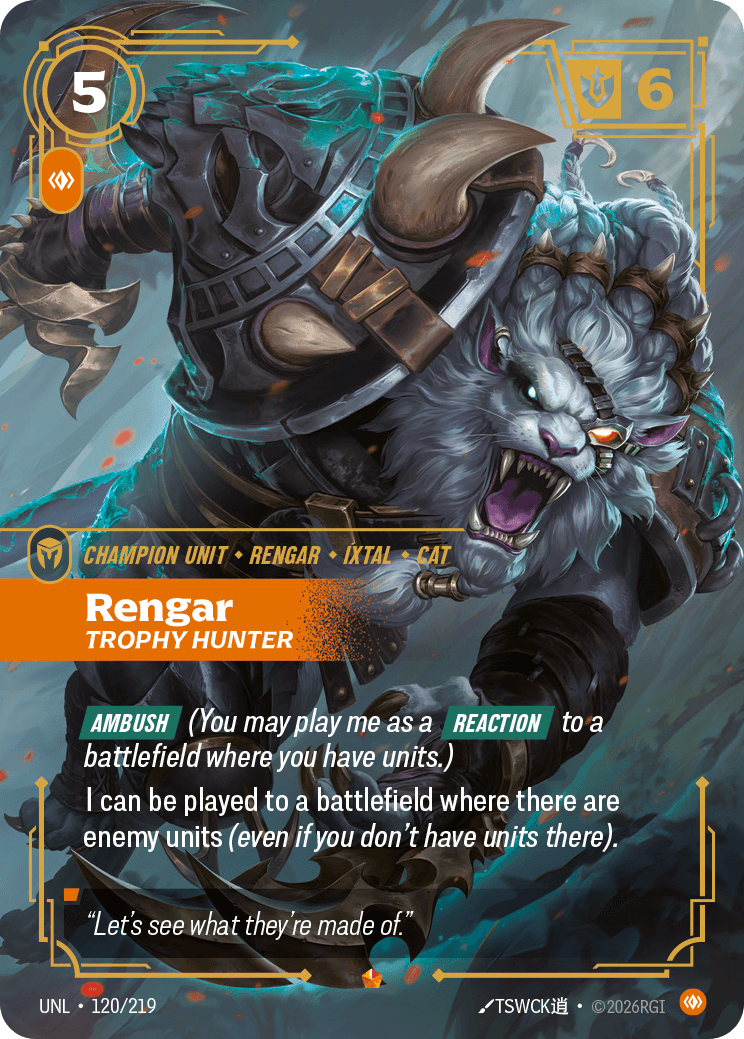
Rengar - Trophy Hunter
Ambush lets it appear where your units already stand, so count it before you commit an important attack.

Fury/Body Legend
Thrill of the Hunt
A Reaction that banishes a friendly unit and replays it to any battlefield for free — the sudden reposition that moves pressure to the lane you left open.
Rengar is not generic aggro. It is a Fury/Body pressure-midrange shell that wants to:
- Make the first relevant exchange clean, so its units survive and score.
- Convert reaction-speed bodies and temporary Might into fights you cannot profitably block.
- Compress the game onto one battlefield where a single surprise unit or pump decides everything.
The legend text is the engine. When the Rengar player plays a unit, they give a unit +1 Might for the turn. Every unit is therefore a potential combat trick, and the trick is worst when the unit arrives at reaction speed or moves to the battlefield that actually matters. If your read on a fight only counts the Might already on the table, you are already a step behind.
Rengar's Kit — What To Respect
These are the cards in Rengar's kit: the legend-locked pieces the deck is built around. Naming them is not the same as claiming a given list runs a specific count of each — kits vary list to list — so respect them for what they do, and confirm the exact wording in the card database.
- Rengar - Pridestalker gives a unit +1 Might for the turn each time the Rengar player plays a unit. That is why the visible board is never the whole story.
- Rengar - Pouncing is a Reaction with Assault that can be played to a battlefield you are attacking. It arrives mid-combat as an extra attacker, not a telegraphed one.
- Rengar - Unseen stacks Accelerate, Assault, Deflect, and Ganking, so it can enter ready, hit harder while attacking, tax your removal, and move between battlefields. It is the piece that makes the map feel unstable.
- Rengar - Trophy Hunter has Ambush and can be played to a battlefield where your units already stand. It is the reason to stop counting only the bodies already on the table before an important attack.
- Thrill of the Hunt is a Reaction that banishes a friendly unit and replays it to any battlefield, ignoring its cost. It is a sudden reposition or protection turn — the card that moves pressure to the lane you left open.
The Rengar Counter Rule
Do not let Rengar choose the only meaningful battlefield. Rengar is at its best when the whole game compresses into one clean fight, because that is where an Ambush body can appear, a reaction-speed attacker can join, a unit can Gank across, and the legend pump can turn one extra body into a scoring swing.
The rule is simple to say: make Rengar spend pressure before it becomes a score. That usually means contesting early, but not with a line that loses to one surprise unit. Force the Rengar player to commit first when you can. If you make a reaction-speed unit protect a mediocre battlefield instead of steal the real one, you are already improving the matchup.
How To Beat Rengar
1. Make The First Trade Matter
Rengar wants the first relevant exchange to be clean. If its first unit survives, scores, or forces you into an awkward answer, every later battlefield gets easier for the Rengar player. Your early cards should either block profitably or pressure a second lane. A body that only stands in the obvious battlefield and dies to a pumped attacker is not enough — you want plays that force Rengar to decide whether the pump attacks, defends, or holds tempo.
2. Respect Reaction-Speed Units
A Reaction attacker can appear on a battlefield you are already fighting over, and an Ambush unit can land where your units already stand. Those two patterns are the reason to stop counting only the units already on the table. Before every important attack, ask what happens if one extra Rengar body appears. If that single body flips the score, your line is too fragile.
3. Don't Waste The Real Answer
The best answer is usually not the first answer you can spend. Rengar wins when you burn interaction on a medium-pressure unit and then lose to the follow-up that actually converts the battlefield. Hold hard removal, a stun, a recall, a bounce, or an exhaust for the turn that changes the score. If you can handle the first pressure card with a normal block or lower-value interaction, do that, and save the clean answer for the Ambush, movement, or reposition window.
4. Force Rengar To Defend
Rengar is much easier to beat when its units have to block. The pump and the reaction pieces are at their best on the attack; they do far less when Rengar is the one defending a scoring lane. Present a second battlefield question. If Rengar must choose between protecting its own lane and stopping yours, the surprise-unit math stops being clean.
Mulligan And Game Plan
Mulligan
Keep hands that do two jobs early: contest the first battlefield and still hold one flexible answer. A hand with only late cleanup is too slow. A hand of small bodies with no answer to the first Ambush turn is also risky. Prioritize:
- Cheap battlefield bodies.
- One efficient answer or tempo reset.
- A way to pressure a second battlefield.
- A follow-up threat that still matters after the first exchange.
Ship hands that need Rengar to stumble. If your first meaningful play happens after Rengar has already forced the first score window, the hand is not good enough.
Early Game
Contest immediately, but do not hand over the clean punish. Make Rengar spend a unit, a pump, or a Reaction to get through the first battlefield. If your early play forces a reaction-speed unit to be used as a plain tempo card instead of a surprise scorer, that is a good exchange.
Mid Game
This is the dangerous stretch. Count open resources and assume Rengar can add a body or move pressure after you commit. The plan here is to identify the battlefield that actually scores and spend your best answer there, not on the first annoying unit.
Late Game
Do not assume the matchup gets easy just because you survived the opening. Rengar can still steal one last fight with an Ambush, a Gank, or a free reposition. Keep a stabilizing body or a flexible answer ready until the score is actually secure.
Sideboard Framework Into Rengar
If your event uses sideboards, note the current constructed limit of up to ten sideboard cards in Riot's tournament rules update. Build a real plan rather than a pile of maybes. A role-based first draft:
- Two cheap contest cards that matter before the first Ambush turn.
- Two tempo resets such as a stun, exhaust, recall, or bounce.
- Two efficient answers for the reaction-speed and Ambush pieces, or for whichever unit is carrying the pump turn.
- One recovery card for games where the first exchange still goes badly.
- One flex slot for your local room, especially if the Rengar decks skew more aggressive or more midrange.
Do not board into a hand full of slow answers. Rengar punishes the gap between drawing the answer and having time to use it.
Matchup Plans By Archetype
Aggro And Pressure Decks
Make Rengar spend resources defensively. Do not race blindly; force it to answer a battlefield before its best setup turn is ready, and keep one cheap interaction piece for the first swing that would actually change the score.
Midrange Decks
You usually have the cleanest counter tools, but you can still lose by trading too fairly. Identify the card carrying the turn, hold the premium answer for the payoff, then turn the corner immediately instead of passing back with no pressure.
Control Decks
Do not keep hands that only become good after the board is already stable. You need early speed bumps, one efficient answer, and a plan to stop the card that turns Rengar's setup into repeated points.
Engine And Combo Decks
Buy one clean setup turn without giving up the whole map. If your engine takes time, pair it with early contest bodies or cheap disruption so Rengar cannot choose every fight before your payoff is live.
Common Mistakes Against Rengar
- Counting only visible Might and ignoring the legend pump.
- Attacking as if Rengar cannot add a reaction-speed unit.
- Spending premium removal before the real score turn.
- Fighting only one battlefield and letting Rengar choose the perfect fight.
- Keeping slow hands because they look powerful later.
- Forgetting that a free reposition can change both timing and battlefield position.
Testing Checklist
Run a few focused games before calling the matchup solved:
- Can your opening hand affect the first meaningful battlefield?
- Which Rengar card forces your first bad trade, and do you have an answer to it?
- Does your best answer work before points are scored, or only afterward?
- Can you pressure a second battlefield while holding interaction?
- Which flexible answer survives an Ambush or a reposition and still matters?
Build And Test On RiftStorm
Everything here is buildable with our own tools:
- Search Rengar's kit in the card database to read exact wording, and look up the keywords it leans on: Ambush, Assault, Deflect, Ganking, and Accelerate.
- Clone a shell in the deck builder and goldfish the counter plan.
- Compare community shells in Riftbound decks.
- Pair this with adjacent matchups on Riftbound Counters.
If you open one of our counter shells, treat it as a RiftStorm testing shell — a starting point built from card roles, not a tournament decklist — and tune it against what you actually see.
Bottom Line
Rengar beats you by making the visible board a lie: a pump you didn't count, a Reaction you didn't see, an Ambush where you thought you were safe. Beat it back by making the early turns expensive, refusing isolated battlefield fights, forcing pressure across more than one lane, and saving your clean answer for the burst or reposition window that actually changes the score. That plan holds even as the exact list moves — which is exactly why we wrote it this way.