This guide combines Riot's official rules and card information with the first public tournament evidence. Use the results to choose a testing lane, then use the rules sections to keep that list legal and sequence Vendetta's new mechanics correctly.
Vendetta At A Glance
- Tournament-rules update: effective July 24, 2026
- First tracked Vendetta Constructed events: July 25–26
- English and Simplified Chinese physical release: July 31, 2026
- French physical release: October 23, 2026
- Numbered base set: 166 cards
- Headline mechanics: Flow, Burn and Empower
- Additional designs: a six-card Decree cycle and Riftbound's first Unit-Gear
- New Legends: nine, including the game's first three opposing-Domain Legend identities
- Official preconstructed decks: Shen, Eye of Twilight and Zed, Master of Shadows
The complete visual set and both ready-to-copy official lists live on the RiftStorm Vendetta hub.
What The First Vendetta Results Actually Say
The opening samples reward curiosity more than certainty. Four events produced four different winning Legends, and several heavily played decks failed to convert in one event before succeeding in another. That is normal for a new set.
NovaRiftbound Online $2K — Azir Wins A 109-Player Field
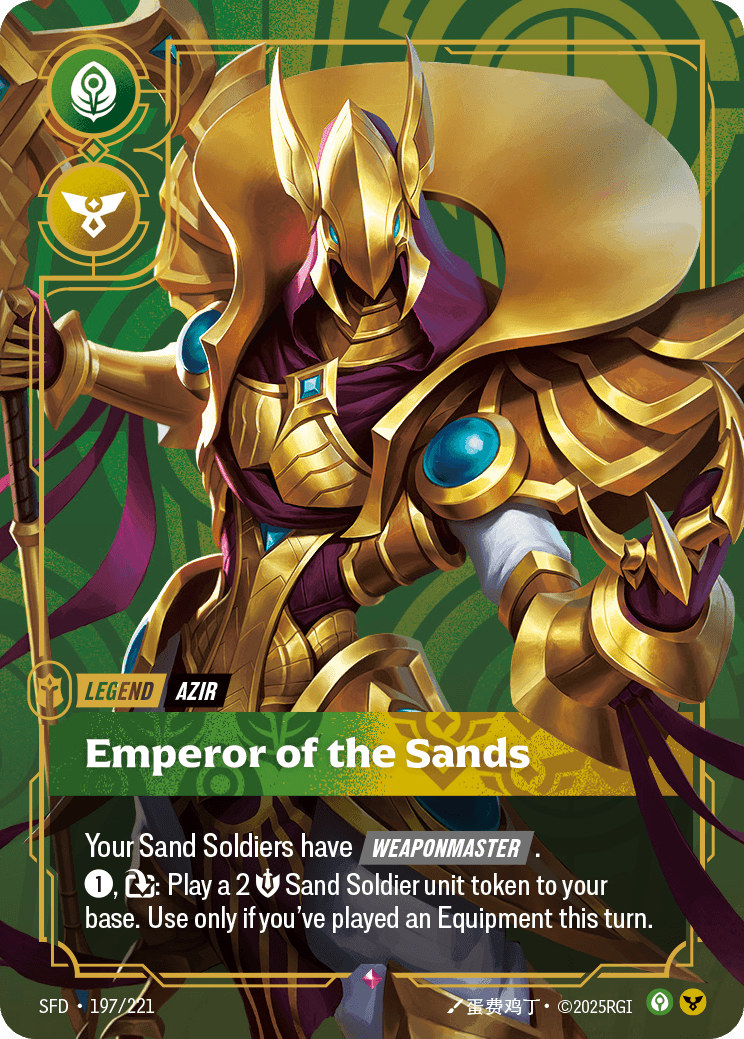
The July 26 NovaRiftbound TCGArena Online $2K Showdown #3 reported 109 players and 93 public decklists. Azir, Emperor of the Sands won as the field's only Azir deck. The Top 8 contained eight different Legends: Azir, Kai'Sa, Kennen, Ezreal, Master Yi, Irelia, Rek'Sai and Viktor.
That is excellent evidence that Azir's exact list deserves testing. It is not evidence that Azir was the most popular deck or that the matchup field has settled. Build the Azir engine in our deck builder, read each gear piece's exact text in the card database, and plan the matchup from the other side with our Azir counter guide.
China Versus World — Diana Wins, Kennen Misses Top 8
The July 25 Sideways Showdown CN vs World had 32 players. Diana defeated Lux in the final. Kennen was the most represented Legend at seven decks, roughly 21% of the field, but placed no copies in the Top 8.
This is a useful warning against treating popularity as conversion. Kennen still has real Flow potential, but pilots need a proactive battlefield plan when the trash engine does not line up perfectly. Build a proactive Kennen shell in our deck builder and prep the matchup with our Kennen counter guide.
Nightcup And Mardi — Nasus And Annie Break Through
The July 27 Nightcup League Cup #1 published all 47 lists. Nasus won over Jayce, with Renekton, Ezreal, two Kennen decks, Viktor and Ambessa completing the Top 8. One day later, the 30-player Mardi Championship #1 was won by the event's only Annie deck; Irelia finished second and also put another list in the Top 4.
Together, those events suggest that Vendetta rewards both new engines and tuned legacy pressure. They also show why a weekly snapshot matters: Kennen followed a missed Top 8 with two Top 8 finishes, while Irelia's performance swung sharply between events. Treat those Nasus and Annie finishes as reasons to test the shells in our deck builder, not as permanent rankings.
For matchup planning against this wider field, use the current Riftbound counter-meta guide.
The Three Mechanics, Precisely
Flow Turns The Trash Into A Second Hand—Once
Flow appears on spells. You may pay a spell's alternate Flow cost to play it from your trash, and that spell is banished after it resolves. The banish clause matters: Flow is recursion, but it is not an endless loop unless another effect specifically recovers the banished card.
A good Flow deck needs useful spells, reliable ways to put them into the trash and turns where the alternate cost creates a meaningful tempo advantage. Filling the trash is setup, not payoff. Kennen and Zed shells still need early units and a way to contest battlefields while assembling the engine.
Burn Is Self-Mill, Not Direct Damage
Burn X moves the top X cards of a Main Deck to its trash. It can stock Flow spells, enable trash-counting effects and fuel Zed's Shadow Clone plan. It also advances the deck toward running out of cards. Burn is resource conversion with a cost; it does not damage a player's score.
After a Burn effect, ask what it unlocked this turn or next. If the answer is vague, the effect may only have shortened your clock.
Empower Is A Persistent State
An effect can empower a unit, gear or Legend. The empowered state persists until the card leaves play or an effect disempowers it; each card's text explains what the state provides. Empower does not inherently add the same stats to every card.
Bounce and removal therefore matter against Empower decks. If an opponent invests multiple effects into one permanent, moving it out of play clears the state and can erase the setup.
Decrees And Unit-Gear
Vendetta includes one Decree spell for each Domain, with each designed to punish its opposite. Decrees are metagame tools rather than a universal keyword: strong when the target is common, narrow when it is not. Ten-card sideboards create room for these targeted effects without forcing every answer into the Main Deck.
Unit-Gear is Riftbound's first multi-type card. It counts as both a unit and gear when a rule or effect checks its type. Read the current full card text when resolving type-sensitive interactions instead of treating it as ordinary equipment.
The Nine Vendetta Legends
Akali, Rogue Assassin — Fury / Calm
Akali is an opposing-Domain Legend built around attacking, retreating toward base and reconquering. Her pilots need to plan movement routes across the battlefield map rather than measuring pressure only through raw Might.
Renekton, Butcher of the Sands — Fury / Body
Renekton recycles runes to generate an extra Energy burst. The first results show that explosive resource turns can compete, but the acceleration still needs to become battlefield tempo before a slower deck stabilizes.
Zed, Master of Shadows — Fury / Chaos
Zed connects Burn, discard, Flow, banishing and Shadow Clones. His official Showdown deck demonstrates the loop, making him the clearest starting point for learning Vendetta's trash economy.
Nasus, Curator of the Sands — Calm / Mind
Nasus rewards expensive cards, rune readying and Empower scaling. His Nightcup win is the first meaningful proof that the engine can survive a diverse field, though one trophy does not lock the optimal 40 cards.
Shen, Eye of Twilight — Calm / Order
Shen rewards paired defenses, Hidden cards and holding battlefields with exactly two units. His official list suits players who enjoy reaction timing, formation and precise combat math.
Jayce, Defender of Tomorrow — Mind / Body
Jayce is an opposing-Domain Legend centered on gear manipulation. His Nightcup runner-up finish makes the gear-combo lane more than preview hype, but its ratios and search lines remain less forgiving than a straightforward unit curve.
Mel, Soul's Reflection — Mind / Chaos
Mel supports spell-heavy control and shrinking opposing units. Her deck-building tension is balance: enough answers to control battlefields without drawing hands that react repeatedly but never establish pressure.
Ambessa, Matriarch of War — Body / Order
Ambessa is an aggressive Empower Legend that can ready units. She reached the first Nightcup Top 8, but each setup card still has to compete with the simple efficiency of developing another unit.
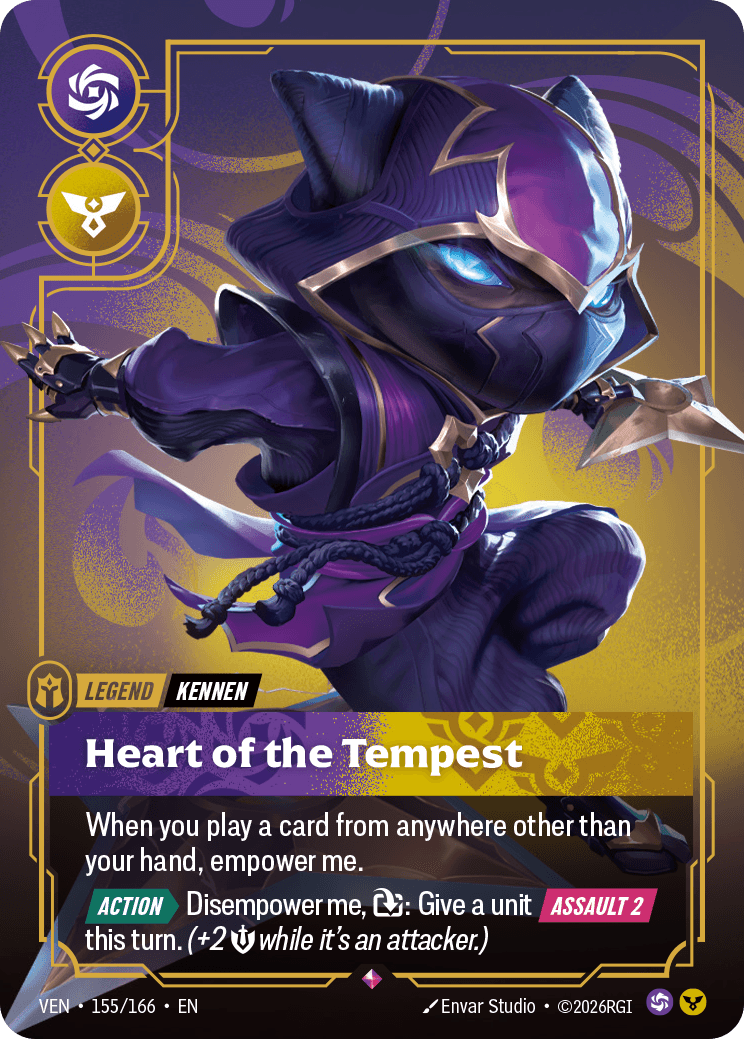
Kennen, Heart of the Tempest — Order / Chaos
Kennen is the set's strongest Flow signpost and the early popularity leader across several samples. Mixed conversion says the deck is real but sequencing-intensive: disciplined pilots must know when to bank trash value and when to fight immediately.
Two Official Decks You Can Sleeve Without Guessing
Riot published full Shen and Zed Showdown lists. RiftStorm transcribed the Main Deck, rune deck and battlefields and checked them against the July 24 construction rules and ban list. You can view and copy both exact decklists. Riot labels the included Champion cards as options; for tournament registration, designate one matching Champion Unit already inside the 40-card Main Deck. Do not add a forty-first card.
Zed — Flow Pressure
Zed's list uses Burn and discard to place useful cards in the trash, Flow to convert setup into tempo and Shadow Clones to keep contesting fields. Keep a playable early unit and a line that develops the trash without abandoning the battlefield. A hand full of clever Flow cards is not functional if it cannot establish a body.
Before a Shadow Clone attack, identify the unit you can banish and the field you expect to score. Treat Perfect Execution and Twilight Step as scoring tools rather than buttons to press at the first legal moment.
Shen — Hold Control
Shen's list builds battlefields in pairs, uses Tank and Hidden reactions to rewrite combat and converts successful holds into cards and points. Prioritize early units that let you develop in pairs. One expensive protector often does less for this plan than two bodies positioned to unlock exact-two-unit rewards.
Preserve Hidden cards for the fight or scoring window where zero-Energy interaction changes the outcome. Vendetta's official errata makes Resonating Strike a Reaction at any time, including before other spells and abilities resolve.
Current Standard Construction And Bans
Riot's July 24 tournament-rules update added Vendetta to Standard's legal set list, and tracked online Constructed events began using the set on July 25. English and Simplified Chinese physical product released July 31. Because product availability and event policy can vary by region, confirm the organizer's current rules before an in-person event.
A legal 1v1 Standard Constructed list needs:
- exactly one Legend;
- exactly 40 cards in the Main Deck, including the Chosen Champion;
- exactly 12 runes;
- exactly three battlefields with unique names;
- cards within the Legend's Domain identity;
- no more than three copies of a named Main Deck card across Main Deck and sideboard;
- a sideboard of zero to ten cards; and
- no currently banned card or battlefield.
Effective July 24, Standard bans Called Shot; Draven, Vanquisher; Fight or Flight; Scrapheap; Stealthy Pursuer; The Arena's Greatest; Aspirant's Climb; Dreaming Tree; Obelisk of Power; and Reaver's Row. Constructed 2v2 also bans the Master Yi, Wuju Bladesman Legend.
The official Showdown lists contain none of those cards. If you change either list, validate the exact export again; legality belongs to the registered cards, not the deck's name.
Vendetta Errata To Know
Three Vendetta cards have official launch errata: Astral Heron; Gangplank, Naval; and Resonating Strike. Riot's corrected text controls even when a physical English card shows older wording. Gangplank's Overnumber treatment also needs the corrected Pirate tag, while the Rival Overnumber Illaoi has corrected token wording.
Keep the official Vendetta errata page available at events. Current text is faster and fairer than resolving a printed-card disagreement from memory.
A Better First Ten Games
Do not rebuild after every loss. Use a short block that produces comparable information:
- Play three games with an unchanged proven or official list and record cards stranded in hand.
- Play three games against fast battlefield pressure and track whether your first unit arrived on time.
- Play three games against slower value and note which cards created a second useful action in one turn.
- Use game ten to test only three changes, not fifteen.
For Flow decks, record how often Burn found an actual payoff and how often the trash lacked the required card type. For Empower decks, note whether the setup survived interaction and whether its payoff scored a field. For legacy shells such as Azir, Viktor or Irelia, record which Vendetta additions improved an existing line rather than adding novelty without consistency.
The first results give us better baselines than launch-day guesses, but the core discipline is unchanged: test one hypothesis at a time and let repeated tournament conversion earn the next conclusion.
Official Rules Sources
For mechanics, legality, bans, and errata, go straight to Riot's official pages:
The tournament results in this guide — the Nova, Sideways, Nightcup, and Mardi finishes — are the public event record we used to pick testing lanes; we don't republish other sites' decklists or send you off to find them. Build and compare every list in our own deck builder, card database, and current public decks.