Viktor is not trying to out-tempo you. He is trying to make every trade you take slightly worse than the last, until you run out of clean answers and the Recruit tokens simply outnumber you.
That is the whole matchup. Viktor - Herald of the Arcane is a Mind/Order engine deck that manufactures 1-Might Recruit unit tokens from several angles at once, then uses cheap reactions and control tools to grind until the token count decides who owns every battlefield. Play it as a race and you lose to the interaction; play it as a grind and you lose to the tokens. The counter is to do neither, and instead hit the engine on the turns it is least defended.
A note on how we write this. We don't publish a card-for-card Viktor 'package' we can't verify from our own current data, and we don't send you to someone else's site to find one. What we give you instead is durable: the gameplan Viktor is running, the cards in his kit and what they do, and a counter plan keyed to mechanics. Read any card's exact text in the card database, build both sides in the deck builder, and pair this with adjacent matchups on Riftbound Counters.
What We Can And Can't Tell You
We do not have a verified current Vendetta Viktor list on record, so we are not going to hand you a 'current' package we can't stand behind. That honesty is the point. A counter plan built on 'Viktor always runs these cards' rots the moment the list shifts. A counter plan built on 'here is what Viktor is trying to do, and here is the kit that punishes loose play' keeps working. This guide is the second kind. When you want to sanity-check exact wording or legality, read the cards themselves in our card database.
What Viktor Is Trying To Do
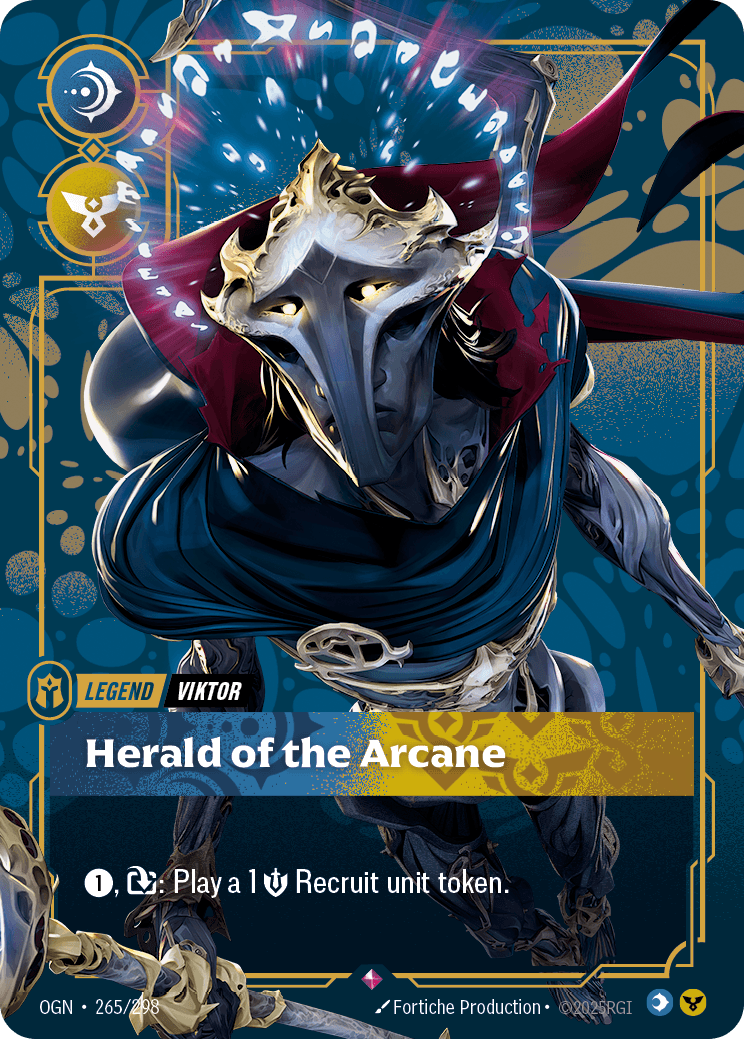
Mind/Order Legend
Viktor - Herald of the Arcane
The identity: for 1 Energy and a tap, play one 1-Might Recruit unit token per turn. The baseline engine you cannot remove — but it exhausts, so it makes only one token a turn.
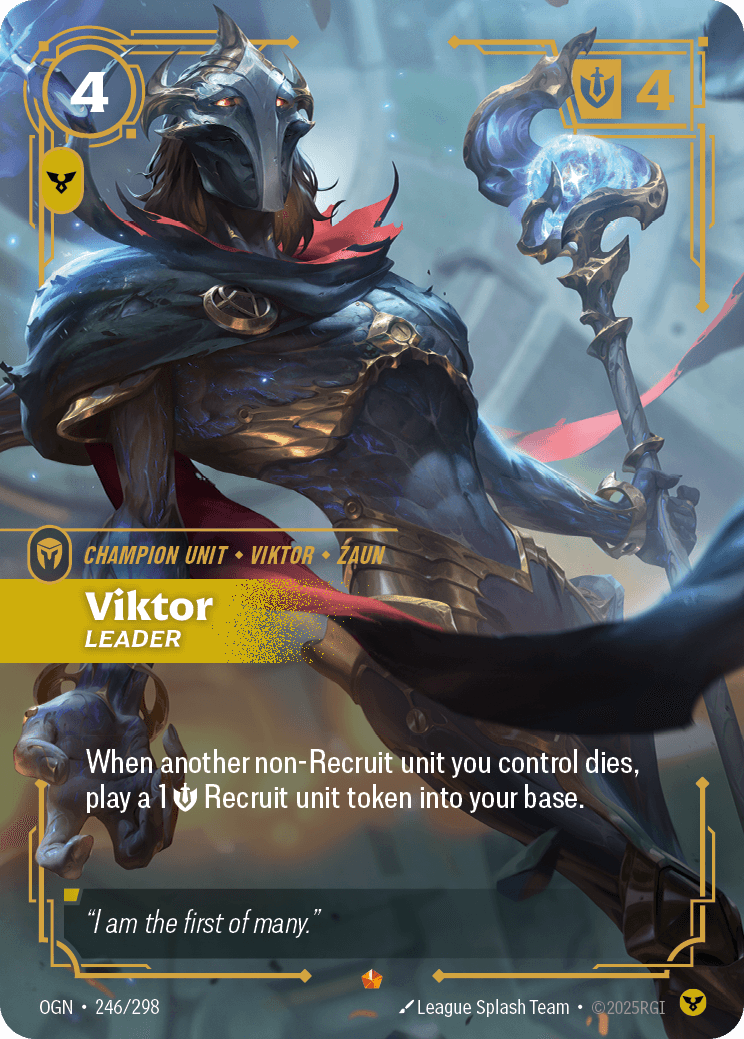
Order Unit
Viktor - Leader
In Viktor's kit: when another non-Recruit unit he controls dies, Leader plays a free 1-Might Recruit into his base. Trading into his board refunds the engine — answer Leader directly.
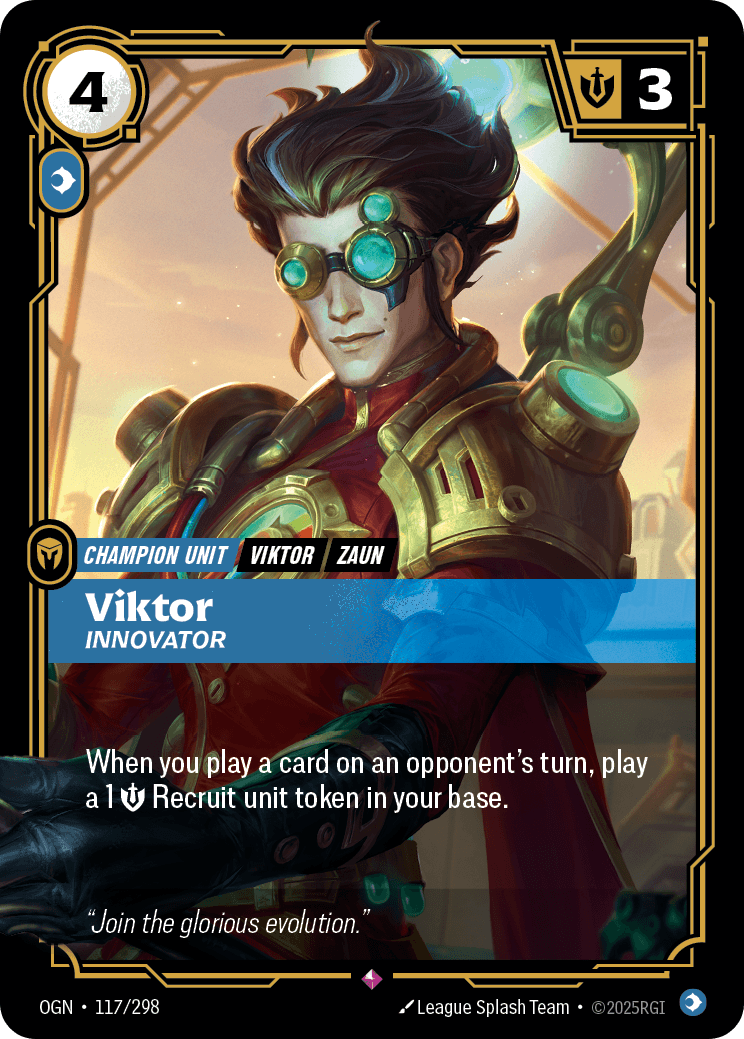
Mind Unit
Viktor - Innovator
In Viktor's kit: when Viktor plays a card on your turn, Innovator plays another 1-Might Recruit, so his reaction spells are never truly free for you.
Viktor - Herald of the Arcane is a grindy Mind/Order control-midrange legend with a token engine bolted on. He tries to:
- Get his Recruit engines online — the Legend always, plus Viktor - Leader or Viktor - Innovator.
- Use cheap reactions to answer your early pressure so the engine has time to stabilize.
- Trade free 1-Might tokens into your paid units to win resource exchanges.
- Convert the token flood into board presence at every battlefield so you cannot contest without overcommitting.
- Close with a payoff that turns a wide, cheap board into either points or an unbeatable defensive wall.
That means the matchup is not solved by "kill his units." Killing a 1-Might Recruit is almost always a bad trade for you and a good one for him. The real question every turn is: is this the card that makes the tokens matter, or is it just another token? Spend answers on the former, never the latter.
Viktor's Kit — What To Respect
These are the cards in Viktor's kit: the legend-locked pieces the deck is built around. Naming them is not the same as claiming a given list runs a specific count of each — kits vary list to list — so respect them for what they do, and confirm the exact wording in the card database.
- Viktor - Herald of the Arcane is always present and always active: for 1 Energy and a tap, play a 1-Might Recruit unit token. You cannot remove it, but notice the cost — it exhausts. Each turn the Legend makes only one token, and making it uses the Legend's tap. Force Viktor to want his Legend doing something else, or make one token per turn simply not enough, and the baseline engine is beatable.
- Viktor - Leader is a 4-cost Order unit: when another non-Recruit unit he controls dies, he plays a 1-Might Recruit into his base. This death-triggered engine punishes lazy trading, refunding a token every time you kill one of his real units. Killing Leader itself does not trigger it, and trading into his non-Recruit fodder feeds him — so answer Leader directly, or ignore his chaff entirely.
- Viktor - Innovator is a 4-cost Mind unit: when Viktor plays a card on an opponent's turn, he plays a 1-Might Recruit in his base. This rewards holding up reaction-speed cards on your turn — every reactive removal or reaction he plays during your turn also spits out a token, which makes his interaction feel free. When Innovator is online, assume any turn you present a threat, he both answers it and grows.
- Siphon Power is his signature and the card that turns harmless tokens into a winning attack. It is a Reaction, so Viktor can play it any time: choose a battlefield, give friendly units there +1 Might and enemy units there -1 Might this turn, to a minimum of 1. A lane of 1-Might Recruits suddenly all swing as 2-Might while your blockers shrink.
How To Beat Viktor
1. Do Not Trade Into 1-Might Tokens
This is the single most common way players lose to Viktor. A 1-Might Recruit costs him almost nothing; your removal spell, combat trick, or 3-cost body all cost you real cards and Energy. Every time you point a paid resource at a free token, you lose the exchange even when you "win" the fight. Let tokens exist. A lone 1-Might Recruit does not score, does not race, and does not threaten anything alone. Walk past it until it is buffed, blocking a battlefield you must take, or the twelfth one on a full board.
2. Answer The Engine, Not The Fodder
When Viktor - Leader or Viktor - Innovator hits the board, that is the card your premium removal is for — killing the engine is worth a real answer in a way killing a token never is. Identify which engine is online and attack the version in front of you: Leader punishes trading, so answer it directly rather than feeding it deaths; Innovator punishes threatening into open resources, so make it defend or remove it before you commit. A generic "beat Viktor" plan that ignores which piece is online will misallocate every answer.
3. Respect Siphon Power's Reaction Swing
Do not walk your board into a battlefield full of Recruits assuming the math is fixed. Siphon Power costs only two and reacts, so Viktor can hold it up on a turn he looks tapped out and fire it exactly when you commit. Assume he can add a point to every one of his bodies there and subtract one from every one of yours for a turn. Only take the fight when it still wins after that swing, or when you have already forced Siphon Power out on a lower-stakes turn.
4. Don't Assume Every Token Is Harmless
Your "ignore the tokens" plan assumes 1-Might chaff, but some Viktor builds field bigger, ready token sources and buff payoffs — a Might buff on the next unit played, a draw-triggered gear, a gear that spits out a larger ready body — that turn free tokens into real attackers. Save your gear and payoff answers for those pieces, plan attacks that go over the bigger tokens or around the lane they hold, and do not build your whole counterplan on the assumption that every body on his side is a one-drop.
5. Play Around His Reaction Turns
Innovator makes Viktor's reactive cards actively good, so he leans on cheap reactions that shrink your attacker and draw while growing his board. Send your best unit into a battlefield where Viktor shows untapped Energy and Mind runes and assume he can drop your attacker below the number it needs, grow off Innovator, and flip a fight you thought you had won. Make him spend the trick on a lower-stakes turn, then push your real threat when it is gone.
6. Go Tall Or Go Around
One 5-Might threat a 1-Might chump cannot stop beats three 3-Might bodies that each get blocked by a free token. Combat math is where players lose this matchup: send a 4-Might attacker in and Viktor chump-blocks with a 1-Might Recruit, buying a full turn of your clock for one free token — and if Leader is out, he did not even lose the token count. Plan attacks that go wide enough that one blocker does not stop the scoring, or tall enough that a chump cannot trade, and use a battlefield-mover to attack where the tokens are not.
Turn By Turn Counter Plan
Turns 1-2: Punish The Setup
Viktor is weakest before the engines are assembled. The Legend makes only one token per turn, and Viktor - Leader and Viktor - Innovator both cost 4 and must survive a turn to matter. This is your window. Develop a real board and threaten a battlefield immediately, because if Viktor spends turn two removing your unit or chump-blocking, that is a turn he did not spend setting up. A hand that does nothing on turns one and two hands him the slow start he wants.
Turns 3-4: Answer The Engine, Not The Fodder
This is where the matchup is decided. When Leader or Innovator hits the board, that is the card your premium removal is for. If you cannot remove it, pivot to pressure and force Viktor to use his tokens and reactions defensively. Every turn he spends reacting is a turn the token count does not snowball.
Turns 5-6: Break Through Before The Wall Is Complete
By now Viktor wants a full board of tokens plus a payoff. Close a battlefield or land your scoring plan before the wall is wide enough to make every attack a bad trade. Go tall or go around: one threat a 1-Might chump cannot stop beats a board that each free token blocks, and a battlefield-mover lets you attack where the tokens are not.
Late Game: Respect The Payoffs
If the game goes long, Viktor's plan is a wide token board that his buffs and Siphon Power turn into a lethal attack, or a token source that keeps refilling bigger bodies. Track his Energy and runes: if he can hold up Siphon Power while a full lane of buffed Recruits swings, the token wall stops being defense and becomes the clock. Never let a "we both have big boards" standoff continue, because the stall favors the side that manufactures free bodies every turn.
Mulligan Guide Against Viktor
Keep hands that can do at least two of these:
- Present real pressure on turns one and two, before the engines are online.
- Answer a 4-cost engine piece (Viktor - Leader or Viktor - Innovator) cleanly.
- Go tall enough that a 1-Might chump block does not stop your clock.
- Threaten a second battlefield so one token wall cannot cover everything.
- Reach your own scoring plan before Viktor's grind takes over.
Ship hands that are all reactive removal. Against most decks a pile of answers is fine; against Viktor, spot removal aimed at a token faucet is a slow loss. You want proactive cards that make Viktor defend, not a deck that trades one-for-one into an engine that refunds itself.
Matchup Plans By Archetype
Aggro And Pressure Decks
You have the best natural angle: end the game before the token count matters. But do not throw bodies blindly into chump blockers. Attack wide or tall, force Viktor to spend removal on turns one through three, and make sure some of your clock is above 1-Might chump range so his free blockers cannot trade with everything.
Midrange Decks
You win the long game only by refusing bad trades. Answer the engine pieces, go over the top with bigger units, and keep a second battlefield threatened. The risk is grinding on his terms and slowly falling behind on the token count, so every answer must be aimed at a card that makes the tokens matter.
Control Decks
You cannot pretend the matchup starts on turn six. Sit back and Viktor assembles all three engines and buries you while you hold removal for high-value targets that never appear. You need early speed bumps and a real win condition, because grinding a deck that refunds its own units is a losing game of attrition.
Combo And Engine Decks
Buy setup turns by making Viktor defend. If your engine forces him to answer, his removal and tokens go on defense instead of building. Interact while you develop, then push your payoff before Siphon Power or a buffed swing flips the board.
Common Mistakes Against Viktor
- Trading real cards into 1-Might tokens. The tokens are free; your answers are not.
- Killing the fodder instead of the engine. Save premium removal for Viktor - Leader and Viktor - Innovator.
- Attacking into chump blockers with a narrow board. One free token stops one attacker; go wide or go tall.
- Ignoring which engine is online. Leader punishes trading, Innovator punishes threatening; the plans differ.
- Letting the game reach a standoff. A "both big boards" stall favors the side that manufactures free bodies.
- Sending your best unit into open resources. Siphon Power and cheap reactions punish overcommitment.
- Leaning on pure removal. Viktor wins the removal war; bring threats.
If you fix only one habit, fix this one: stop spending answers on free bodies. Spend them on the card that turns the free bodies into a win.
Practice Checklist
Before you call your Viktor matchup ready, answer honestly:
- Can your deck pressure a battlefield before turn three, while the engines are still assembling?
- Do you know which card answers Viktor - Leader or Viktor - Innovator cleanly?
- Can you attack tall enough that a 1-Might chump does not stop your clock?
- Do you have a plan for a buffed token lane and Siphon Power swinging a combat?
- Can you threaten a second battlefield so one screen cannot cover the board?
If the answer is no to two or more, the matchup needs more reps.
Build And Test On RiftStorm
Turn this into practice, not just reading:
- Search Viktor's kit in the card database to read exact wording, then look for tall threats, clean removal for 4-cost bodies, gear answers, and battlefield-movers.
- Clone your closest shell in the deck builder and build a Viktor test list beside it with all three engine pieces. Play out the exact windows where you either answer an engine or break a wall.
- Browse Riftbound decks to see how other pilots adapt their threat base against the token engine.
- Map Viktor against the rest of your room on Riftbound Counters.
If you open one of our counter shells, treat it as a RiftStorm testing shell — a starting point built from card roles, not a tournament decklist — and tune it against what you actually see across the table.
Bottom Line
Viktor is a top engine deck because he turns free 1-Might Recruit tokens into winning trades and, eventually, into points behind a wall. The Legend makes a token every turn, Viktor - Leader refunds one on every friendly death, Viktor - Innovator makes one every time he interacts on your turn, and Siphon Power turns a harmless lane into a lethal swing. Left alone, that engine buries you.
You beat Viktor by making the engine expensive. Pressure the setup turns before the pieces assemble. Refuse to trade paid cards into free tokens. Aim every premium answer at Leader or Innovator rather than the fodder. Go tall or go wide enough that a chump block does not stop your clock. And close the game before the token wall and the buff payoffs make the grind unwinnable. That plan holds even as the exact list moves — which is exactly why we wrote it this way. For more matchups, open the Riftbound Counters hub and compare shells in Riftbound decks.