Teemo - Swift Scout is a Mind/Chaos tempo-disruption deck — a deck that would rather grab an early battlefield, bury the board in face-down [Hidden] cards, and turn every attack you make into a guessing game than race you head-on. It stays a first-wave counter target through the format because that identity is stable even when the exact list moves.
A note on how we write this. We don't publish a card-for-card Teemo 'package' we can't verify from our own current data, and we don't send you to someone else's site to find one. What we give you instead is durable: the gameplan Teemo is running, the cards in its kit and what they do, and a counter plan keyed to mechanics. Read any card's exact text in the card database, build both sides in the deck builder, and pair this with adjacent matchups on Riftbound Counters.
What We Can And Can't Tell You
We do not have a verified current Vendetta Teemo list on record, so we are not going to hand you a 'current' package we can't stand behind. That honesty is the point. A counter plan built on 'Teemo always runs these cards' rots the moment the list shifts. A counter plan built on 'here is what Teemo is trying to do, and here is the kit that punishes loose play' keeps working. This guide is the second kind. When you want to sanity-check exact wording or legality, read the cards themselves in our card database.
What Teemo Is Trying To Do
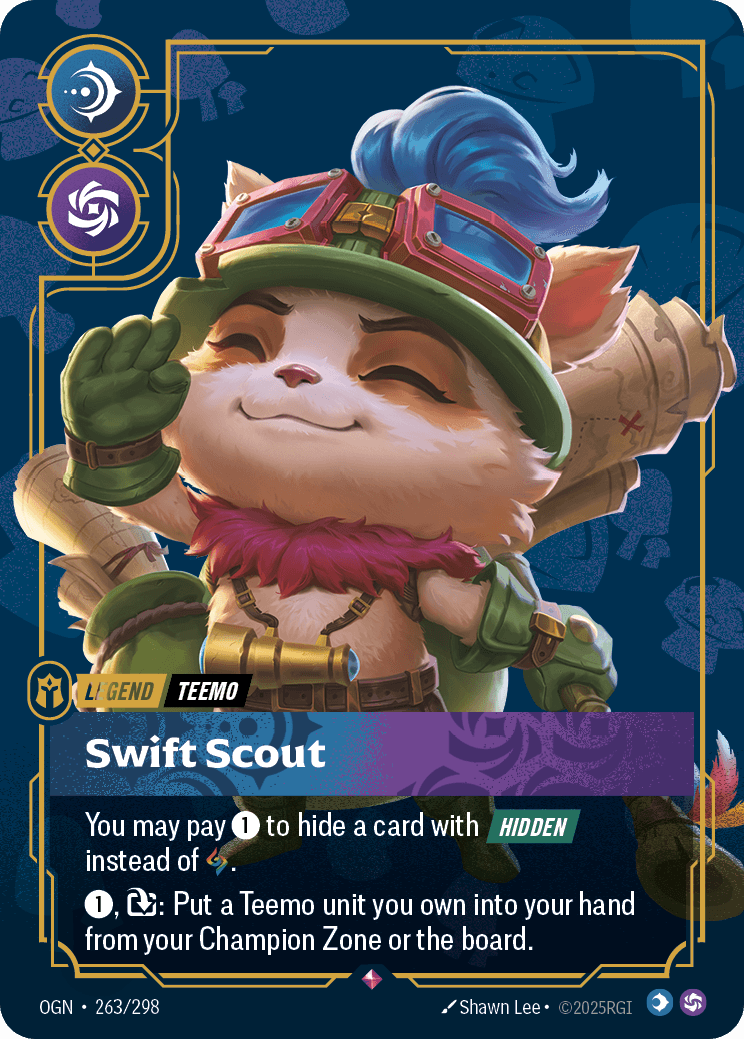
Mind/Chaos Legend
Teemo - Swift Scout
The identity: pay 1 Energy to hide a [Hidden] card instead of a rune, and exhaust to return a Teemo unit from the Champion Zone or board to hand. Pressure its Energy to break the fog.
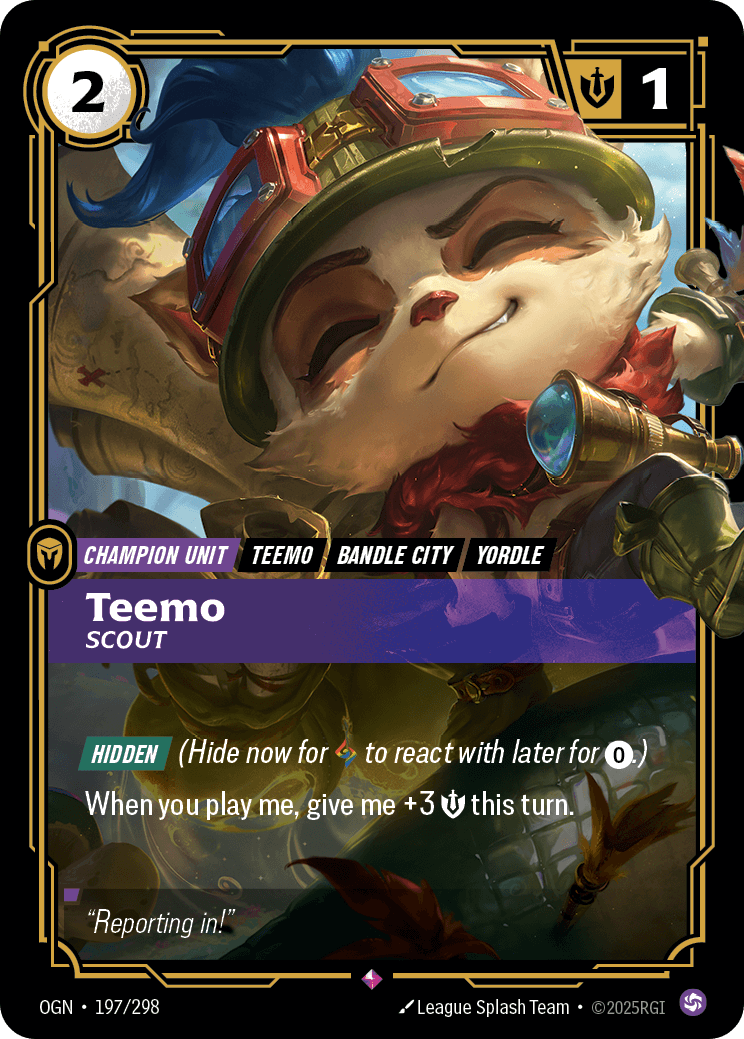
Chaos Unit
Teemo - Scout
In Teemo's kit: a 2-cost [Hidden] body with +3 Might the turn it lands. The early land-grab — contest the first lanes and let the buff deflate before you spend removal.
Mind Unit
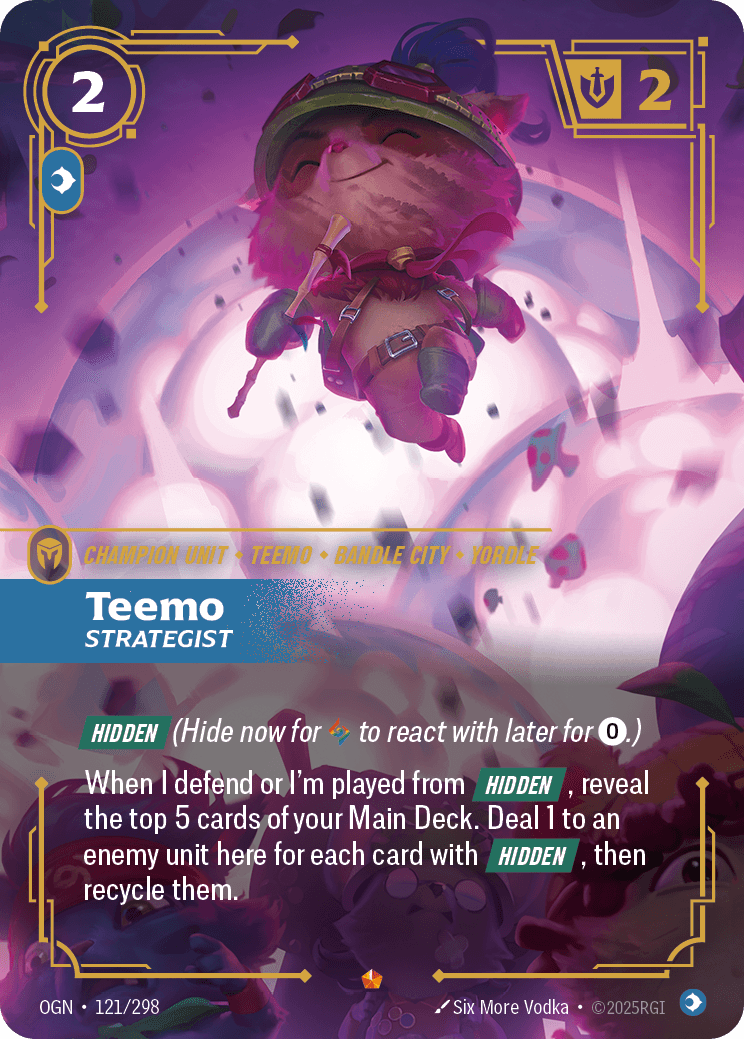
Teemo - Strategist
In Teemo's kit: when it defends it pings your attacker for each [Hidden] card revealed off the top five. Attack with units that survive the damage and bait the reveal first.
Teemo is a Mind/Chaos deck that tries to:
- Grab initiative on an early battlefield before you have set up.
- Bank face-down [Hidden] cards cheaply, so every one of your attacks becomes a question.
- Score point by point under the fog until the scoreboard hits 8, using the confusion to make each of your combats a bad trade.
The deck is dangerous because information, not raw power, is the resource. Every turn the pilot banks a face-down card, they add a question mark that taxes your decisions. You hold back a good attack because a hidden card might be a blowout; you send it in and it is a blowout; either way Teemo scores somewhere else and inches toward 8. The whole design makes waiting feel safe and attacking feel reckless at the same time.
The counter rule is simple: a hidden card that never fires is a dead card. Teemo only gets value when you walk into the reaction. Make the Swift Scout pilot choose between spending hidden cards to defend and spending tempo to score, and the bluff collapses.
Teemo's Kit — What To Respect
These are the cards in Teemo's kit: the legend-locked pieces the deck is built around. Naming them is not the same as claiming a given list runs a specific count of each — kits vary list to list — so respect them for what they do, and confirm the exact wording in the card database.
- Teemo - Swift Scout is the engine. It lets the pilot pay 1 Energy to hide a [Hidden] card instead of committing a rune, so face-down cards can go down almost every turn while Energy stays open for reactions. Its second line — 1 Energy and exhaust to return a Teemo unit from the Champion Zone or the board to hand — recurs the deck's best bodies, so you are racing a loop, not a fixed set of threats.
- Teemo - Scout is a 2-cost [Hidden] body that gains +3 Might the turn it is played. That is the early land-grab: a swing big enough to steal a point on turns one or two, which deflates the following turn.
- Teemo - Strategist is a 2-cost [Hidden] unit that, when it defends, chooses one of your units, reveals the top five cards of the Main Deck, and deals 1 to that unit for each [Hidden] card revealed. In a hidden-heavy deck that is free damage at the exact moment you commit.
- Guerilla Warfare returns up to two [Hidden] cards from the trash to hand and lets the pilot hide cards ignoring costs that turn. It is the reload: the fog you spent is not gone, it comes back for free.
How To Beat Teemo
1. Deny The Free Land-Grab
Teemo - Scout wants to land with +3 Might and steal the first battlefield uncontested. Have a body or a contest for the opening lanes so that early point costs the pilot something. You do not need to win the fight outright — you need to make Teemo spend to hold, so its early tempo costs cards instead of gaining them. And remember the phrase "this turn": the +3 Might is temporary, so if you survive the swing, the Scout shrinks and becomes easy to trade into or out-body next turn. Do not burn premium removal into the inflated number.
2. Bait The Hidden Cards Before You Commit
Every face-down card is a bluff you are paying full price for until you make Teemo prove it. Before you send your real threat, poke with an expendable attack to make the pilot either flip a hidden card or let a point through. If they burn a reaction on your bait, your follow-up goes in clean. If they hold everything, you scored for free. Never lead with your best unit into a wall of unknowns.
3. Attack With Units That Survive The Ping
Teemo - Strategist punishes greedy attacks by pinging your attacker for each [Hidden] card revealed off the top five — often 2-3 damage for free at the moment you commit. Read that into your attack selection: if your attacker dies to a few points of damage, assume it dies when it swings into face-down cards. Send bodies that outsize the ping, and remember the Strategist only fires when it defends — force Teemo to attack, or fight in a lane it is not holding, and the ping never happens.
4. Pressure A Second Battlefield
The fog is strongest when your whole game is stacked in one place. Present pressure on two battlefields at once and the Swift Scout pilot cannot both hide cards to build the wall and spend Energy defending two lanes. Make them pick. Every turn they spend defending is a turn they are not banking hidden cards or moving toward 8. Your second battlefield does not need to be huge — it needs to be real enough that Teemo cannot ignore it.
5. Fight The Recursion With Resource Pressure
You cannot remove a legend, and Teemo - Swift Scout loops the deck's best bodies back to hand, so killing a Strategist or Scout once does not end the pressure. The answer is not removal, it is resource pressure. The legend is only busy when the pilot has Energy to spend on hiding and recurring. Develop a real board, force actual blocks and trades, and the fog machine sputters because every Energy spent defending is Energy not spent hiding a card.
Mulligan Guide Against Teemo
Keep hands that do at least two of these:
- Contest a battlefield on turns one or two so the Scout does not grab a free point.
- Present an expendable body you can use to bait a hidden reaction.
- Apply pressure on a second battlefield to split the pilot's Energy.
- Deploy a threat that survives a Strategist ping of a few damage.
- Keep coming after the first exchange rather than running dry.
Ship hands that only work in a slow grind. A pile of expensive value that does nothing on turns one through three hands Teemo exactly the early initiative and information it is built to snowball. The ideal keep is not the most powerful hand — it is the one that makes Teemo's first tempo turn cost something and lets you attack around the fog by turn three.
Turn-By-Turn Counter Plan
Turns 1-2: Don't Let The Scout Grab A Free Point
Teemo - Scout wants to land with +3 Might and steal the first battlefield uncontested. Have a body or a contest for the opening lanes so that early point is not free. You do not need to win the fight — you need to make the pilot spend something to hold, so their early tempo costs them cards.
Turns 3-4: Bait The Hidden Cards Before You Commit
This is the turn that decides the game. Before you send your real threat, poke with an expendable attack to make Teemo either flip a hidden card or let a point through. If they burn a ping or a held reaction on your bait, your follow-up attack goes in clean. If they hold everything, you scored for free. Never lead with your best unit into a wall of unknowns.
Turns 5-6: Force The Choice Between Hiding And Scoring
Once you are trading evenly, present pressure on two battlefields at once. The Swift Scout pilot cannot both build the fog and defend two lanes and score their own points. Make them pick. Every turn they spend defending is a turn they are not banking hidden cards or moving toward 8.
Late Game: Close Before The Grind Sets In
If the game stretches, respect that the legend's recursion and the deck's Gold-gear value floor are built to keep Teemo afloat in long games. Do not settle into a slow value war it is designed to win. Keep a threat live that ends the game, and push the scoreboard rather than trading resources forever.
Matchup Plans By Archetype
Aggro And Pressure Decks
You are the favorite if you stay disciplined. Contest early so the Scout does not steal a free point, bait the reactions with expendable bodies, and close before the fog stabilizes. Do not throw your whole hand into one lane where a single stun or shove resets you.
Midrange Decks
You have the tools but the highest risk of drifting passive. Trade into the early bodies, bait the hidden cards with pressure you can afford to lose, then commit your real threat once the reaction is spent. Keep a second lane live so Teemo cannot line every answer up in one place.
Control Decks
Don't keep hands that only come online late. You need early speed bumps and a way to keep Teemo honest, because a Teemo pilot who banks cards unpressured turns the mid-game into a chain of cheap reactions. Become the beatdown where you can.
Engine And Combo Decks
Buy setup time with board presence. If your first turns do nothing, Teemo develops the fog and open Energy, then your payoff has to happen under cheap interaction. Make Teemo answer something real while you build.
Common Mistakes Against Teemo
- Paying full price for bluffs — freezing over a face-down card that is often nothing. Make Teemo prove the reaction is real by baiting it cheaply.
- Leading with your best unit into an unknown battlefield and losing it to a Strategist ping or a held reaction.
- Panic-answering the +3 Might Scout with premium removal instead of waiting one turn for the buff to drop off.
- Stacking one battlefield so a single reaction swings the whole game.
- Killing a Teemo unit once and forgetting the legend can return it to hand and replay it.
- Settling into a grind the deck's value floor is built to win instead of closing the game.
- Going passive and letting Teemo hide a card every turn while scoring uncontested.
If you fix only one habit, fix this: stop respecting hidden cards you have not made Teemo commit. A face-down card that never fires did nothing. Bait it, attack around it, and make the Swift Scout pilot pay to be scary.
Practice Checklist
Before you call the Teemo matchup ready, answer honestly:
- Can your deck contest a battlefield before the +3 Might Scout steals the first point?
- Do your attackers survive a Strategist revealing a couple of [Hidden] cards?
- Do you have an expendable body to bait reactions before committing your real threat?
- Can you pressure two lanes so Teemo cannot both hide and defend?
- Do you have a closer that ends the game before the value floor matters?
- Are you spreading threats so a single stun or bounce cannot blank your whole plan?
If the answer is no to two or more, the matchup needs more reps.
Build And Test On RiftStorm
Everything here is buildable with our own tools:
- Search Teemo's kit in the card database to read exact wording.
- Clone a shell in the deck builder and goldfish the counter plan, then build a Teemo test copy stuffed with hidden cards to feel the fog from the other side.
- Compare community lists in Riftbound decks.
- Pair this with adjacent matchups on Riftbound Counters.
If you open one of our counter shells, treat it as a RiftStorm testing shell — a starting point built from card roles, not a tournament decklist — and tune it against what you actually see across the table.
Bottom Line
Teemo - Swift Scout is a top disruption deck because it sells you a guessing game and charges you full price for its bluffs. The legend hides a card almost every turn for cheap Energy and loops its best bodies back, the Strategist punishes greedy attacks, the Scout steals early points, and Guerilla Warfare reloads the fog you thought you had cleared.
You beat Teemo by refusing to guess. Contest early so the Scout does not grab a free point. Bait the hidden reactions with expendable bodies before you commit. Spread pressure across two lanes so the Swift Scout pilot cannot hide and defend at once. Attack with units that survive the ping, and close the game before the value engine grinds. That plan holds even as the exact list moves — which is exactly why we wrote it this way. For more matchups, open the Riftbound Counters hub and compare shells in Riftbound decks.