Ornn is not a deck that beats you with a single explosive turn. He beats you by surviving your early aggression, quietly stacking gear, and then presenting a Forge God so large and so protected that your removal bounces off and your blocks trade badly. As of July 2026, Fire Below the Mountain is the format's premier Calm/Mind Voltron engine, and the reason it keeps showing up is simple: if you let it reach its setup, the math stops being fair.
The good news is that Ornn is also one of the most linear, most punishable engine decks in the room. It is slow, it leans on gear you can see coming, and it struggles to draw cards. That means the counter plan is less about clever answers and more about tempo discipline: make Ornn spend his engine on defense, kill or bounce the payoff before the gear count climbs, and never give him a free turn to build.
A note on how we write this. We don't publish a card-for-card Ornn 'package' we can't verify from our own current data, and we don't send you to someone else's site to go find one. What we give you instead is durable: the gameplan the gear engine is running, the cards in Ornn's kit and what they do, and a counter plan keyed to mechanics. Read any card's exact text in the card database, build both sides in the deck builder, compare public shells in Riftbound decks, and start the wider route map on Riftbound Counters.
Ornn, Fire Below the Mountain: Why This Matchup Matters Now
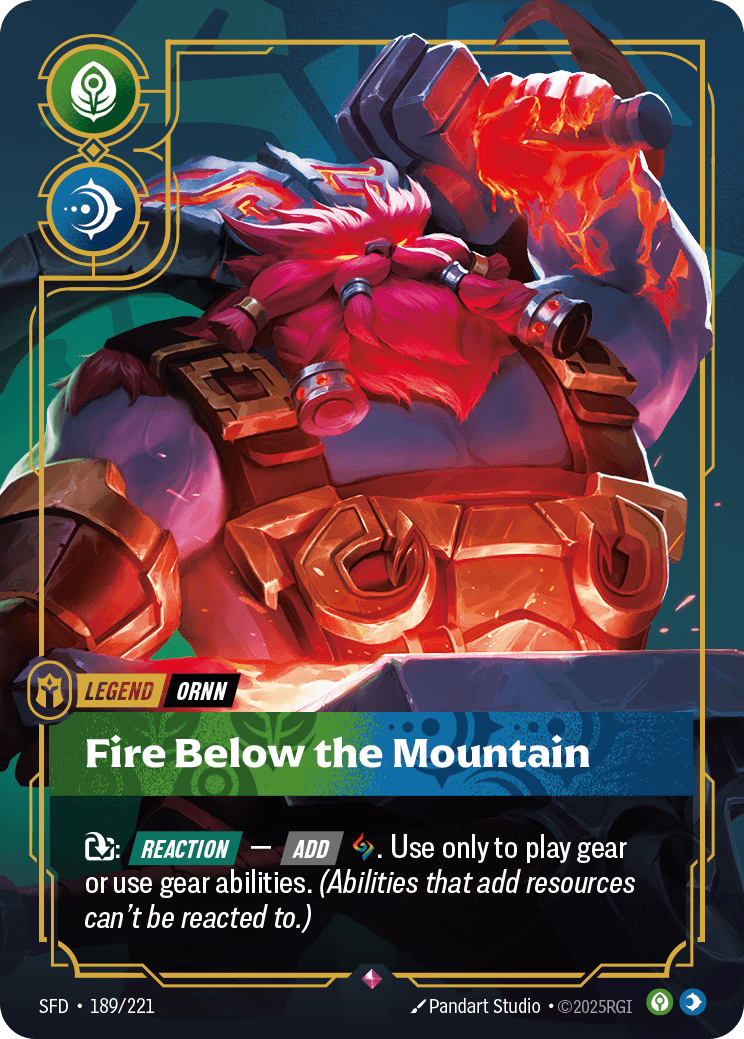
Calm/Mind Legend
Ornn - Fire Below the Mountain
The identity: the legend's exhaust reaction adds a rune, but only for gear, so denying gear turns strands the whole engine.
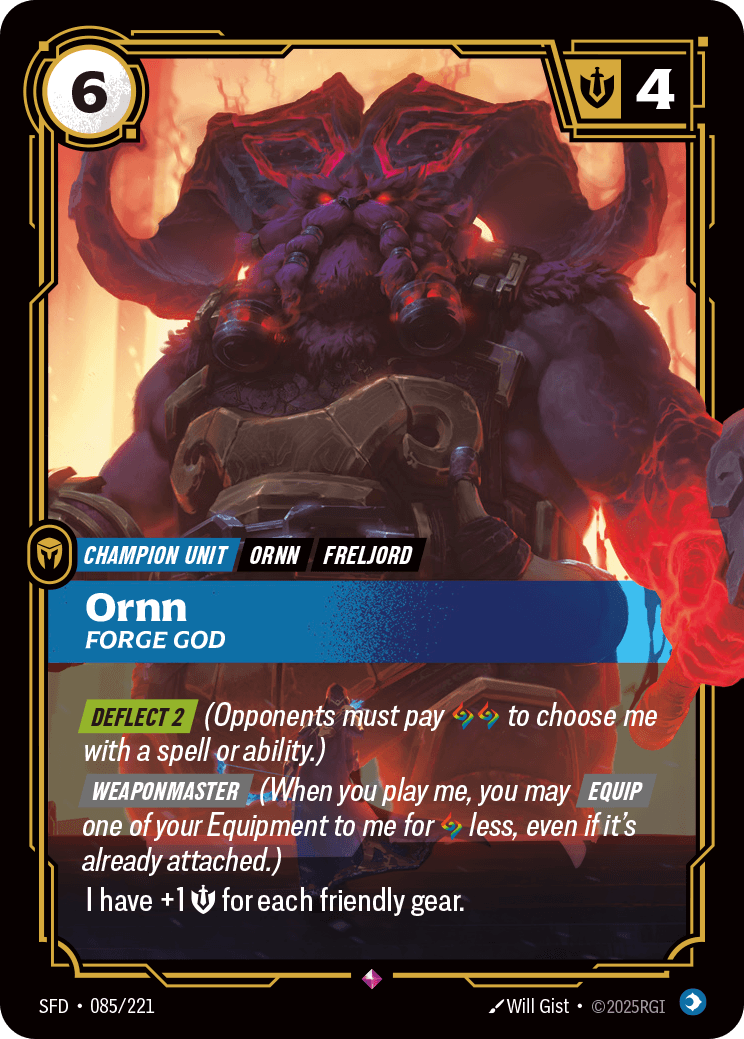
Mind Unit
Ornn - Forge God
In Ornn's kit: Deflect 2 taxes targeted removal, Weaponmaster equips on entry, and he has +1 Might per friendly gear, so answer him before the gear count climbs.
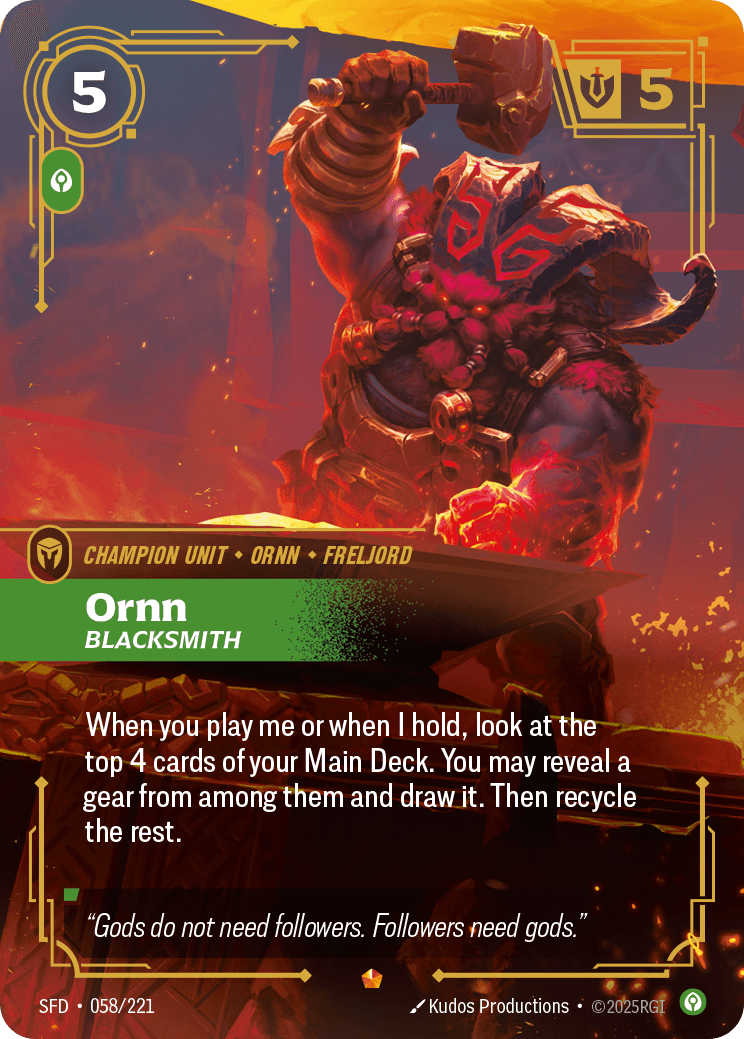
Calm Unit
Ornn - Blacksmith
In Ornn's kit: Blacksmith looks at the top four cards for a gear to draw, so removing him early keeps the deck's card-draw problem exposed.
Ornn matters because he is the clearest expression of a build-around engine in the current format. The legend, Fire Below the Mountain, costs nothing to field and gives the pilot a repeatable reaction: exhaust to add a rainbow rune, usable only to play gear or use gear abilities. That single line is the whole deck's identity. It is ramp that never touches your units directly, so it does nothing to stabilize a losing board, but it means the Ornn player can chain out equipment a turn earlier than his rune count suggests.
In practice Ornn is a high-risk, high-reward slow strategy, and the same weaknesses show up again and again: he gets run over by fast, holding-and-defending decks, he gets removed by clean answer decks that can pay his Deflect tax, and he has real trouble with card draw. Those are not minor footnotes. They are the entire counter plan, restated as a scouting report.
So the framing you want is this: Ornn is a deck that is trying to reach turn six or seven with a board of gear and a Forge God to carry it. Your job is to make sure the game is already decided by then, or that the Forge God turn is a dud because you answered it. Do not treat this like a grind. Treat it like a race against a clock the Ornn player cannot speed up much.
The counter rule is simple: the engine only wins if you give it time. Do not give it time.
What Ornn Is Trying To Do
Most Fire Below the Mountain lists follow the same arc. They want to survive the early turns, deploy gear-generating bodies, use the legend's rune ramp to play equipment ahead of curve, and then land Ornn - Forge God as a Weaponmaster payoff that immediately equips and scales.
The shell usually wants to:
- Ramp gear early with Fire Below the Mountain's rune, plus cheap enablers that make gear tokens or dig for gear.
- Dig for the right equipment with Ornn - Blacksmith, who looks at the top four cards and pulls a gear.
- Build a gear count that turns into raw Might, because Forge God has +1 Might for each friendly gear.
- Land the payoff under protection, using Weaponmaster to equip on entry and Deflect 2 to tax your removal.
- Convert the oversized body into repeated battlefield wins while the gear board keeps growing.
That means the matchup is not solved by holding one perfect answer for Forge God, though that helps. It is solved by refusing to let the deck reach the state where Forge God is a 10-plus Might, Deflect 2 threat with a ready-effect gear behind it. A Forge God with two gears is scary. A Forge God the turn he lands, with nothing attached yet and no board built, is just an expensive body you can trade with or ignore.
Before every mid-game turn, ask this question: how many friendly gears does Ornn control right now, and how many will he control after this turn? That number is the matchup. Everything else is detail.
Fire Below the Mountain: The Rune Ramp You Must Respect
Fire Below the Mountain's ability reads as a reaction: exhaust the legend to add a rainbow rune, and use it only to play gear or use gear abilities. The parenthetical matters too: abilities that add resources cannot be reacted to, so you cannot interact with the ramp itself.
Two things follow from that text.
First, the ramp is conditional. It does nothing unless the Ornn player is spending on gear. If you can make him want to spend runes on units, removal answers, or defense instead, the legend sits there doing nothing. A Fire Below the Mountain that is exhausted for a gear cannot also help hold up a reaction, and a legend that never gets to fire because the Ornn player is scrambling on defense is a dead engine.
Second, the ramp lets Ornn deploy equipment a full rune ahead of what you would expect. That is why an on-curve Forge God turn can also include an equip, or why a gear can hit the board a turn early. Do not count Ornn's mana the way you count a normal deck's. Assume he has one extra rune specifically earmarked for gear, and plan combat as if the early equipment lands sooner than his visible runes allow.
The best counterplay is to attack the condition, not the ability. You cannot stop the rune from being added. You can make every rune the Ornn player spends a rune he wishes he had for defense.
Ornn - Forge God Is The Card The Whole Deck Is Built Around
Ornn - Forge God is a 6-cost Mind unit with three lines that all point the same direction. Deflect 2 means opponents must pay two extra rainbow runes to choose him with a spell or ability. Weaponmaster means when you play him, you may equip one of your Equipment to him for one rune less, even if it is already attached. And he has +1 Might for each friendly gear.
Read together, those lines describe a body that gets bigger the longer the game goes, arrives already equipped, and taxes your removal. This is the card your entire counter plan orbits.
Here is what actually beats it.
- Combat. Deflect 2 only taxes spells and abilities that target him. It does nothing against being blocked, being attacked, or dying in a fight. If you can win the combat math, you never pay the tax. This is why aggressive decks that force fights beat Ornn: they answer Forge God with units, not with targeted removal.
- Bounce and movement. Effects that move a unit to base or return it do not always need to target in a way Deflect punishes, and even when they do, sending Forge God home resets the tempo and wastes the Weaponmaster equip. The wider format's Chaos bounce is the classic answer here.
- Paying the tax. If your deck simply has the runes to pay Deflect 2 and remove him, do it before the gear count makes him too big to kill with one answer. Two extra runes is a real cost, but it is a cost, not a wall.
- Timing. The single most important thing: answer him early. A Forge God with one gear is a manageable body. A Forge God with four gears and a Shurelya's Requiem behind him is a game-ender. Every turn you wait, the +1 Might per gear makes your answer worse.
The mistake players make is saving a premium removal spell for Forge God and then discovering the Ornn player equipped, readied with Shurelya's Requiem, and attacked on the same turn the body landed, so the answer arrives one beat too late. Do not admire the setup. Break it.
Ornn - Blacksmith And The Card-Draw Problem
Ornn - Blacksmith is a 5-cost Calm unit that, when you play him or when he holds, looks at the top four cards of the deck and lets you reveal and draw a gear, recycling the rest. He is the deck's answer to its own biggest flaw: card draw.
In practice the deck struggles to draw cards, which limits how reliably it assembles the gear it needs, and Blacksmith and the deck's other gear-diggers are the patch for that. That makes them high-value answers, but for a specific reason: removing them does not just take a body off the board, it re-exposes the deck's structural weakness. An Ornn player who cannot find gear is an Ornn player whose Forge God is small and whose legend ability does nothing.
So when you have a choice between answering a random early body and answering the piece that finds gear, lean toward the enabler. You are not just trading one-for-one. You are widening the crack the deck already has.
This is a good place to open the card database and look for cheap units and reach that can pressure a 5-cost Blacksmith the turn it lands, before it holds and digs again.
The Gear Package: Count Every Attachment Before You Block
The equipment in an Ornn shell is not flavor. Every gear is a stat line on Forge God and, sometimes, an effect that swings combat.
- Shurelya's Requiem is the scary one, and it gets its own section below. For block math the point here is simpler: it is another unique gear on the board, and it is the card that can turn an ordinary Forge God turn into a double-action blowout.
- Forgefire Cape and Rabadon's Deathcrown are unique gears that mostly exist to be attachments and to pad the gear count. Each one is another +1 Might on Forge God. When you plan blocks, literally count the gears in play and add that number to Forge God's printed Might. Do not eyeball it.
- Non-combat gear. Some gears do more than pad Might - a few can, when unattached, banish themselves to dump a board of units into play for a burst. That is a non-combat second wave. If the Ornn game goes long, keep track of any unattached gear that is sitting there doing nothing yet; it may be waiting to pay off.
The counter habit is arithmetic. Before any fight involving Forge God, count friendly gears, add that to his Might, and only then decide whether your block or attack is good. Players lose this matchup by treating Forge God as a fixed-size unit when he is a running total.
The Gear Enablers: Small Boards Are Not Harmless
Ornn's gear count does not only come from playing gear from hand. Several cheap units manufacture it - some make a gear token when they conquer, some dig for gear when they move, and some hand out gold gear tokens on entry. Together, these bodies quietly push the gear count up and smooth the draws.
The read here is that early Ornn boards are not harmless just because they are small. A turn-two body that connects for a free gear token is a free point of Forge God Might later and a live target for Weaponmaster. So contest these attacks. Do not let a cheap body conquer unopposed and call it a fine turn, because in this matchup an unopposed conquer is a gear you handed over.
One specific warning: some of these enablers offer you a free gold gear token too. Do not take it just because it is free. Giving yourself a gear does nothing for you and rewards the Ornn player with another token toward Forge God. Decline it.
Shurelya's Requiem: The Signature Swing Turn
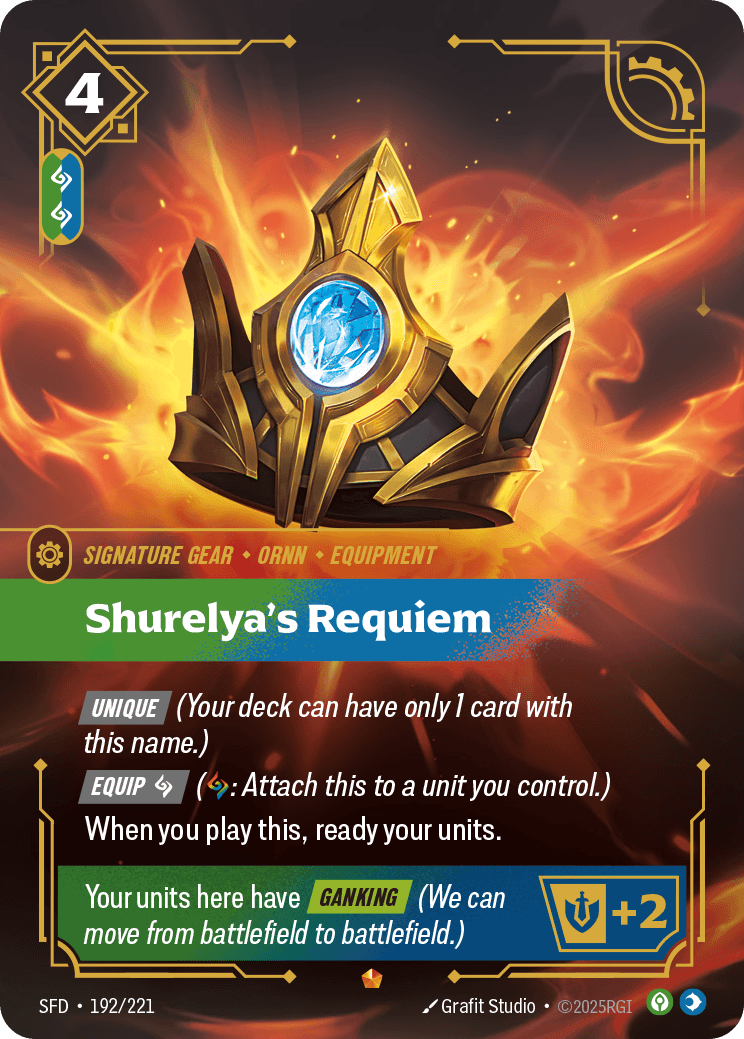
Calm/Mind Gear
Shurelya's Requiem
In Ornn's kit: a unique signature gear that readies your units when played, letting Ornn attack and defend the same turn, so bait it before your key push.
Shurelya's Requiem is Ornn's signature gear, which means it is legend-locked - only a Fire Below the Mountain deck can run it - and it is the single card that turns a normal gear turn into a blowout. Its text is short and brutal: it is a unique Calm/Mind Equipment you attach for a rainbow rune, and when you play it, ready your units.
Read what that does on a developed board. Ornn equips Forge God, plays Shurelya's Requiem, and every one of his units readies. Now the body that just attacked can also defend, or a board that already acted gets a second set of actions. This is the turn where the gear count stops being a passive Might bonus and becomes tempo: one card buys Ornn an extra combat step, and a Forge God that swung into you is suddenly back up to block.
The counterplay is timing, not gear hate. You usually cannot stop the signature gear from resolving, so treat the Shurelya's turn as the moment your own reactive answer earns its place. If you are holding a bounce or a removal spell for Forge God, using it before the ready effect lets one body attack and defend is far better than watching Ornn get two actions and then answering the leftovers. And keep counting the rest of the attachments: Rabadon's Deathcrown and Forgefire Cape are unique signature gears that exist mostly to pad the gear count, so every one you see is another +1 Might on Forge God and another reason the readied swing hits harder.
Turn By Turn Counter Plan
Turns 1-2: Contest Everything, Concede Nothing
Your first job is to make the early board a fight. Ornn wants these turns to be free: deploy a gear enabler, connect for a gold gear token, hold up the legend for a gear. A hand that does not pressure a battlefield on turn one or two is usually too slow to punish him.
Contest the early gear-token bodies. Attack into the gear-digger's lane so moving it is not free value. Make the Ornn player choose between developing gear and answering your board. Every turn he spends reacting is a turn Fire Below the Mountain is not ramping into equipment.
Turns 3-4: Kill The Enabler Or The Payoff Setup
This is where the matchup is usually decided. Around now Ornn wants to land Blacksmith to dig for gear, or start chaining equipment ahead of curve. This is your window to remove the enabler that fixes the deck's card-draw problem, or to keep the board pressured so the Ornn player cannot spend a full turn setting up.
If you see Blacksmith, strongly consider answering it. If you see the gear count starting to climb, decide now whether you are racing or holding an answer for Forge God, because after this the payoff turn arrives.
Turns 5-6: Break The Forge God Turn
Forge God comes down around here. Have your plan ready. If you are aggressive, race: a Forge God with one gear does not stabilize a board that is already behind on points. If you are holding an answer, use it on the turn he lands, before Weaponmaster and Shurelya's Requiem turn one body into a full attacking-and-defending threat.
Watch specifically for the Shurelya's Requiem ready turn. That is the swing where Ornn gets two actions out of one board. If you have a reaction that matters, this is often the moment.
Late Game: Do Not Let The Second Wave Steal It
If the game goes long, Ornn's tools change. A gear can banish itself to dump a board of units into play as a non-combat second wave. A readied Shurelya's Requiem can hand him two actions off one board. Late-game tools can even return spent gear from the trash to hand. A long game against Ornn is a game where his gear count has had time to become everything at once. If you are ahead, close. Do not let the game drift into the turns where the gear investment finally pays multiple dividends.
Mulligan Guide Against Ornn
Keep hands that can do at least two of these things:
- Pressure a battlefield on turn one or two.
- Contest an early gear enabler before it makes or finds a gear.
- Deploy a proactive threat that forces the Ornn player onto defense.
- Hold a clean answer or fight for Ornn - Forge God.
- Keep applying pressure after the first Forge God appears.
Ship hands that only come online late. A pile of expensive value cards and one reactive spell is exactly the hand Ornn wants you to keep, because it hands him the free setup turns his engine needs. Against most of the room a slow keep is a gamble. Against Ornn it is a concession.
The ideal keep is proactive. You want a hand that makes turn one and turn two cost the Ornn player something, so that Fire Below the Mountain never gets a clean run at building the gear board.
Sideboard Plan Into Ornn
Tournament deck construction still makes sideboarding a precise exercise, so build a real plan rather than a pile of maybes.
A strong Ornn sideboard package should cover these jobs:
- 2 cheap aggressive units that contest the early board and keep the gear enablers honest.
- 2 answers for Forge God that either win combat, bounce him to base, or comfortably pay Deflect 2.
- 2 tempo or pressure cards that let you threaten a second battlefield so Ornn cannot stack every gear on one lane.
- 1 gear or equipment answer if your local lists lean on Shurelya's Requiem and big attachments.
- 1 reach or closer for the games where you got ahead and need to finish before the gear count peaks.
The big warning: do not board into slow control against Ornn. If you cut proactive cards for value, you hand the deck exactly the resource it is worst at generating on its own, which is time. You want faster and more disruptive, not slower and grindier.
Matchup Plans By Archetype
Aggro And Pressure Decks
This is Ornn's worst matchup: fast holding-and-defending lists get ahead quickly. Lean into it. Contest the early gear enablers, force fights that ignore Deflect 2, and close before Forge God stabilizes. Do not slow down to answer every gear. Race the clock and make the Forge God turn arrive too late to matter.
Midrange Decks
You have clean answers and a real board, which is a strong position, but the trap is comfort. Your threats need to demand answers before the gear count climbs. Keep enough interaction to break the Forge God turn, but do not sit passively trading, because Ornn's ceiling goes up every turn while yours mostly stays flat.
Removal And Tempo Decks
If you can pay Deflect 2 and answer Forge God cleanly, this matchup swings your way, which is why the wider format's yellow and clean-removal decks handle Ornn. The plan is disciplined: do not waste removal on gear tokens or enablers you could beat in combat, and save your premium answer for the moment Forge God is worth the two extra runes but not yet too big to kill.
Control Decks
Do not pretend the matchup starts on turn seven. If you let Ornn build uncontested for six turns, his payoff arrives with Deflect, a huge Might total, and a gear board that feeds a readied Shurelya's Requiem swing. You need early speed bumps, cheap answers for the enablers, and a bounce or reset for Forge God. The control player who waits for the perfect answer often finds the answer is now too small.
What To Test On RiftStorm
This article should become reps, not just reading.
Use Riftbound Counters to map Ornn against the rest of your expected room. Open the deck builder and build two lists: your real deck and an Ornn test list with the gear package. Goldfish the Ornn side for the first six turns so you internalize how fast the gear count climbs and how early Fire Below the Mountain ramps into equipment. Then play only the turns that matter: the Blacksmith dig, the first equip-ahead-of-curve, and the Forge God landing.
Use the card database to search for cheap bodies, bounce, move-to-base effects, and removal you can afford after paying Deflect 2. Then browse Riftbound decks to see how other players are adapting their aggressive and removal shells against the gear engine.
Common Mistakes Against Ornn
These are the habits that make Ornn feel unbeatable:
- Playing a slow, value-oriented game and giving the engine the free time it needs.
- Ignoring early gear enablers and letting cheap bodies build the gear count for free.
- Miscounting Forge God's Might by forgetting the +1 per friendly gear.
- Saving removal too long so Forge God equips and readies with Shurelya's Requiem before your answer lands.
- Trying to target through Deflect 2 when a combat trade or a bounce would have been cleaner and cheaper.
- Taking a free gold gear token you are offered and rewarding the Ornn player for offering it.
- Treating a wide gear board as harmless and forgetting each attachment is another +1 Might on Forge God and another reason the Shurelya's Requiem ready turn ends the game.
If you fix only one habit, fix this one: stop giving Ornn free turns. The deck's entire game plan is time. Take the time away and the engine never fires.
Bottom Line
Ornn, Fire Below the Mountain is a top-tier Riftbound gear engine because he converts uncontested setup turns into an oversized, protected Forge God. But he is also slow, gear-dependent, and short on card draw, which means the counter plan is unusually clear.
Contest the early board. Answer the enablers that fix his draws. Count every gear before you commit to a fight. Break the Forge God turn before Weaponmaster and Shurelya's Requiem give him two actions from one body. And above all, refuse to give the engine time.
That is the difference between losing to the idea of Ornn and beating the actual deck across the table.