Volibear - Relentless Storm is the purest ramp legend in Riftbound, and the matchup is not really about his handful of oversized units. It is about whether you let his ability turn Mighty bodies into free runes before you have done anything to the board.
That ability rewards playing a Mighty unit — one with 5 or more Might — by letting Volibear exhaust the legend to channel a free rune. In practice a Fury/Body pile can drop a big body, get paid for it, and reach the next big body a full turn ahead of a normal curve. Every game where you fall behind on tempo is a game where you eventually stare down a finisher your board simply cannot fight through.
A note on how we write this. We do not publish a card-for-card Volibear list we cannot verify from our own current data, and we do not send you to someone else's site to go find one. What we give you instead is durable: the gameplan Volibear is running, the cards in his kit and what they do, and a counter plan keyed to mechanics. Read any card's exact text in the card database, build both sides in the deck builder, compare public shells in Riftbound decks, and pair this with adjacent matchups on Riftbound Counters.
What We Can And Can't Tell You
We do not have a verified current Vendetta Volibear list on record, so we will not hand you a full 40-card list dressed up as the current deck. That is deliberate. A counter plan built on 'Volibear always runs these cards' rots the moment the list shifts. A counter plan built on 'here is what Volibear is trying to do, and here is the kit that makes it work' keeps paying off through format churn.
This guide is the second kind. Everything below is anchored to Volibear's Fury/Body ramp identity, his own kit, and the keywords you will actually have to fight — Mighty, Deflect, Tank, Shield — not to a guessed list. For the current legality picture, bans, and errata, Riot keeps the official record on playriftbound.com.
Volibear, Relentless Storm: Why This Matchup Is About Tempo, Not Size

Fury/Body Legend
Volibear - Relentless Storm
The engine: every Mighty (5+ Might) unit Volibear plays lets him channel a free rune, so the whole matchup is about denying that ramp tempo early.

Fury Unit
Volibear - Furious
In Volibear's kit: Deflect 2 taxes your targeted removal, and its attack deals 5 split among your units at the battlefield — bounce it or route around it rather than answering it head-on.
Body Unit
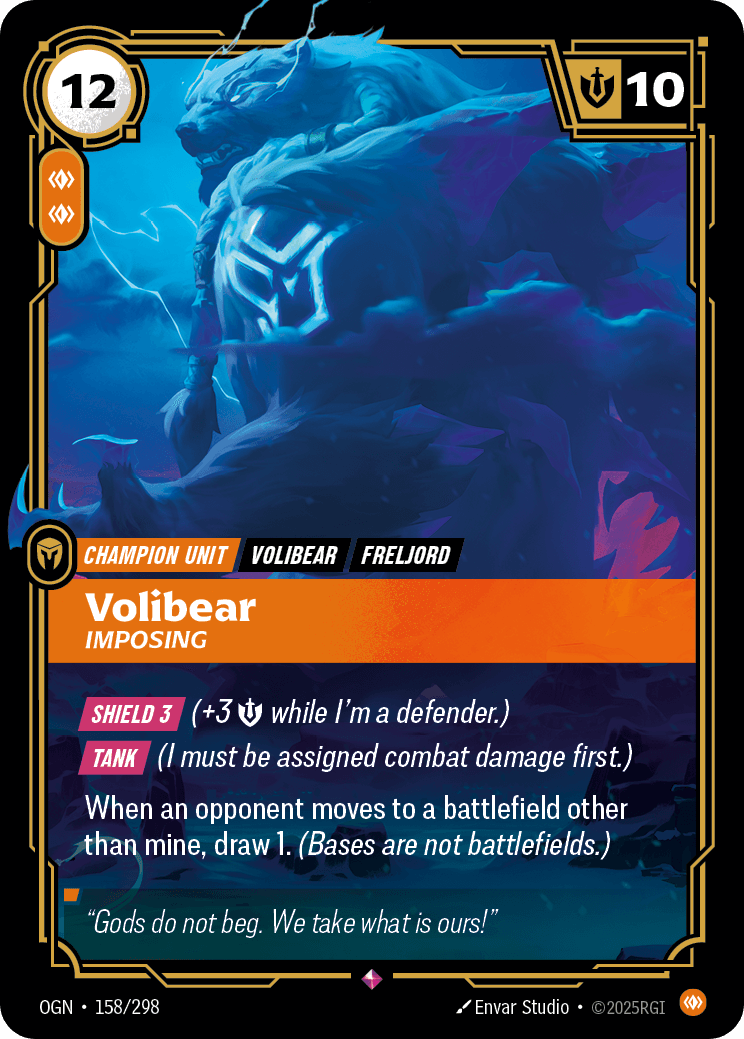
Volibear - Imposing
In Volibear's kit: Shield 3 and Tank make it a wall, and it draws Volibear a card whenever you move to another battlefield — bounce it or win fast, don't drift around it.
It is tempting to look at his oversized finishers and conclude the matchup is about out-sizing him. It is not. You will almost never win a straight Might race against a dedicated ramp deck — the whole thing is built to have the biggest unit on the important battlefield.
The real matchup is about tempo. Volibear wants a slow, grindy game where his ramp gets to compound. Our tier read puts him below the most consistent legends in the format, and the reason is exactly this fragility: he is the best ramp legend on ceiling, but he loses space to decks that are more consistent turn to turn, and he folds hard to cheap interaction that undoes his ramp tempo.
So the counter rule is simple and it drives everything else in this guide: make Volibear pay full price. Every rune he channels off his ability is tempo you gave him. Every turn you spend not threatening a battlefield is a turn his ramp runs unopposed.
What Volibear Is Trying To Do
A Fury/Body Volibear list has a very legible game plan:
- Land a Mighty (5+ Might) unit as early as possible to start channeling free runes off the legend.
- Chain into progressively larger bodies while that free rune keeps his resources ahead of curve.
- Drop an oversized finisher onto the battlefield that matters and use its size and keywords to lock the lane.
- Keep the ramp curve from stalling so the big turn always arrives.
Notice what is missing: a cheap, resilient early board that scores fast. A ramp shell is top-heavy by design. Before ramp comes online, a Volibear hand is a pile of expensive cards and a couple of enablers. That window is where you win the game.
Before every turn, ask one question: did Volibear channel a rune this turn? If yes, he played a Mighty unit and got paid. Your job is to make sure that unit did not also gain board position or a battlefield.
Volibear's Kit — What To Respect
These are the cards in Volibear's kit: the legend-locked pieces the deck is built around. Naming them is not the same as claiming a given list runs a specific count of each — kits vary list to list — so respect them for what they do, and confirm the exact wording in the card database.
Volibear - Relentless Storm (the legend)
The engine. When Volibear plays a Mighty unit — one with 5 or more Might — he can exhaust the legend to channel a rune. That single line is the whole matchup: every uncontested Mighty body is also a free rune, which is why denying the early ramp turn matters more than answering the late finisher.
Volibear - Furious (Fury)
Furious has Deflect 2, so opponents must pay two rainbow runes to choose it with a spell or ability — a tax designed to make your removal awkward. When it attacks, it deals 5 damage split among any number of enemy units at that battlefield, clearing your blockers and swinging in the same motion. The read: do not plan on cheap targeted removal here. Pay the Deflect tax deliberately on a turn you can spare the runes, or, far better, do not target it at all — bounce it to base or conquer a different battlefield while it is stuck defending the one it is on.
Volibear - Imposing (Body)
A wall. Shield 3 gives it +3 Might while defending, Tank forces it to be assigned combat damage first, and it draws Volibear a card whenever an opponent moves to a battlefield other than its own. That last clause is a subtle trap: if you try to slip past Imposing by moving your units elsewhere, you are drawing Volibear cards. The read: it is not a unit you punch through and not one you profitably run away from. Bounce it, or win elsewhere fast enough that the card draw does not matter — and do the Shield 3 math before you ever commit attackers into it defending.
Stormbringer (Fury/Body)
A base-launched swing. Stormbringer takes a friendly unit sitting in Volibear's base, deals damage equal to that unit's Might to every enemy unit at a battlefield, then moves the unit onto that battlefield. Against a deck that parks huge bodies in the back, this turns a Might number in base into a board wipe plus a planted attacker in one card. The read: a big Volibear unit in base is not idle — a clustered blocking line can be swept, and the finisher does not have to walk in the front door.
How To Beat Volibear
1. Make Him Pay Full Price For Ramp
Every rune Volibear channels off his ability is tempo you handed him. Contest or remove his earliest Mighty enabler, or force it to defend, so the first big body costs him something beyond its Energy. Do not sandbag interaction waiting for a bigger target; the early body that switches on the ramp is the target.
2. Bounce And Reset Beat Big Units, Not Combat
This is the single most important mechanical point in the matchup, and it is why cheap effects that send units back to base are the classic Volibear answer. They do not remove his unit and they do not need to. They send the oversized body back to base, and then you conquer the battlefield with a unit that could never have won the fight otherwise.
Against a deck whose entire plan is having the biggest thing on the key battlefield, moving that thing off the battlefield for a turn is a full tempo swing. You get the score, and he has to re-deploy and re-commit runes to get the unit back into position. Prioritize effects that reposition rather than target, so Deflect never taxes you.
One caution lives in his own pool: some Fury units can lock movement to base while they are on the board. If a list runs that effect and it is live, your bounce-to-base plan is turned off. Track it. If it is out, you either answer that unit first or fall back to racing a different battlefield.
3. Pay The Deflect Tax On Purpose, Or Route Around It
Deflect 2 is the reason normal answer timing fails against Furious. If you must target it, do it on a turn you can afford two rainbow runes; otherwise route around it entirely by bouncing it or by winning a lane it cannot defend. Stumbling into the tax on a turn you needed those runes for something else is exactly the trap the keyword is built to spring.
4. Don't Feed Imposing's Draw
Imposing punishes running away. If your plan is to win elsewhere, win fast — every move to another battlefield hands Volibear a card. Bounce it or ignore it decisively; do not drift around the wall turn after turn, because that slow dance is card advantage for him.
5. Count The Pump Before You Block
Volibear's attackers can be bigger than the board shows. Fury lists carry pump and ready effects — keywords like Assault that stack for extra Energy, and effects that untap attackers — so a unit you sized your blocks against can suddenly be several Might larger, or a tapped-out board can be ready again. Before you commit blocks or plan a defensive trade, count the pump he could have. If your block only works when he has none of it, it is not a real block.
Mulligan And Keep Rules Against Volibear
Keep hands that can do at least two of these:
- Threaten or contest a battlefield in the first two turns.
- Pressure or remove an early Mighty enabler before the ramp pays off.
- Carry a bounce or reset effect for the eventual finisher.
- Present a proactive clock that forces Volibear to defend instead of ramp.
Ship hands that only get good on turn six. A pile of your own expensive cards and one reactive spell loses the tempo race, because Volibear is better at the long expensive game than you are. In this matchup the slow hand is the trap hand.
The ideal keep is not your biggest draw. It is your fastest functional draw: something that makes Volibear's second and third turns cost him board position or a removed enabler.
Battlefield Sequencing: Where To Fight
Sequencing is how you turn the theory above into wins.
Turns 1-2: Deny The Ramp Turn
Your first job is to make Volibear's earliest Mighty unit cost him something beyond its Energy. Remove the enabler, contest the battlefield it wanted, or force it to defend. Every turn Volibear channels a rune off an uncontested unit, you are one step closer to the top-heavy game he wants. Do not sandbag your interaction here waiting for a bigger target — the enabler is the target.
Turns 3-4: Build A Score Lead, Do Not Trade Down
This is the window. Volibear is between his enablers and his finishers. Contest battlefields aggressively and put points on the board. You want the score to be uncomfortable for him before any finisher arrives, because a Volibear who is behind on score has to use his big units to defend and stabilize rather than to close. Route your pressure to the battlefields he is not defending and make him spread. Avoid throwing units into a fight you cannot win.
Turns 5-6: Bounce The Finisher, Take The Battlefield
When a finisher lands on the key battlefield, this is where your bounce and reset cards earn their slot. Do not try to out-combat a Deflect 2 attacker or a Tank with Shield 3. Send it to base, conquer with whatever you have, and force Volibear to spend another full turn and more runes re-deploying it. If a movement lock is on the board turning off your bounce, answer that first or pivot to a battlefield he cannot defend.
Late Game: Do Not Let The Grind Come Back
If the game goes long, Volibear's ramp eventually catches up in raw resources. Keep pressure coming back every turn. The anti-Volibear game you want is one where he is always one battlefield behind, never one where you clear his board and pass. The moment you become passive, his top end takes over.
Matchup Notes By Archetype
Aggro And Pressure Decks
You are the favorite if you respect the finishers. Race his score, force his big bodies to defend, and hold one repositioning effect for the turn a finisher would otherwise flip a battlefield.
Midrange Decks
You have the best tools, but sequencing decides it. Trade into the enablers early, build a score lead in the ramp window, and keep a reset for the finisher rather than spending it on a mid-size body.
Control Decks
Don't keep hands that only answer late. You need early speed bumps and repositioning for the finisher; a Volibear who ramps unpressured will simply have bigger threats than your answers by the time you want to use them.
Engine And Combo Decks
Buy setup time with a proactive board. If your first turns do nothing, Volibear ramps freely and your payoff has to land under a finisher. Make him defend something while you assemble.
Common Mistakes Against Volibear
These are the errors that make Volibear feel unbeatable when he is not:
- Racing on size. Trying to out-Might a ramp deck is the loss. Beat the tempo, not the numbers.
- Saving removal for the big unit. The enabler that starts the ramp is the real target. Killing it early is worth more than killing a finisher four turns later.
- Throwing targeted removal into Deflect 2. Furious taxes you two rainbow runes to be chosen. Pay it on purpose or route around it; do not stumble into the tax.
- Punching into a Tank with Shield 3. You assign damage into the wall first and it is bigger than it looks. Bounce it or ignore it.
- Drifting around Imposing carelessly. It draws a card whenever you move to a different battlefield. Win elsewhere fast; do not slow-play around it and feed it cards.
- Ignoring a movement lock. If one is out, your bounce plan is off. Answer it or change lanes.
- Under-counting pump and ready effects. His attackers can be several Might bigger than the board shows. Count the pump before you block.
If you fix only one habit, fix this: stop waiting for the big unit. Punish the ramp turn that creates it.
Testing Checklist
Run at least five focused games before you call the matchup solved:
- Can your opening hand contest a battlefield or remove an enabler by turn two?
- Do you have enough bounce or reset to move a finisher off the key battlefield when it lands?
- Can you build a score lead in turns three and four while Volibear is still ramping?
- What is your plan when a movement lock turns off your bounce?
- Are you paying the Deflect tax on purpose, or accidentally throwing removal into it?
Use the Riftbound Counters hub to pair this guide with adjacent matchups, then save the tuned list in the deck builder. Browse Riftbound decks to compare how other players are attacking the ramp plan.
Build And Test On RiftStorm
Everything here is buildable with our own tools:
- Search Volibear's kit in the card database to read the exact wording.
- Clone a shell in the deck builder and goldfish the counter plan against a ramp curve.
- Compare community lists in Riftbound decks.
- Pair this with adjacent matchups on Riftbound Counters.
If you open one of our counter shells, treat it as a RiftStorm testing shell — a starting point built from card roles, not a tournament decklist — and tune it against what you actually see.
Bottom Line
Volibear - Relentless Storm has the best ability of any ramp legend: channel a free rune every time he plays a Mighty unit. That makes his ceiling terrifying and his floor fragile. He wants a slow game where the ramp compounds into finishers that own the board.
You beat him by refusing that game. Deny the early ramp turns. Build a score lead while he is still assembling. When the finishers land, bounce them to base and take the battlefield rather than fighting through Deflect and Tank. Keep pressure coming back so the grind never catches up.
Do that, and Volibear becomes exactly what the tier read says he is: a high-ceiling deck that folds to disciplined tempo. Let the ramp run, and you lose to the idea of Volibear long before you lose to the bears themselves.