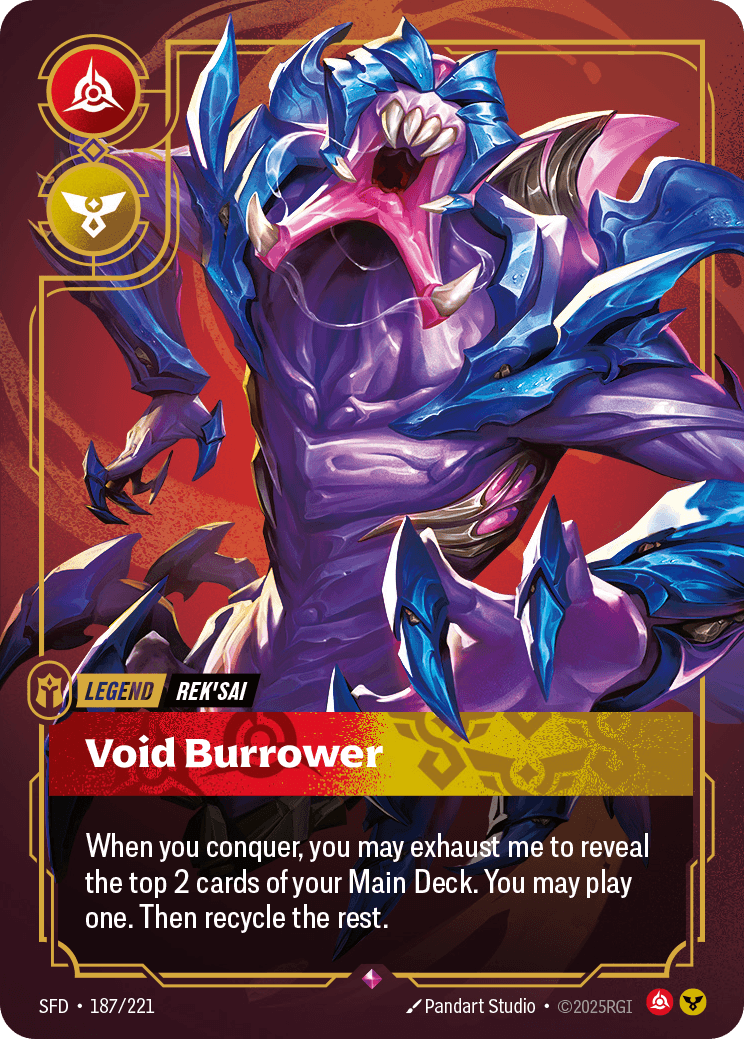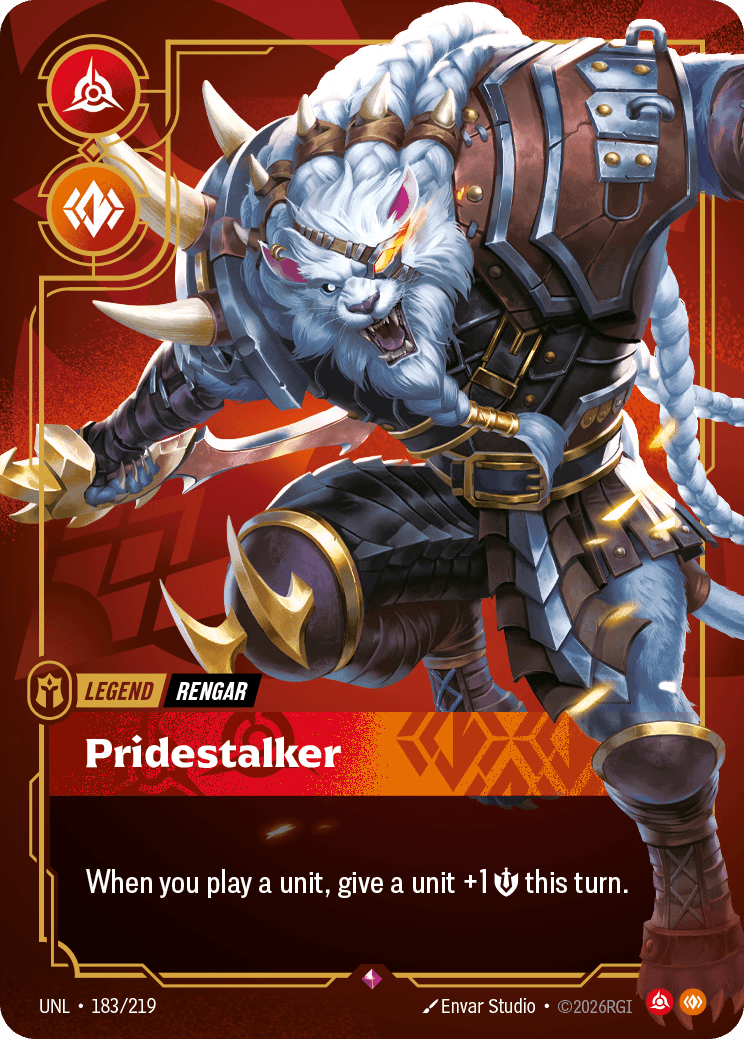
Prismaticismism won the 594-player Ottawa Showdown on Rengar, Pridestalker with a 12-0-2 record and no match losses. Rengar was only 18 decks in the field. Rek'Sai was almost as easy to overlook at 22 registrations, but three of those decks reached the Top 8. Kennen was still the most-played Legend by a wide margin, yet its 48 registrations produced three Top 6 finishes without the trophy.
That is the current US Vendetta headline: Rengar is the deck that actually finished the job, Rek'Sai is the deck converting far above its registration share, and Kennen is still the matchup every player must prepare to face.
China adds the necessary second lens. A coordinated eight-city S4 City Challenge circuit put roughly 1,006 players into the format on the same weekend. The sharpest regional split is Kai'Sa: 13 of 128 decks in the reported Beijing field, compared with only four Kai'Sa registrations in Ottawa. China is not handing the US a replacement tier list. It is showing which questions the western room has not been asking yet.
Ottawa Finally Gives Vendetta A Champion
The early Ottawa read was valuable but incomplete. After seven rounds of best-of-three play, Master Yi led the early performance table while Kennen led the registration race. Rek'Sai, Rengar, Draven, and Mel were among the Legends that had survived the opening rounds undefeated. That was enough to set a testing agenda, but not enough to call a winner.
The final report changes the emphasis. Prismaticismism took Rengar through the entire event without a match loss, finishing 12-0-2 in the largest western Vendetta event recorded so far. The run is impressive for two separate reasons. First, it survived a field large enough to contain 40 distinct Legends. Second, it did so without relying on popularity. Only 18 players registered Rengar, roughly 3% of the room.
The rest of the Top 8 makes the result even more useful. Kennen occupied second, fourth, and sixth. Rek'Sai occupied third, fifth, and eighth. Ezreal took the remaining reported slot. That is not a random pile of new-set experiments. It is a concentrated picture of the decks that could navigate a large, best-of-three room while the field was still learning Vendetta's new card pool.
Rengar is therefore the first deck US players should test after reading the standings. Not because one event proves that Rengar is the new universal best deck, but because a 3% field share converted into the title with a match-loss-free record. That gap between registration and conversion is exactly where the most valuable early metagame information lives.
The Ottawa Top 8 Is A Conversion Story
Metashare tells us what players expected. Conversion tells us what the tournament rewarded. Ottawa gives us enough captured lists to compare the two without pretending that a single event is a permanent tier list.
Kennen was the room's registration leader with 48 decks. Three Kennen lists reached the Top 6, which confirms that the deck is powerful enough to reward serious pilots, but none won the event. Rek'Sai needed only 22 registrations to put three decks into the Top 8. Rengar needed 18 to win the whole tournament. Ezreal also reached the Top 8 from a much smaller share than the headline Vendetta Legends.
The point is not that low-played decks are automatically better. Low play rate can mean a deck is under-tested, difficult to pilot, expensive to assemble, or simply not trusted by the broader field. The point is that Ottawa separated the decks players were excited about from the decks that were already prepared to convert.
That separation should change how US players read tournament coverage this week. Ask four questions instead of reaching for a tier label:
- How many copies entered the field?
- How many reached the elimination rounds?
- Did the deck win, or did it only fill the bracket?
- Does the list attack the same battlefield and resource axis as the decks everyone is already preparing for?
Rengar and Rek'Sai answer those questions differently. Rengar supplied the win. Rek'Sai supplied the repeat conversion. Kennen supplied the matchup density. Master Yi and Draven supplied the reminder that Set 3 fundamentals did not disappear when Vendetta released.
Rengar Is The Punishment Deck The Room Underestimated
Rengar's Ottawa win is more important than a simple rogue-deck headline. The deck punishes a common launch-week mistake: spending too much of the first turns assembling a powerful future turn while leaving the current battlefield under-defended.
A large Vendetta room naturally creates that mistake. Players are opening new cards, testing Empower and Flow lines, and trying to decide whether an established shell can absorb the set's new tools. The more complicated the expected field becomes, the more valuable a deck is that can make the opponent answer a concrete battlefield problem immediately.
Rengar is a clean pressure test because it asks whether the opponent can win the first meaningful combat exchange without burning every premium answer. If the opponent stabilizes but loses too much time doing so, Rengar can turn a small battlefield lead into a lethal race. If the opponent ignores the board to protect a later engine turn, Rengar can make that delayed value irrelevant.
The US test for Rengar is not simply whether your deck can remove Pridestalker. It is whether your opening hand can contest the first two battlefields while preserving enough interaction for the turn where Rengar converts a normal combat lead into a game-ending swing. Play the matchup with realistic mulligans and sideboards. A deck that beats a goldfish Rengar list while losing to its pressure curve has not solved the matchup.
Rengar also gives budget-conscious players a useful lesson. The tournament winner came from a much smaller field share than the most expensive headline decks. That does not make every Rengar list cheap or every expensive card unnecessary, but it does make Rengar the right deck to proxy before committing to the most visible Vendetta purchase.
Rek'Sai Is The Breakout To Learn Before The Crowd
Rek'Sai is the strongest emerging deck from Ottawa because it combined a small field share with repeatable Top 8 conversion. Three of 22 registered Rek'Sai decks reached the elimination rounds, including third, fifth, and eighth. That is more persuasive than a single early undefeated screenshot because multiple pilots found a path through the same large room.
The deck also sits in an unusually valuable position. It was not invented after Vendetta, so experienced pilots already understand its battlefield rhythm, but it has enough access to new tools to punish opponents who assume that an older archetype will be easier to target. The deck's pressure does not need to look like Kennen's pressure to create the same kind of deckbuilding stress.
Rek'Sai makes the opponent answer a sequence rather than a single marquee unit. A removal spell that technically answers the visible threat may still be wrong if it costs the turn needed to develop elsewhere. A battlefield trade that looks even may be losing if it gives Rek'Sai the first meaningful conversion. That is why the deck is such an important counterweight to Kennen testing: it punishes narrow answers without asking the same questions.
The right US preparation plan is to put Rek'Sai directly after Rengar in the gauntlet. Test whether your deck can keep its normal development pattern while respecting the pressure curve. Then test the matchup again after sideboarding, when the Rek'Sai pilot has access to the ten-card Constructed sideboard and can change its posture instead of simply adding more removal.
If Rek'Sai repeats this level of conversion in the first Summoner Skirmish window, it will move from breakout to pillar. Ottawa gives it the strongest reason to earn that promotion.
Kennen Is Still The Matchup Boss
Kennen did not win Ottawa, but it remains the deck most likely to define US testing rooms. Forty-eight registrations made it the most-played Legend, and three Kennen decks reached the Top 6. That is a large enough footprint that every player must be able to explain how their deck wins the matchup.
The mistake is to read the missing trophy as a failure. Kennen's presence in second, fourth, and sixth shows that it can navigate a large event. The more accurate conclusion is that Kennen is the format's central matchup without yet being its uncontested best conversion deck.
That distinction matters for deckbuilding. A list that spends every slot trying to beat Kennen may be correct for a local room full of new-set pilots, but it can be strategically wrong for a large event if it loses to the smaller Rengar and Rek'Sai populations that converted better. The goal is not to make Kennen disappear from your testing queue. The goal is to beat it without turning your deck into a narrow anti-Kennen machine.
Run Kennen against the Ottawa winner first. Rengar tests whether your answers are fast enough. Run Kennen against Rek'Sai next. Rek'Sai tests whether your answers remain efficient when the opponent creates pressure from a different angle. Then bring in Master Yi and Draven to check whether the list still functions against proven shells that do not care about your anti-Kennen plan.
Master Yi Won Twice, But Ottawa Still Matters
Master Yi finally converted in the same weekend as Ottawa. EndMePlox won the 112-player Riftbound Championship Series event at Hobby Con on Master Yi, and acheron.ix won the 59-player I Micelion Cup online the next day on the same Legend. Two wins end the long stretch where Master Yi led or crowded fields without reaching the top of the final standings.
The larger Ottawa result keeps the conclusion honest. Master Yi represented 37 decks there, but its best finish was 13th. That does not invalidate the two wins. It tells us that the deck's story is now more interesting than either master Yi is washed or Master Yi is automatically tier zero. The deck can win, it remains a benchmark, and its largest-event conversion still needs to catch up with its reputation.
For US players, Master Yi belongs at the front of the gauntlet because it tests whether a deck can contest a battlefield without spending every answer too early. It also tests patience. A Yi pilot who makes you commit first can turn an apparently safe board into a losing exchange, especially when your list has sideboarded into answers that are too narrow for the rest of the room.
Treat the two weekend wins as a correction to the old narrative, not a replacement for the Ottawa sample. If Master Yi keeps converting during the first Summoner Skirmish window, it will become much harder to argue that the deck is only a popularity relic from the previous set.
Draven And Kha'Zix Show The Field Is Still Punishing
Draven is the cleanest bridge between Ottawa's early performance read and China's results. He was one of the strongest early Ottawa signals, then won the Shanghai S4 City Challenge. That combination matters because it does not depend on a single new Vendetta engine. Draven wins by making ordinary early-game decisions expensive for the opponent.
A room that prepares only for Kennen and Master Yi can leave itself open to a deck that turns small battlefield edges into durable resources. Draven punishes slow hands, weak combat math, and interaction that arrives after the opponent has already earned too much value. He should be one of the first pressure decks you test after Rengar and Rek'Sai.
Kha'Zix supplies the more surprising breakout. E-Gauge won Runes & Rift Open 20, a 40-player event, on Kha'Zix after the Legend's first notable Vendetta finish had already put it on the watch list. The sample is small, but the sequence is exactly how an emerging deck earns more testing: first a deep finish, then a win before the room has fully adjusted.
Do not turn Kha'Zix into a purchase recommendation from one 40-player event. Put it in the gauntlet as a punishment deck. If your sideboard has no plan for Kha'Zix after you have spent all ten slots on the biggest registration leaders, that is useful information about your preparation even if Kha'Zix never wins another event.
China Turns Kai'Sa Into A Mandatory Test
China's most important contribution this week is not a universal ranking. It is a regional split sharp enough to expose a blind spot.
The coordinated S4 City Challenge weekend covered eight cities and roughly 1,006 players: Beijing, Shanghai, Shenzhen, Chengdu, Guangzhou, Fuzhou, Hangzhou, and Wuhan. Most of the events were capped at 128 players, with Hangzhou at 124 and Wuhan at 114. That is enough volume to treat the circuit as a real supporting sample rather than one isolated local result.
Kai'Sa is the clearest difference between the regions. The reported S4 Beijing field put Kai'Sa at 13 of 128 decks, about 10%. Ottawa had only four Kai'Sa decks in a 594-player room, well under 1%. The difference is not a rounding error. China is actively testing and registering a Legend that the western room mostly ignored, and the results have moved Kai'Sa into the global conversation.
The supporting trophies point in the same direction. Wuhan was won by Master Yi, Shenzhen by Kai'Sa, and Shanghai by Draven. Three cities, three winners, and three different reasons to keep the gauntlet broad. China is not mirroring Ottawa's Rengar result, but it is confirming that the format can reward very different battlefield and resource plans in the same release window.
There is an important format caveat. Many Chinese City Challenge events use best-of-one structures for much of the tournament, so their incentives are not identical to a large North American best-of-three Showdown. A deck that maximizes a strong opening or exploits a single-game matchup can look more attractive in that environment. That does not make Kai'Sa irrelevant to US players. It makes Kai'Sa a hypothesis that the next US events should test rather than a conclusion to copy without checking.
The practical question is simple: can your deck pressure Kai'Sa before its flexible engine turns a small battlefield into a resource advantage? If the answer is no, the Chinese results have already told you where your next testing hour belongs.
What The Two Regions Agree On
The US and China results do not point to one shared list. They point to a shared set of structural lessons.
First, Vendetta did not erase the previous competitive core. Master Yi won twice in the US weekend and again in Wuhan. Draven won Shanghai and remained a strong Ottawa signal. Familiar decks still have the advantage of practiced sequencing, and new cards do not automatically overcome that advantage.
Second, popularity is a weak substitute for preparation. Kennen was Ottawa's most-played Legend and still earned three Top 6 places, but Rengar and Rek'Sai converted more efficiently from much smaller populations. A good gauntlet needs both the deck everyone will register and the deck that is quietly punishing the room.
Third, the emerging Legends are attacking different axes. Rengar punishes slow setup and loose combat math. Rek'Sai taxes narrow answers through repeated battlefield pressure. Kai'Sa tests whether the opponent can close before a flexible engine takes over. Kha'Zix threatens a different kind of interaction problem, while Mel remains the new-set resource question that Ottawa put into the undefeated conversation.
Fourth, the format is too young for a short tier list to be more useful than a test queue. Ottawa supplied the first large western answer. China supplied a broad supporting field. The first Vendetta Summoner Skirmish window, which begins August 17, and the first Vendetta Regional Qualifier in Barcelona on August 21–23 will provide the next level of evidence.
Riot's official Showdown Series announcement describes these events as sanctioned opportunities between local play and premier competition. Riot's Barcelona preview lists the first Vendetta Regional Qualifier as a $25,000 event with rewards through Top 128. Those are the next results that can turn Ottawa's signals into a durable format map.
The US Vendetta Gauntlet For August 17
If I were preparing for the first week of Vendetta Summoner Skirmishes, I would test in this order:
- Rengar for the Ottawa championship and the pressure curve that the room under-registered.
- Rek'Sai for three Ottawa Top 8 finishes from only 22 registrations.
- Kennen because it was Ottawa's most-played Legend and still placed three copies in the Top 6.
- Master Yi because two weekend wins corrected its recent conversion narrative without erasing the Ottawa benchmark.
- Draven because it connects the Ottawa performance read to China's Shanghai trophy.
- Kai'Sa because Beijing registered her at about 10% while Ottawa barely registered her at all.
- Mel because the new Legend was in Ottawa's undefeated early group and still lacks the repeat sample needed to classify her.
- Ezreal because it reached the Ottawa Top 8 and remains a proven spell-tempo deck that can punish slow Vendetta openings.
- Kha'Zix because its first Vendetta win came immediately after its first notable finish.
- Azir because the engine deck remains a live large-field test and recent Showdown results keep rewarding pilots who can make a small number of cards matter.
This is a testing queue, not a final tier list. The first five cover the major US signals. The next five make sure you are not preparing for only the decks that dominate the conversation.
Build The Sideboard Around Jobs
Vendetta's ten-card Constructed sideboard gives players more room to adapt, but it does not remove the need to prioritize. The best sideboards will be built around matchup jobs rather than a one-card answer for every Legend.
Start by assigning slots to the field's density. Kennen and Master Yi deserve dedicated attention because they are likely to appear repeatedly in US events. That does not mean every card in those slots should be a narrow silver bullet. It means your post-board plan should improve without making the main deck's core sequencing worse.
The next job is surviving early battlefield pressure. Rengar, Rek'Sai, Draven, and Ezreal can all punish a hand that spends too long preparing for the midgame. Your sideboard should give you a way to stabilize without giving up the initiative completely. A reactive card that answers a threat but loses the next battlefield may be technically legal and strategically useless.
Reserve the final group for engine and regional checks. Kai'Sa, Mel, Azir, and Kha'Zix do not all ask the same question, but they can all make a narrow anti-aggro plan look embarrassing. Flexible disruption, clean resource denial, or a way to change the speed of the game will often be more valuable than a fourth copy of an answer you already draw naturally.
The central sideboard mistake this week is to overbuild for Kennen because Kennen is visible. Ottawa says the real cost of that plan is losing to the smaller decks that converted better. China says the cost may also include losing to a Legend your local room has not even registered yet.
What We Know And What We Still Need
We know Ottawa was a 594-player Constructed Showdown with 581 decklists recorded, making it the best-documented large Vendetta event so far. We know Rengar won without a match loss, Rek'Sai placed three decks in the Top 8, and Kennen placed three decks in the Top 6 without taking the trophy. We know Master Yi won two smaller events in the same weekend, while its largest-event Ottawa finish was 13th.
We know China's coordinated eight-city circuit put roughly 1,006 players into the same set of early Vendetta questions. We know Kai'Sa represented about 10% of the reported Beijing field but less than 1% of Ottawa. We know the China trophies split across Master Yi, Kai'Sa, and Draven, and that the region is supplying pressure, engine, and midrange tests that the US room cannot afford to dismiss.
We still do not know whether Rengar can repeat in another large best-of-three field. We do not know whether Rek'Sai's Ottawa conversion will survive targeted sideboards. We do not know whether Kennen's huge registration share becomes a win-rate advantage once players stop learning the deck in public. We do not know whether Kai'Sa's Chinese strength transfers directly to US tournament structures.
Those are good questions for the first Summoner Skirmish window and for Barcelona. They are also better questions than whether Ottawa has already produced a permanent tier-one answer.
Bottom Line
The Ottawa Showdown finally gave the Vendetta meta a champion, and the champion was not the deck most players expected. Rengar won from only 18 registrations and went 12-0-2 without a match loss. Rek'Sai put three decks into the Top 8 from 22 registrations. Kennen still owned the room's attention, but the standings did not make it the only deck worth respecting.
China widens the story instead of contradicting it. An eight-city, roughly 1,006-player circuit made Kai'Sa the most obvious regional split, with 13 of 128 decks in Beijing compared with four in Ottawa. Master Yi, Kai'Sa, and Draven split Chinese trophies, while the US weekend added two Master Yi wins to a field where Rengar, Rek'Sai, and Kennen defined the large event.
If you are preparing for the next US event, start with Rengar and Rek'Sai, keep Kennen at the center of the matchup map, and then test Master Yi, Draven, Kai'Sa, Mel, Ezreal, Kha'Zix, and Azir before you call the format solved. The first real Vendetta tier list is still being played.
Build And Test On RiftStorm
RiftStorm keeps the competitive workflow first-party. Read the relevant Legend kits in the card database, proxy the Ottawa and China matchup queue in the deck builder, browse community-built lists in Riftbound decks, and organize the matchup plan in Riftbound Counters. For the event runway, Riot's Showdown Series announcement explains the sanctioned event structure, while the Barcelona preview covers the first Vendetta Regional Qualifier.